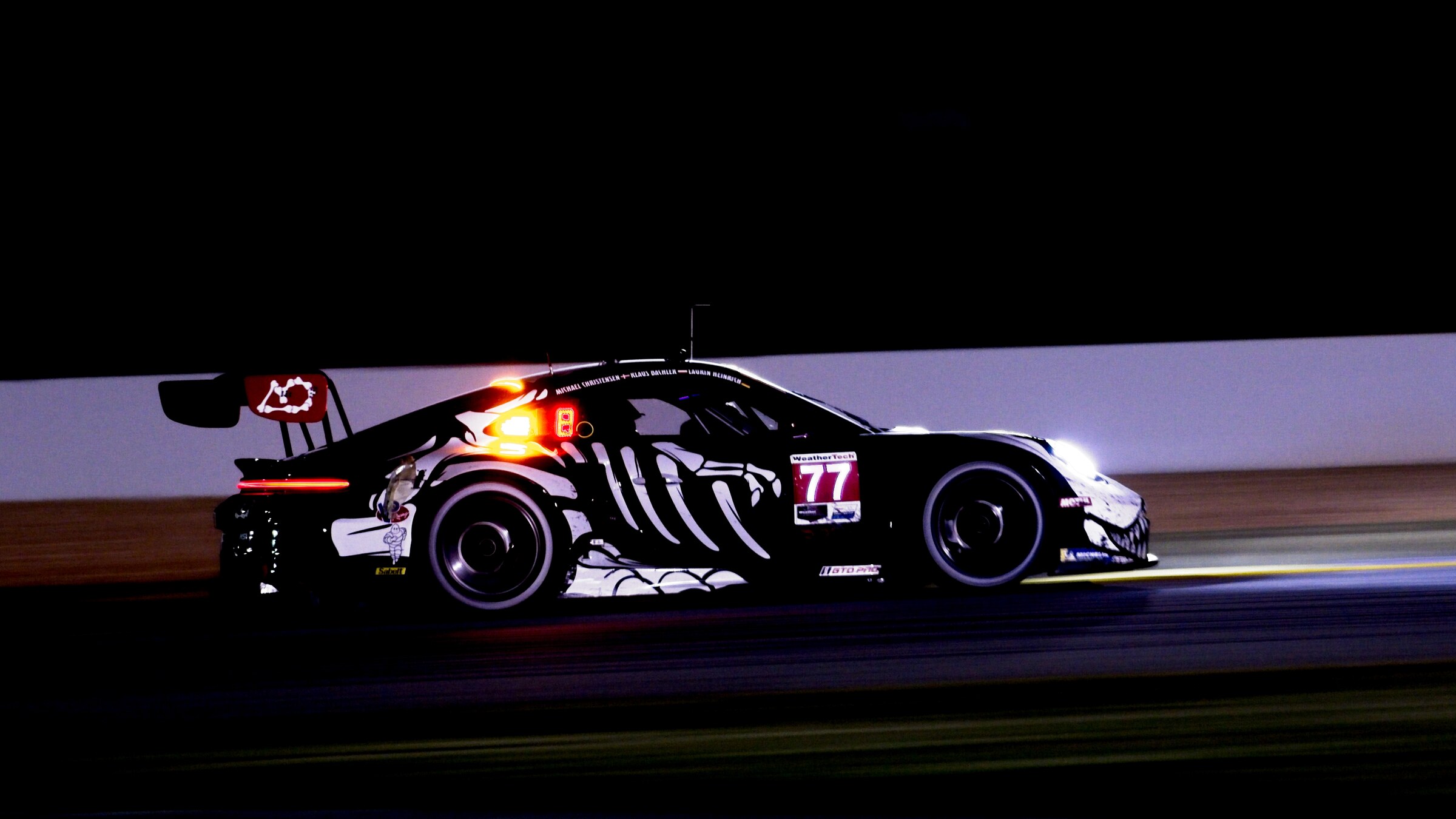
AO Racing and Absolute Racing are taking their event partnership to a second major Asian race, turning a successful one-off at Suzuka into the outline of a repeatable international operating model.
AO said on 15 October that AO Racing by Absolute will enter the FIA GT World Cup at Macau on 19–22 November. Laurin Heinrich will drive the No. 8 Porsche 911 GT3 R Evo in AO's first appearance on the Guia Circuit. The entry follows the organisations' overall victory at the Suzuka 1000km in September, their first event together.
The sporting announcement is straightforward. The business significance lies in how the programme has been assembled. AO is carrying its recognisable team identity, its relationship with Heinrich and its Porsche-facing competition story into a region where Absolute already operates. The same approach also lets Absolute add a differentiated entrant to a wider four-car Porsche effort at Macau.
It is a partnership model that can extend reach without requiring every participant to recreate a complete racing organisation in every market. It also creates commercial inventory around a team identity that travels independently of a full-season championship entry.
No party has disclosed the contract, budget, staffing split, freight responsibility, technical-service allocation, intellectual-property licence or sponsorship rights. The exact operating structure should therefore not be presented as fact. What the public evidence does show is a second event using the same joint identity after a successful first deployment, with Porsche Motorsport Asia Pacific publicly welcoming the partnership's return.
For teams, manufacturers and suppliers, that sequence is more useful than a generic expansion claim. It shows what an event-led international programme can achieve, and what it still has to prove.
One partnership, two very different assignments
Suzuka and Macau are not repetitions of the same product.
The Suzuka 1000km was an endurance race with Heinrich sharing the car with Alessio Picariello and Julien Andlauer. AO described the September result as its first overall GT victory and Porsche's first overall win at the event since 1994. The race gave the new partnership an immediate sporting proof point.
Macau is a standalone, single-driver sprint event on a street circuit. Heinrich returns, but the operational rhythm, risk profile and public audience are different. The car must work in a narrow performance window, damage can be costly, track time is limited and the event concentrates attention from premium manufacturers competing in the same GT3 market.
That difference matters commercially. A partnership that can move from a long-distance Japanese race to a sprint World Cup in Macau is potentially more valuable than a single-event arrangement built for one format. The parties can reuse working relationships and brand assets while testing them under a new sporting brief.
The FIA says the three World Cup categories at the 2026 Macau Grand Prix have filled every available entry space, producing 68 competitors from 34 countries and territories. The GT contest contains a record eight manufacturers in the year that GT3 celebrates its 20th anniversary. FIA GT Commission president Lutz Leif Linden described Asia as hugely important for premium manufacturers and their GT models.
AO's entry is therefore not simply another race booking. It puts the organisation into a capacity event where entry scarcity, manufacturer competition and regional visibility raise the value of credible delivery.
AO brings an identity that can travel
AO's most portable asset is not a building or a transporter. It is the Rexy identity attached to its Porsche GT programme.
For Macau, the green dinosaur has been recoloured in chrome red and gold and named Chìjīn Rex, or Red Gold. AO explicitly connects the palette with prosperity and celebration in Chinese culture. At Suzuka, a samurai-inspired Bushi Rex gave the joint entry a Japan-specific character.
Those treatments are more than decorative liveries. They make each overseas appearance distinct while keeping the underlying team identity recognisable. That supplies content for launches, social channels, apparel, model cars, collectibles, hospitality and partner campaigns. It also helps an event-specific programme create continuity when it has no season-long run of race weekends.
AO's August Suzuka announcement said merchandise would follow the racing reveal. That does not disclose sales, licensing income or campaign performance, and none should be inferred. It does confirm that the visual identity is intended to support a consumer product as well as a competition entry.
The commercial advantage is a modular campaign. The base character remains familiar, a regionally relevant variant creates scarcity, and the race provides a date around which products and content can be released. A full-season team can do the same thing, but an event-led entrant needs the device more because it has fewer appearances in which to build attention.
The risk is that novelty outruns sporting relevance. AO's Suzuka victory gives the campaign credibility that a livery launch alone would not provide. Macau now tests whether the brand can hold attention when the sporting outcome is unknown and competition is compressed into a high-risk street event.
Absolute supplies regional operating credibility
Absolute's value is visible in the scale of the Macau programme. The SRO-operated GT World Challenge Asia site says the organisation will run four Porsche entries: Heinrich under the AO Racing by Absolute identity, Alessio Picariello and newly crowned DTM champion Thomas Preining under Tempo by Absolute Racing, and Dorian Boccolacci in the fourth car.
Sportscar365 independently reported the same four-car Porsche effort and quoted Porsche Motorsport Asia Pacific managing director Alexandre Gibot referring to Absolute's technical infrastructure. The manufacturer has not won the FIA GT World Cup and is assembling experienced Guia Circuit drivers for another attempt.
That context makes the joint entry easier to understand. AO is not sending a standalone car into an unfamiliar event in isolation. Its programme sits inside a larger operator and manufacturer effort with shared regional knowledge and multiple data points across nominally separate entries.
The public sources do not say which engineers, mechanics or commercial staff belong to which organisation, whether personnel are shared between cars, or who controls setup decisions. It would be wrong to invent those details. Even so, placing AO within Absolute's four-car platform can create practical advantages in freight planning, local procurement, garage processes, circuit knowledge and Porsche technical support.
For an international entrant, a credible regional operator can reduce the number of capabilities that must be built permanently. For the regional operator, a partner with its own brand equity can add audience reach and a fresh commercial story without requiring a new car platform.
The lesson is not that outsourcing makes international racing cheap. GT3 programmes still require expensive cars, parts, freight, personnel, testing, insurance and event support. The lesson is that ownership of those capabilities can be distributed. A team can choose which assets must remain under its direct control and which are more efficiently supplied by a partner already embedded in the market.
Event-led expansion preserves optionality
AO and Absolute have announced Suzuka and Macau, not a full Asian championship campaign. That distinction is strategically useful.
A permanent overseas base carries fixed cost before it creates revenue. Premises, local employees, equipment, inventory and administration must be supported through a calendar. A two-event partnership can instead test sporting compatibility, sponsor response, merchandise demand, manufacturer support and operating efficiency with more variable cost.
The approach also preserves choice. A successful Macau programme could lead to another standalone race, selected rounds or a wider campaign. An unsuccessful one does not leave the entrant committed to a season of activity that was never commercially justified.
AO has used a related structure outside Asia. Its European endurance activity has appeared under the AO by TF identity with TF Sport, including Le Mans. The contracts and responsibilities are not public and the two partnerships should not be assumed to be identical. Together, however, they show a consistent willingness to carry AO's programme identity through established operators in different regions.
That is a capital-allocation decision as much as a sporting one. It allows AO to concentrate investment in the elements that differentiate the organisation while buying or sharing event execution where another team already has the people and systems.
The model has limits. Knowledge can remain with the operating partner rather than the entrant. Sponsor servicing may be split across organisations. Data governance, accident liability, insurance, spares ownership and decision rights can become complicated. If the partnership ends, continuity may end with it.
Those issues have to be settled in the operating agreement even when the public-facing brand looks unified.
Suppliers need to understand who owns each workstream
Joint entries create opportunity for suppliers but can also create ambiguity.
An event programme can require international freight, temporary import documentation, local transport, garage equipment, composite repair, paint and vinyl, radio and data systems, catering, apparel, merchandise, photography, video, social production and guest services. Some contracts may sit with AO, some with Absolute, some with Porsche Motorsport Asia Pacific and some with the event or championship.
The strongest supplier proposal starts by identifying the budget owner and the operational owner. They may not be the same company. A livery studio might receive creative approval from AO while coordinating installation with Absolute. A logistics provider might contract with the operator while supplying status data to the entrant and manufacturer. A hospitality agency might need rights clearance from several parties before using the car, driver or event marks.
The red-and-gold Macau identity adds a deadline-sensitive production chain. Digital design, colour proofing, material selection, installation, spares and content capture have to land before scrutineering. When an entry exists for one event, there is little opportunity to amortise a failed first production run across later rounds.
Suppliers should price that risk explicitly. Clear approval gates, asset-delivery dates, change-control rules and contingency stock are more valuable than a low headline quote that assumes everything will arrive correctly the first time.
Manufacturer alignment makes the model stronger
The arrangement is not only bilateral. Porsche Motorsport Asia Pacific is a visible third stakeholder.
Porsche supplies the common product around which the four Absolute-run entries are organised. AO supplies a distinctive entrant identity and a driver who finished third at Macau in 2025. Absolute supplies the platform described by Porsche's regional management as supported by technical infrastructure. Each party gains something different from the same car programme.
For Porsche, the four entries expand the probability of a competitive result while presenting different team identities. For AO, manufacturer alignment helps connect a US-based programme to a regional event. For Absolute, the manufacturer relationship supports a multi-car operation with a clear competitive objective.
This is why event-led partnerships can be more robust when the manufacturer is involved early. Technical support, parts availability, driver allocation and marketing approvals can be coordinated around one programme instead of negotiated as separate late-stage requests.
It does not remove conflicts. Four cars competing for the same World Cup create questions about information sharing, priority, spare capacity and incident recovery. Those protocols must be agreed before track activity begins.
What would make the programme repeatable
The partnership has passed its first sporting test but not yet its business test.
Suzuka produced a win. Macau can demonstrate whether the operating structure travels across event formats, whether AO's identity converts attention in a second market and whether the partners can deliver a complex four-car manufacturer programme without diluting individual entrants.
The useful measurements are wider than finishing position. AO should be able to compare content reach, merchandise conversion, partner exposure, guest engagement and the cost of deploying through a regional operator with the alternative of a standalone programme. Absolute should be able to measure incremental utilisation of people and equipment, commercial contribution and the value the AO identity adds to its Porsche platform. Porsche can assess technical performance, brand reach and the quality of the customer-team network.
None of those figures has been made public. The absence of numbers is itself important: the Macau announcement proves continuation, not profitability.
For the wider industry, the development shows a practical route between a domestic programme and permanent global expansion. A team can export its identity and selected competitive assets while a regional specialist delivers much of the local operating platform. The arrangement can be repeated event by event, expanded if the evidence supports it or stopped without dismantling a foreign base.
AO Racing by Absolute now has a victory and a second high-profile assignment. If Macau is delivered well, the partnership will have demonstrated something more valuable than a striking car: a credible way to make a team brand travel.
Sources and further reading
- AO Racing Macau announcement, 15 October 2026 ↗
- FIA capacity entry-list announcement, 16 October 2026 ↗
- Sportscar365 independent report, 15 October 2026 ↗
- GT World Challenge Asia programme report, 15 October 2026 ↗
- AO Racing Suzuka victory announcement, 14 September 2026 ↗
- AO Racing original Suzuka partnership announcement, 5 August 2026 ↗
- AO Racing 2026 Le Mans programme record ↗
- Wikimedia Commons image record ↗