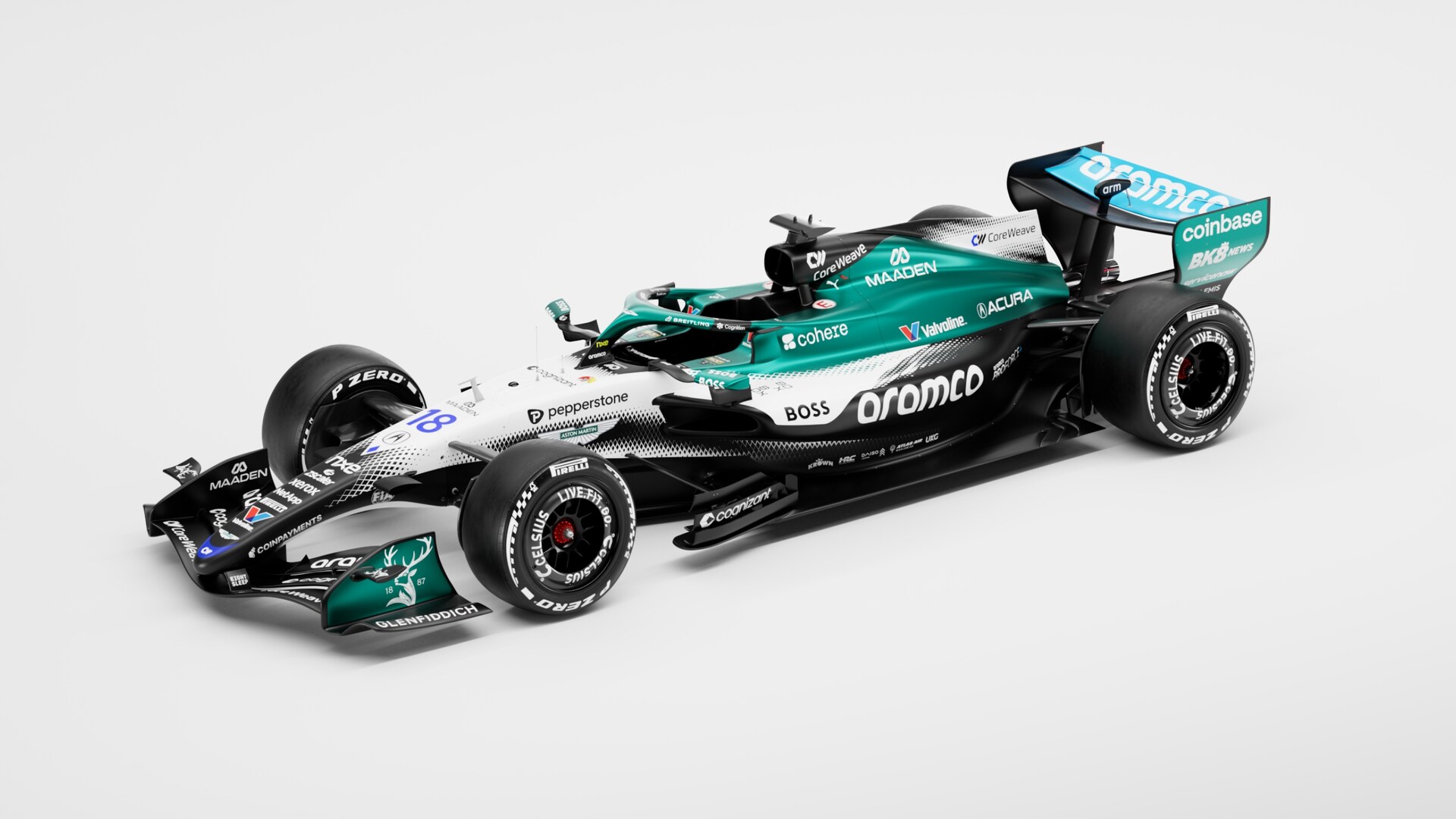
Aston Martin Aramco Formula One Team is using its Las Vegas Grand Prix livery to put CoreWeave in front of a global audience. Behind that conventional sponsorship asset sit two less conventional deliverables: a near-real-time radio-intelligence platform and an aerodynamic model used before race weekends.
That distinction matters to the motorsport supply chain. A logo takeover proves that a partner bought and activated rights. A working tool, used by engineers under race-weekend time pressure, can turn a partnership into a reference account for a technology supplier.
The disclosed evidence is unusually specific for a sponsorship announcement. CoreWeave says its radio system processed 40 channels simultaneously at Monaco, covering 50-plus hours, about 21,000 messages and roughly 380,000 words. It says transcription, speaker identification and topic classification are available within five seconds. A separate aerodynamic programme is claimed to have reduced the error between wind-tunnel predictions and on-track performance by 50%.
Both results are supplied by the companies involved. No independent audit, absolute error baseline, word-error rate, contract value or return-on-investment calculation has been published. The strongest conclusion is therefore not that either product has transformed competitive performance. It is that Aston Martin and CoreWeave have moved two AI applications from a sponsor presentation into recurring operational use, creating a more credible commercial case study than livery exposure alone.
The radio system sells time, not transcripts
Formula 1 teams already hear a large volume of radio traffic. The operational problem is converting that flow into information quickly enough to affect decisions. Aston Martin says the CoreWeave-backed system listens to 22 competitor channels and more than 15 internal intercom channels, transcribes and categorises the messages, and exposes them through search and a chat-style interface.
At Monaco, where strategy can turn on traffic, weather and track position, the system generated tens of hours of audio and thousands of messages. CoreWeave puts the more precise totals at more than 50 hours, 21,000 messages and 380,000 words. Those figures illustrate the scale of the filtering task, but scale alone is not value. The commercial claim rests on whether engineers can retrieve a relevant message before its tactical usefulness expires.
CoreWeave says the processing chain returns transcription, diarisation and topic classification within five seconds while handling all 40 channels. The supplier says the model was trained with more than 3,000 labelled samples and went through 75 iterations before the present deployment. Testing began at Qatar and Abu Dhabi in 2025, with full deployment during 2026.
This is a useful product-development sequence for motorsport suppliers: identify an existing data stream, label domain-specific material, test at live events, then integrate the output into the user’s decision workflow. The valuable layer is not generic speech-to-text. It is vocabulary, speaker separation, topic labelling, retention, search and delivery at a latency compatible with race operations.
The public evidence does not disclose transcription accuracy, false-positive rates, the proportion of messages reviewed by humans or how often an output changes a decision. CoreWeave uses the phrase “production-grade accuracy”, but without a published word-error rate or benchmark it remains a supplier description. Engineers still decide what matters and what to do. The tool reduces the cost of finding evidence; it does not replace sporting judgement.
A 50% improvement needs a denominator
The aerodynamic model tackles a different conversion problem. Wind tunnels reproduce a controlled representation of airflow, while a race car operates with changing ride height, steering angle, yaw, surface, temperature and wind. The gap between the two is an expensive source of uncertainty.
CoreWeave says its Physical AI Field Engineering team spent six weeks working with Aston Martin’s Vehicle Science group. The resulting model combines wind-tunnel information, historical race data and vehicle-dynamics inputs to predict how aerodynamic performance will translate to the track. It was delivered before the 2025 Abu Dhabi Grand Prix and has been used during 2026 in the week before each race to help calibrate setup.
The supplier reports a 50% reduction in prediction error between wind-tunnel and on-track aerodynamic performance. That is material if repeatable, because better correlation can sharpen setup choices and make each development run more informative. It can also help teams use scarce wind-tunnel and simulation capacity on the questions with the highest expected value.
The claim still needs careful boundaries. Neither company publishes the original error, the new absolute error, the sample size, the tracks included, the validation method or whether the comparison held across different upgrade packages and operating conditions. A 50% reduction from a small baseline and the same percentage from a large one have very different competitive meanings.
Nor does the figure establish a lap-time gain. Correlation is one input into car performance, alongside component quality, setup execution, reliability, tyres, driver feedback and the accuracy of other models. The disclosed result should be treated as a self-reported engineering metric, not a measured sporting return.
For technology buyers, the six-week delivery period may be as commercially relevant as the headline percentage. It suggests a field-engineering model in which supplier staff work with the team’s domain experts to convert proprietary data into a deployed pipeline. Aston Martin retains the pipeline and can retrain or extend it. That is closer to a joint product implementation than to rented compute sold by the hour.
Sponsorship becomes a reference-customer strategy
CoreWeave joined Aston Martin in May 2025 as Official AI Cloud Computing Partner, with naming rights to the team’s wind tunnel. The original announcement said the team would move on-premises computing workloads into CoreWeave’s environment. Subsequent public descriptions indicate a more dynamic, hybrid architecture, while the exact placement of workloads, storage and sensitive data remains undisclosed.
That evolution is not unusual. Race teams have legacy systems, latency requirements, trackside constraints, intellectual property and reliability needs that rarely fit a simple all-or-nothing cloud narrative. For prospective customers, the relevant question is not whether every workload sits in one location. It is whether the architecture meets performance, security, cost and continuity requirements.
The partnership gives CoreWeave three layers of value. The first is category and branding rights: team association, the named wind tunnel and the Las Vegas livery. The second is operational access: engineers, data and problems that can test the supplier’s platform. The third is proof-of-use: quantified case studies that its commercial teams can take to other data-intensive industries.
Aston Martin gains compute capacity, field engineering and software that would be costly to assemble separately. It also gains a partner willing to spend on visible activation. The exchange can be more efficient than a cash-only sponsorship if the technology contributes genuine operating value, though neither party has disclosed the rights fee, service value, credits, engineering cost or accounting treatment.
The Las Vegas takeover is therefore distribution for the case study. CoreWeave branding appears across both cars and the garage, and Lance Stroll has a dedicated helmet design. Those assets create reach. They do not prove that the technology generated an economic return. The supporting technical disclosures are what make the activation more than a paint scheme.
For other suppliers, the lesson is to design rights and delivery together. A technical partner should know which operating problem it is expected to solve, which data it can access, who owns the resulting pipeline and what evidence may be published. A sponsor that waits until launch week to search for a technical story will struggle to produce credible proof.
Data governance is part of the product
The radio application also shows why motorsport AI contracts need more than model-performance clauses. The platform retains searchable transcripts from competitor channels and internal intercoms. Public race radio may already be available to teams, but internal communication can include strategy, operational detail and personal data.
Access controls, retention periods, encryption, audit logs and deletion rules are therefore product requirements, not back-office additions. The public releases do not disclose those controls, and their absence from marketing material should not be read as evidence that they do not exist. Buyers should still insist that they are defined contractually and tested operationally.
Model development creates another ownership question. More than 3,000 labelled samples and 75 iterations represent accumulated domain knowledge. Contracts need to separate the team’s raw data, labels created with team expertise, general tooling, trained weights and improvements that may be reused for another customer. A vague “AI partnership” label does not resolve those rights.
The aerodynamic pipeline carries even higher competitive sensitivity. Wind-tunnel data, correlation methods and vehicle-dynamics inputs reveal how a team understands its car. Keeping the pipeline in Aston Martin’s hands is commercially important, but portability depends on documentation, interfaces and the ability to operate or retrain it without continuous dependence on the original field-engineering team.
Resilience must also be designed around race operations. The radio tool’s value falls sharply if connectivity, inference capacity or an upstream feed fails during a live session. Teams need defined fallback procedures, local or cached capabilities where appropriate, service levels and a clear way to distinguish unavailable output from “nothing relevant found”.
What teams should buy — and suppliers should prove
The two programmes point to different procurement measures. For radio intelligence, a buyer should track end-to-end latency, transcription accuracy by channel and noise condition, topic-classification precision, search success, availability and the number of decisions supported. Volume processed is useful capacity evidence but not an outcome.
For aerodynamic correlation, the measures should include absolute prediction error, stability across circuits and operating conditions, retraining frequency, engineer time saved and whether setup or development choices become more accurate. A percentage improvement should always be accompanied by the baseline and test population.
For both, teams should calculate total operating cost. Compute consumption is only one part. Data movement, storage, labelling, integration, field engineering, support, security review and internal user time can exceed the headline infrastructure price. The parties have not disclosed pricing, contract minimums or how services are allocated between sponsorship consideration and team expenditure.
Technology suppliers should resist the temptation to claim competitive causation. Race results aggregate too many variables. A more defensible reference account identifies a defined workflow, a before-and-after operating metric, the deployment period and the limits of the evidence. CoreWeave’s five-second processing claim and 50% correlation-error claim are useful because they are testable, even though the published material is not sufficient to validate them independently.
Promoters and rights holders also have a stake. Technical activation gives a partner content that can live beyond a logo impression and creates material for business hospitality, engineering recruitment and customer demonstrations. But access to team data and facilities must remain inside sporting, commercial and security rules. Rights inventory should not be confused with permission to publish sensitive technical detail.
The commercial test comes after Las Vegas
The first test is whether both tools remain in regular use after the livery activation. Continued deployment, broader user adoption and repeatable metrics would demonstrate that the partnership has created durable operating capability rather than a campaign asset.
The second is external productisation. CoreWeave’s Physical AI Field Engineering unit was formally launched in September to help customers turn proprietary data into production systems. Aston Martin is a prominent reference, but the supplier has not said that either Formula 1 application is available as an off-the-shelf product, licensed to other teams or exclusive to Aston Martin.
The third is evidence quality. Independent benchmarks, absolute baselines, uptime, accuracy ranges and case studies across multiple events would make the technical claims easier for procurement teams to evaluate. Without them, prospective customers must conduct their own validation.
The fourth is contract renewal and scope. Expansion into further workflows would signal internal demand. A renewal based mainly on branding would indicate a different value mix. Financial terms are private, so the industry will need to infer direction from disclosed deployments rather than logo size.
Aston Martin and CoreWeave have already cleared an important threshold: they can point to two operating systems, deployment histories and quantitative claims. The special Las Vegas livery gives those claims an audience. Their lasting business value will depend on whether the tools keep reducing decision time and uncertainty after the cars return to their usual colours.
Sources and further reading
- Aston Martin official CoreWeave livery and technology announcement, 16 November 2026 ↗
- Aston Martin feature on its two CoreWeave AI systems ↗
- CoreWeave technical account of the radio-intelligence platform, 20 July 2026 ↗
- CoreWeave technical account of the aerodynamic model, 16 November 2026 ↗
- CoreWeave Physical AI Field Engineering launch, 10 September 2026 ↗
- PYMNTS independent report on Aston Martin’s radio AI deployment ↗
- Blocks & Files independent analysis of Aston Martin’s hybrid data architecture ↗
- Official source-authorized image record, 16 November 2026 ↗