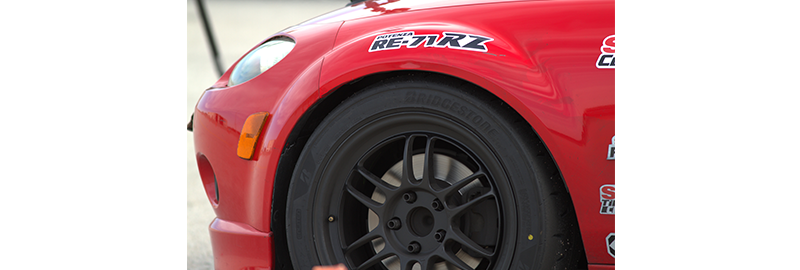
Bridgestone has signed a three-year agreement to become the Official Tire of the Sports Car Club of America and the sole tyre supplier to SCCA Club Spec, combining sponsorship rights with a defined product role across grassroots competition.
The Potenza RE-71RZ will become the designated tyre for Solo Spec Coupe, Club Spec MX-5 and Club Spec Mustang, as well as the Club Spec Cayman category launching in 2027. SCCA says the entire Club Spec fleet will move to the tyre from the 2027 season.
That makes this more than an awareness deal. Bridgestone is attaching its brand to SCCA programmes while placing one product at the centre of a repeat purchasing and support cycle for competitors. For the organiser, the same agreement links class standardisation, member benefits and participation initiatives to a supplier with a direct commercial interest in serving the category.
Sponsorship and supply reinforce each other
Official-partner status gives Bridgestone access to SCCA's wider community across autocross, track days and time trials. Sole-supplier status goes further: every eligible Club Spec competitor will need the designated tyre to participate under the category rules.
The combination creates a useful commercial loop. Competition use generates product visibility and operating feedback; the spec position converts that exposure into demand; member activity and trackside support can then keep the brand present between purchases. The partners also plan educational programmes, exclusive member experiences and support for Track Night in America and SCCA Women on Track.
SCCA has added a specific acquisition mechanic for 2027. During a month that has not yet been identified, Bridgestone will offer discounted Track Night in America entry to members and non-members, with co-branded shirts for participants using the offer. That gives the partnership a measurable route from promotion to an on-track experience, including prospects who are not yet SCCA members.
Financial terms, rights fees and product-volume commitments were not disclosed. Nor have the partners said whether Bridgestone will fund the scholarships, event discounts or trackside activity directly, or how those activation costs are divided.
A spec tyre shifts the operating burden
Standardising tyres can reduce one expensive variable for competitors. It makes comparison between cars easier, narrows testing choices and allows organisers to write clearer technical rules. SCCA says member testing at the 2026 Solo National Championships assessed the RE-71RZ for autocross, circuit and street use before the 2027 change.
Yet exclusivity also concentrates responsibility. When one product becomes mandatory, availability, consistency and service quality become part of the category's delivery system. A shortage, delayed size, regional distribution gap or unexpected production change can affect entries rather than merely shift market share between brands.
That matters because Club Spec spans different vehicle platforms and age profiles. SCCA's published programme includes the 2005–2009 Ford Mustang, 2006–2015 Mazda MX-5 and 2017–2025 base Porsche 718 Cayman or Boxster. The partnership announcement also covers Solo Spec Coupe. Supporting the programme therefore requires fitment planning and inventory across distinct competitor groups, not a single event shipment.
The public announcements do not set out tyre prices, member discounts on the RE-71RZ, allocation policy, regional stock commitments, service-level targets or contingency plans. They also do not disclose how long an approved specification must remain unchanged. Those details will determine whether standardisation produces the accessibility benefit promoted by the partners.
Performance data becomes a commercial asset
Bridgestone entered the agreement with strong reported adoption. The company says the RE-71RZ and its RE-71RS predecessor accounted for more than 3,300 eligible entries and 70% of class wins during the 2026 SCCA Solo season. At the Solo National Championships, it reports 729 of 908 drivers in eligible street-tyre classes used the products.
Those figures come from Bridgestone's announcement and have not been presented as an independently audited market study. They nevertheless explain the commercial logic: the supplier is formalising a position after competitors have already provided substantial evidence of product acceptance.
For other suppliers, the lesson is that grassroots rights can be built around evidence before exclusivity is signed. Competition results, adoption rates and member testing give a promoter data with which to evaluate a partner, while the supplier can justify activation around demonstrated product use rather than projected media exposure alone.
What teams and organisers should watch
The deal's first proof point will be the 2027 transition. Competitors will need timely information on approved sizes, supply channels, pricing, rule dates and the treatment of existing tyre stock. Regional organisers will need consistent technical guidance, and Bridgestone's promised trackside support will need enough reach to match where the cars compete.
For SCCA, the agreement can make Club Spec easier to explain: defined cars, controlled modifications and one tyre supplier. For Bridgestone, it converts a broad official designation into product demand, participation marketing and a development relationship with drivers.
The opportunity is clear, but so is the dependency. The commercial value will be created only if the exclusive supply system remains available and predictable enough to support the accessibility claim on which the partnership is built.