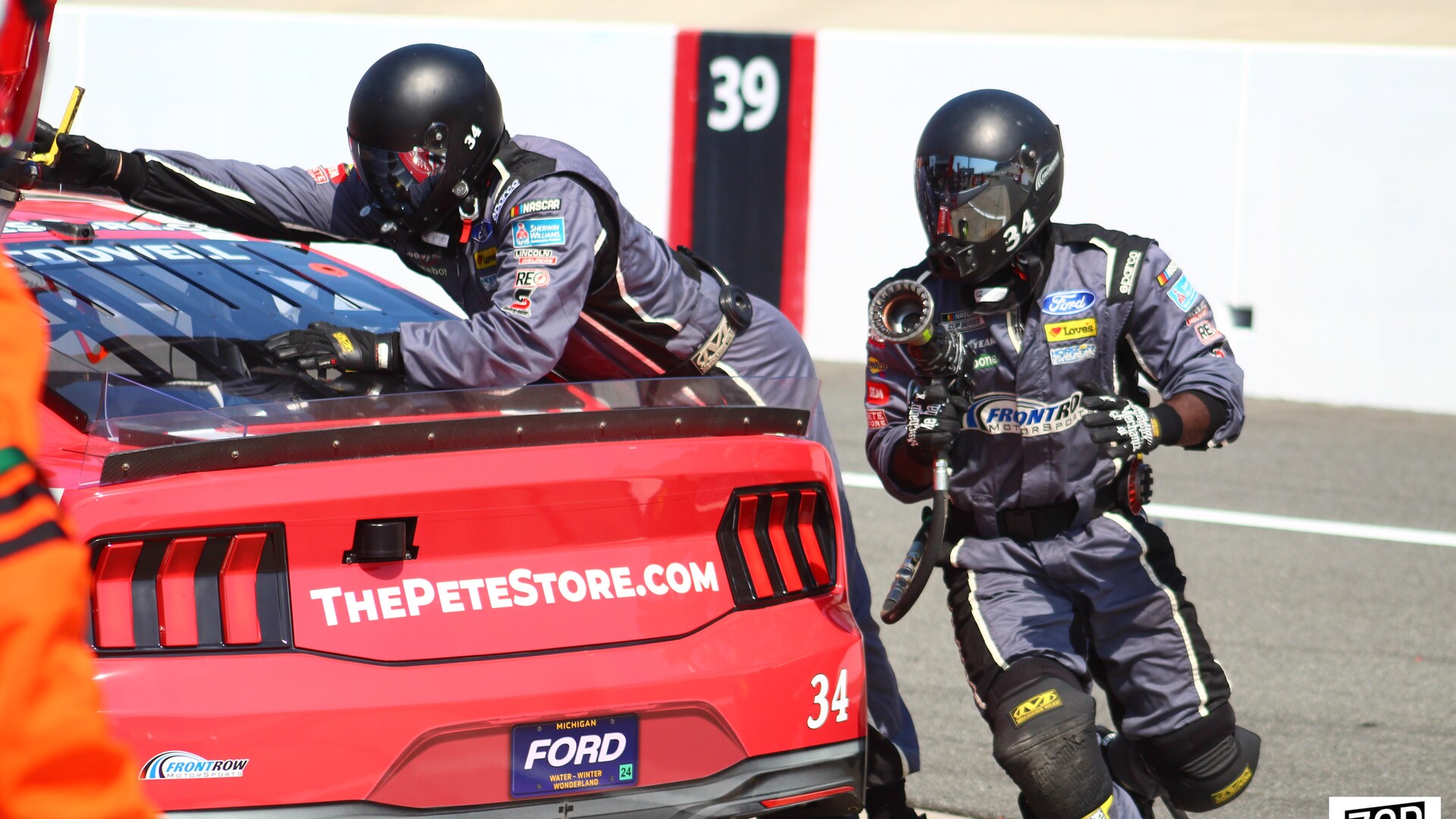
NASCAR chief executive Steve O’Donnell has confirmed that the sanctioning body is discussing a possible cost cap with Cup Series teams and has consulted Formula 1 about its system. The commercial objective he put first was not a short-term reshuffling of competitive order. It was team value.
Speaking during NASCAR’s State of the Sport press conference at Homestead-Miami Speedway on 6 November, O’Donnell said a cap could help owners build more valuable businesses. He also described the idea as complicated and costly, said owners are not aligned, and made clear that nothing is imminent.
That combination matters. NASCAR has not announced a cap, a spending level, a timetable or even a preferred structure. It has confirmed a live strategic discussion and identified the economic outcome it wants. For teams, suppliers, manufacturers, sponsors and prospective investors, the next question is therefore not what the limit will be. It is what NASCAR would have to measure for any limit to be credible.
The answer reaches well beyond an annual number. A workable system would need a reporting perimeter, cost definitions, treatment of manufacturer and related-party support, rules for organisations operating in several series, independent assurance, an enforcement process and a transition period. Without those pieces, a nominal ceiling could move expenditure between entities without making team economics more predictable.
Valuation changes the purpose of the debate
Cost controls are often presented as competitive-balance tools. O’Donnell framed NASCAR’s discussion more directly around franchise economics. He pointed to Formula 1 as evidence that cost governance can support team valuation, while stressing that the different operating model makes implementation difficult.
That focus follows the December 2025 settlement between NASCAR, 23XI Racing and Front Row Motorsports. The settlement restored six charters and established evergreen charters subject to the mutual agreement’s terms. NASCAR said the outcome was intended to provide long-term stability, while the financial terms remained confidential.
Permanence improves the durability of the asset. It does not, by itself, stabilise the cash flow generated by that asset. A credible cost framework could become a second leg of the valuation case by narrowing the range of spending required to compete, making future investment needs easier to model and giving buyers more confidence in the relationship between central revenue and team expenditure.
Independent market reporting shows why that distinction is important. Sports Business Journal reported in December 2025 that the sale price for one Legacy Motor Club charter had reached $45 million and that industry participants expected evergreen terms to lift future values. Those were reported transactions and market estimates, not a NASCAR valuation guarantee. The cap discussion is significant because it addresses the earnings and capital discipline underneath the charter price rather than the scarcity of the charter alone.
For owners, that can affect more than a future sale. A clearer cost base can support minority investment, borrowing, succession planning and longer supplier commitments. For NASCAR, stronger team balance sheets can reduce the risk that a downturn, sponsor loss or manufacturer change destabilises the grid. For new capital, however, a rule is valuable only if its scope and enforcement are robust enough to produce comparable information.
Formula 1 offers a system, not a number
NASCAR has discussed the subject with Formula 1, including the accounting resources required. That is the right comparison to study but the wrong model to copy mechanically.
The FIA’s current Formula 1 financial regulations set a $215 million cost cap for a season with 24 or fewer competitions, with an adjustment for additional events. The number attracts attention; the architecture around it does the real work. The regulations define a reporting group, require detailed submissions and record retention, assign declarations to senior officers and controlling parties, and give the Cost Cap Administration powers to monitor compliance and investigate potential breaches.
The Formula 1 rules also exclude defined categories, including driver pay, the three highest-paid individuals, marketing, finance costs, tax, certain property costs and non-Formula 1 activities. Those exclusions illustrate the central design choice. A cost cap does not necessarily control every dollar spent by a racing organisation. It controls the categories the rulemaker decides are relevant to competitive activity.
NASCAR should therefore treat $215 million as evidence of Formula 1’s regulatory structure, not a benchmark for stock-car spending. No public basis exists for inferring NASCAR’s eventual level, and O’Donnell did not propose one. The useful lesson is that the perimeter, exclusions, related-party rules and evidence standards have to be settled before the limit can mean anything.
Formula 1’s reporting group also captures the overwhelming majority of costs associated with an entrant’s Formula 1 activities even when those costs sit elsewhere in its legal group. That principle is particularly relevant to NASCAR. A team cannot be assessed reliably if engineering, personnel, property, data or purchasing can be shifted to an affiliated entity without a consistent valuation method.
NASCAR’s operating model creates different boundaries
Cup Series teams work within the Next Gen environment, where standardised components and approved suppliers already constrain parts of the technical contest. That reduces some categories a financial rule might otherwise need to police. It does not remove the accounting problem.
Many organisations share people, buildings, transport, simulation, commercial staff and purchasing across Cup, the O’Reilly Auto Parts Series, the Craftsman Truck Series and other racing programmes. A rule would need to say whether costs are measured per organisation, per charter, per car or through another unit. It would also need an allocation method for expenses that benefit several cars or series.
Manufacturer support is another boundary. Support can arrive as cash, personnel, engineering, data, simulation access, technical services, discounted components or in-kind work. If only cash payments count, two teams receiving economically similar assistance could report very different costs. If every service must be valued, the system needs consistent transfer-pricing rules and evidence that teams and manufacturers can produce without disclosing more intellectual property than necessary.
The same issue applies to owner-related companies. Wind-tunnel time, computing, fabrication, property, travel and professional services can be bought from affiliates or bundled with other business activity. A credible framework would need arm’s-length valuation, rules for shared assets and the ability to examine transactions without turning every commercial disagreement into a sporting case.
Crash damage and inventory further separate stock-car racing from a simple annual payroll limit. Teams need to hold parts for a long season, respond to multi-car incidents and manage components supplied through controlled channels. NASCAR would have to decide whether exceptional accident costs receive relief, whether inventory is counted when purchased or used, and how insurance recoveries or supplier credits are treated.
None of these questions makes a cap impossible. They explain why NASCAR says it is complicated and why a headline limit cannot precede the accounting design.
Suppliers would become part of the compliance system
A cost cap is usually described as a restriction on teams, but suppliers carry much of the evidence needed to enforce it. Contracts, invoices, rebates, payment timing, engineering support and related-party transactions all become inputs to regulated reporting.
Approved vendors could face requests for standard cost certificates or clearer separation between component price, development work, trackside service and commercial rights. Multi-team suppliers would need controls that protect customer confidentiality while allowing auditors to verify that discounts and bundled services are recorded consistently. Companies connected to an owner, manufacturer or team principal would face particular scrutiny.
The procurement effect could cut both ways. A ceiling may encourage longer contracts, volume commitments and greater demand for predictable unit pricing. It may also concentrate purchasing among suppliers able to meet documentation and audit requirements. Smaller specialist businesses could be disadvantaged if compliance becomes a condition of sale without proportionate support.
Teams should therefore involve procurement and finance leaders early, not treat a cost cap as a technical-department project. Supplier master data, purchase-order discipline, time recording and contract classification would need to be reliable before the first reporting period. Retrospective reconstruction is expensive and creates avoidable disputes.
The Next Gen supply chain gives NASCAR a useful starting point because some prices and product flows are already visible centrally. The difficult areas will be custom services, shared development, labour and value transferred outside a straightforward parts invoice.
A cap could protect competition while preserving activation
Sponsors will want to know whether controlled team spending also constrains commercial programmes. Formula 1’s model excludes marketing costs from the cap. NASCAR could make a different choice, but preserving a separation between competitive expenditure and sponsor activation would allow teams to continue investing in content, hospitality, retail, business-to-business programmes and fan engagement.
That distinction matters to revenue growth. A team that has reached a competitive-spending ceiling should still have an incentive to win sponsors and activate them well. If every commercial dollar simply reduces the amount available for racing, the rule could weaken the very enterprise value it is meant to support.
Promoters and partners could benefit from healthier teams with more stable participation and more consistent activation. They would also need clarity about services supplied in exchange for rights. Complimentary hospitality, media production, event space or partner-provided technology can have competitive or commercial value depending on how it is used. The accounting policy should classify those exchanges before teams sign multi-year deals.
Manufacturers face a parallel issue. A cap that recognises engineering support too narrowly could discourage technical collaboration or drive it into hard-to-measure channels. One that ignores support could leave spending unequal and undermine confidence. The goal should be comparable economic treatment, not a prohibition on manufacturer expertise.
Compliance cost can be regressive
Larger teams already have finance, legal, procurement and internal-control capacity. Smaller teams may have less complex operations but fewer people to produce evidence, answer audit questions and interpret a new rule. A system intended to narrow competitive spending could impose a proportionally heavier administrative burden on the organisations it is meant to help.
Sports Business Journal reported in 2024 that team representatives were concerned about accounting and verification cost, manufacturer support and the allocation of expenses across multiple programmes. The report also identified component or parts limits as a possible alternative to a full financial cap. NASCAR’s current discussion should revisit those concerns with actual process mapping rather than assume Formula 1’s reporting model fits unchanged.
A proportionate design could include central templates, shared training, a published accounting manual, confidential pre-clearance for unusual transactions and phased assurance. NASCAR could also fund or procure baseline audit support for smaller organisations while preserving auditor independence.
There are intermediate options. Usage limits on selected components, personnel limits in defined functions, restrictions on testing or simulation, and standard prices for controlled services can target particular cost drivers with less entity-wide accounting. Those tools are less comprehensive than a financial cap, but they may be easier to verify. A hybrid could apply direct limits where inputs are visible and financial reporting where flexibility is valuable.
The choice should follow evidence about what drives spending, not a desire to announce a single number.
The transition should begin before enforcement
If NASCAR advances the proposal, a shadow-reporting period would be more valuable than an immediate hard launch. Teams could submit cost information under draft definitions without sporting penalties, allowing the sanctioning body to identify inconsistent allocations, missing data and categories that produce unintended results.
That stage should include manufacturers and key suppliers. A working group could test how cash support, engineering services, owner-related transactions, multi-series labour, inventory, crash damage, property and centralised parts are valued. Independent accountants could assess whether the requested evidence is obtainable and whether the same transaction produces the same result across organisations.
The next stage would require a formal accounting standard, an independent assurance protocol and a confidential interpretation process. Teams need decisions before committing expenditure, not after a season has closed. Published anonymised rulings could help the industry understand precedent without exposing commercial information.
Enforcement design is equally important to valuation. Investors will discount a system if penalties are unpredictable, if well-resourced teams can prolong disputes, or if breaches are discovered years after the affected season. NASCAR would need clear categories for procedural and overspend violations, proportionate sanctions, appeal rights and deadlines for final decisions.
The first enforced year could use softer procedural penalties while retaining meaningful consequences for deliberate concealment. That would recognise learning costs without making compliance optional. It would also give suppliers time to update contracts and systems.
What the industry should watch next
The first signal is governance: whether NASCAR creates a formal owner and manufacturer working group, appoints external accounting expertise or circulates a data request. Those steps would show that discussion is moving toward design.
The second is scope. A credible consultation should identify whether the unit is the team, charter or car and explain how shared operations, manufacturer services and related parties will be treated. Until that perimeter is visible, estimates of a cap level have little analytical value.
The third is a pilot. Shadow reporting would demonstrate that NASCAR is testing information quality rather than negotiating only the headline number. It would also reveal the compliance burden before smaller teams must absorb it.
The fourth is the relationship with the charter agreement. Teams and investors will want to know how cost governance interacts with distributions, competitive commitments, transfer rules and the long-term value of an evergreen charter. NASCAR has not disclosed any such linkage.
Finally, watch for alternatives. If team alignment remains elusive, NASCAR could extend the existing controlled-parts model, limit selected resources or introduce reporting without an immediate ceiling. Those measures would still reshape procurement and competitive spending.
For now, the confirmed development is narrower but consequential: NASCAR is studying cost control, has sought Formula 1’s experience and is discussing the subject with teams because it believes stronger cost discipline could support team valuation. There is no imminent proposal. The opportunity is to turn permanent charter rights into more predictable operating businesses; the risk is to mistake a limit for a system. The commercial value will be created in the definitions, data and enforcement long before it appears in any headline number.
Sources and further reading
- NASCAR official State of the Sport video, 6 November 2026 ↗
- NASCAR official State of the Sport report, 6 November 2026 ↗
- Full State of the Sport press-conference transcript, 6 November 2026 ↗
- NASCAR official charter settlement announcement, 11 December 2025 ↗
- FIA Formula 1 Financial Regulations, Issue 08, 1 October 2026 ↗
- Sports Business Journal cost-cap analysis, 26 March 2024 ↗
- Sports Business Journal charter-value report, 12 December 2025 ↗
- Associated Press charter-settlement report, 11 December 2025 ↗
- Licensed image record: Zach Catanzareti Photo, CC BY 2.0 ↗