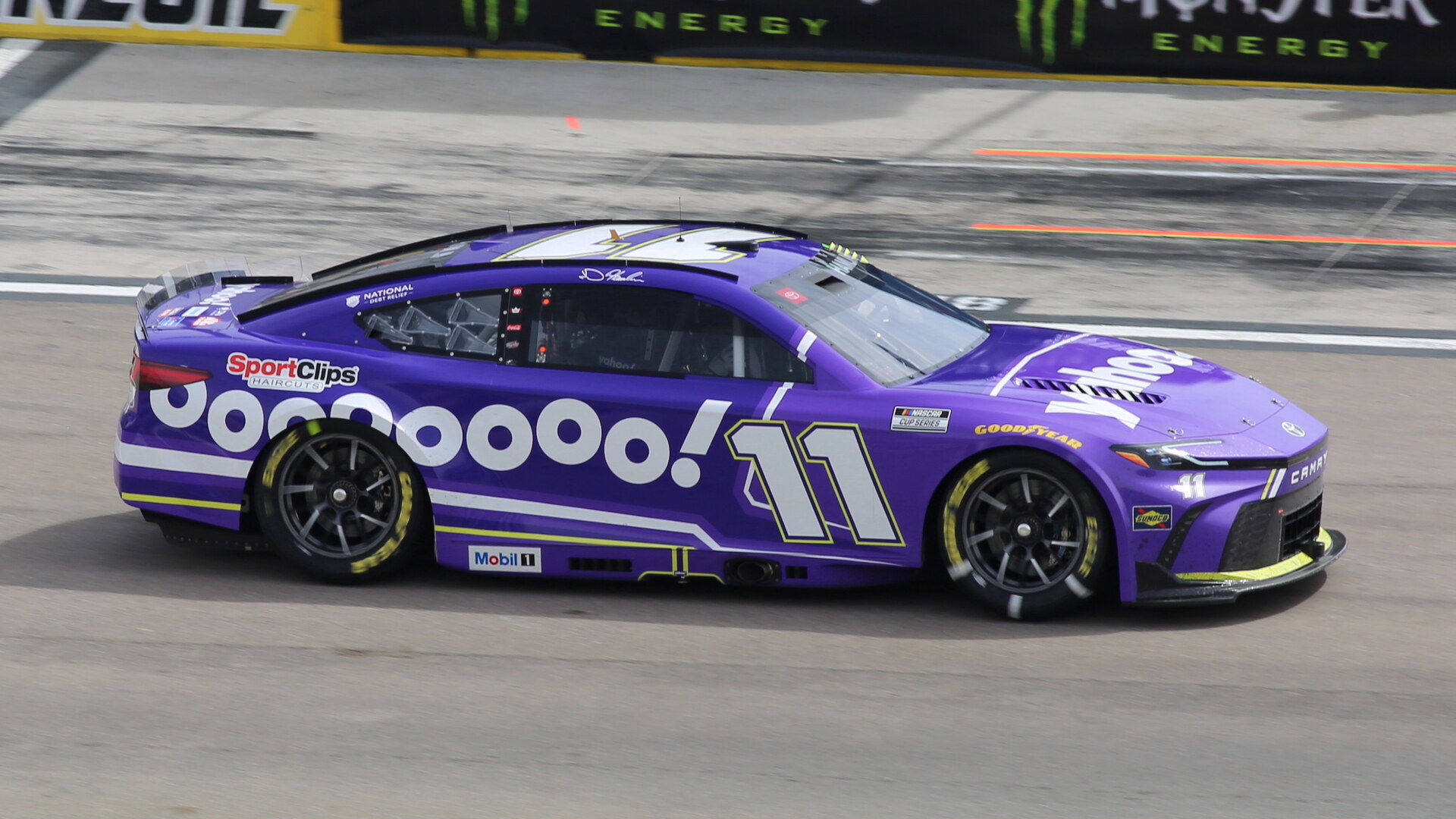
Progressive Insurance will become the primary sponsor of Denny Hamlin’s No. 11 Joe Gibbs Racing Toyota at 24 NASCAR Cup Series races in 2027, including the Daytona 500, the All-Star Race and eight of the ten Chase events.
The agreement announced on 6 November is not simply another renewal. Progressive backed 18 races when the relationship began in 2025, reduced that programme to 11 races in 2026 and will now expand to 24. Year on year, its primary inventory will more than double. Compared with the original 2025 package, it adds six events and places one brand across most of the championship narrative.
Financial terms were not disclosed. Joe Gibbs Racing and Progressive did not publish the rights fee, activation budget, category exclusivity, hospitality allocation, performance incentives, data rights or any commitment beyond the 2027 season. The scale of the inventory is nevertheless visible. Progressive has bought a platform that runs from NASCAR’s most commercially important opening race through the championship finale and reaches every national broadcast window used by the Cup Series.
For teams and sponsors, that changes how the deal should be managed. Twenty-four primary races are not 24 isolated logo placements. They create a continuous media, retail, agent-engagement and customer-acquisition programme that must be planned as one portfolio.
The inventory is larger than the livery
The official release lists the Daytona 500 first, then 15 further regular-season events including the All-Star Race, followed by eight Chase races. Progressive will be primary at Watkins Glen, New Hampshire, Las Vegas, Charlotte, Phoenix, Talladega, Martinsville and Homestead-Miami during the ten-race title phase.
That late-season concentration is commercially valuable because it keeps the same visual identity on the car when the sporting story becomes most consequential. It also gives Progressive repeated opportunities to build one campaign rather than reintroduce itself after long gaps. The finale at Homestead provides an endpoint for national advertising, agent activity, customer hospitality and community programmes that can begin with Daytona.
The 2027 Cup calendar moves among FOX Sports, Prime Video, TNT Sports and USA Sports. Progressive’s selected races appear in all four windows. The sponsor can therefore test how the same team asset performs across free-to-air, cable and streaming audiences without buying four separate team relationships.
That does not mean the car sponsorship includes broadcast advertising. Rights on the vehicle, team clothing, digital channels and hospitality are distinct from media bought from television or streaming partners. The value comes from coordination: Progressive can place paid media around events where it already controls the primary team identity, giving its advertising a recognisable race-day asset.
The distinction matters for valuation. A team should not price 24 races only as the sum of 24 rate cards. A larger package can include continuity, category protection, driver access, production efficiencies, customer programmes and a season-long content narrative. Conversely, a sponsor committing at this scale should demand measurement that separates the value of the rights from its additional activation and media spend.
Progressive is treating racing as acquisition media
The timing aligns with Progressive’s wider marketing strategy. In its third-quarter filing, the insurer said companywide advertising costs were $1.6 billion for the quarter and $4.5 billion for the first nine months of 2026. Both figures were 18 per cent higher than the comparable periods in 2025.
More important than the absolute spend is the company’s stated discipline. Progressive says it will continue advertising to maximise growth while it remains on track for its profitability target and can acquire customers at or below its target acquisition cost. The filing classifies advertising and agency commissions as acquisition expenses.
That language provides the commercial lens for the JGR expansion. The sponsorship should be assessed not only on awareness or race results but on whether it helps produce quotes, policy sales, bundled households, retention and efficient acquisition in markets and product categories that Progressive wants to grow.
The connection with NASCAR is unusually direct for an insurer. Progressive sells personal and commercial vehicle cover as well as motorcycle, boat, recreational-vehicle and property products. The team programme offers content around mobility and ownership while giving the brand access to consumers, agents and commercial partners. That relevance is a strategic fit, but the parties have not disclosed customer-conversion results, so it should not be treated as proof of return.
Progressive’s own filing also shows why measurement will be demanding. Personal-auto shopping and competition increased during 2026, while policy life expectancy declined year on year. Advertising is one input in a much larger pricing, product and retention system. A race sponsorship can support acquisition and brand preference; it cannot by itself explain policy growth or retention.
The first two seasons created an activation template
The relationship began in March 2025 with an 18-race primary programme. Sports Business Journal reported at the time that JGR had open inventory after the departure of major partners and described the agreement as one of the team’s most important recent sponsorship deals. The publication reported that leading Cup teams generally sought low-to-mid six-figure fees per race and estimated the initial package would reach at least the mid-seven figures. Those were market estimates for the 2025 agreement, not disclosed financial terms and not a basis for calculating the 2027 value.
Progressive returned for 11 races in 2026. The parties then extended the relationship beyond the car: Hamlin appeared in two commercials, took part in Progressive’s first Reddit question-and-answer session, met agents at company events and joined a school donation project. JGR owner Joe Gibbs specifically cited commercials, billboards, at-track experiences and community work when announcing the expansion.
Those activities are more useful than a generic promise to “activate”. They show four channels already tested: mass advertising, digital interaction, intermediary engagement and community activity. The 24-race programme gives each channel more occasions and more geographic coverage.
For sponsors, the lesson is that expanded inventory is more likely when the first agreement produces reusable operating formats. A team can sell additional races more convincingly if it can show how driver time, content production, hospitality and partner events worked in practice. Race results may add momentum, but repeatable activation reduces the execution risk of buying a larger package.
For JGR, the programme provides a more stable planning base. Wrap production, uniforms, merchandise, photography, sponsor approvals and hospitality can be standardised across a majority of the season rather than rebuilt for a different primary brand every week. The resulting savings are operational, even though no cost data have been published.
A large primary sponsor changes the team’s risk profile
Concentrating 24 races with one partner reduces inventory fragmentation. It can improve brand recognition, simplify production and give the team greater revenue visibility. It also increases exposure to one company’s marketing priorities, financial performance and executive decisions.
That trade-off is central to modern NASCAR sponsorship. A rotating portfolio diversifies commercial risk but creates more sales, approval and activation work. An anchor partner makes the car easier to recognise and the programme easier to plan, but a future reduction leaves a larger block to replace.
The Progressive agreement does not reveal how JGR allocated inventory previously used by other No. 11 partners. It would be wrong to assume that any named partner has left or reduced its commitment without a separate announcement. The team still has 13 events between the Daytona 500 and Homestead, including the All-Star Race within that count, that are not included in Progressive’s 24-race list, plus the pre-season Clash and Daytona qualifying races. Those events preserve room for other primary programmes and team-level partnerships.
JGR will need clear category and activation governance. An insurer working across personal auto, commercial auto, property and specialty lines can touch dealer, fleet, financial-services and mobility categories that other partners may also target. The larger the package becomes, the more important it is to define exclusivity, data access and customer ownership rather than rely on a broad “official partner” label.
Suppliers are affected as well. A 24-race identity creates larger and earlier demand for vinyl, paint, uniforms, merchandise, signage, digital templates, photography and promotional vehicles. Vendors can plan capacity and amortise design work across more events, but they must handle track-specific contingency, damage replacement and short production deadlines. A stable core livery does not eliminate version control when event marks, associate sponsors or regulatory decals change.
The broadcast spread creates a measurement experiment
The 2027 schedule gives Progressive a useful comparison across media environments. Its FOX Sports races include the Daytona 500 and much of the first half of the season. Prime Video carries selected early-summer events. TNT Sports covers part of the summer, while USA Sports carries the late regular season and Chase.
The sponsor can compare reach, engagement, search activity, quote starts and agent leads by event and distribution platform. It can also test whether primary-team identity performs differently when combined with national commercials, local agent events, social content or customer hospitality.
The analysis needs controls. Race audiences vary by venue, time, sporting stakes and competing events. Hamlin’s performance changes exposure. Weather and incidents affect broadcast time. Progressive’s insurance pricing and competitive position change by state. A strong evaluation framework should therefore compare markets and periods, not credit every movement to the livery.
Useful measures include unaided and aided awareness, share of search, visits to campaign landing pages, quote starts, completed quotes, policy conversion, agent referrals, hospitality usage and content engagement. Those should be connected to the rights calendar before the season begins. Retrospective dashboards tend to measure what is easy rather than what the partnership was intended to change.
Teams can help by providing consistent asset delivery and event-level reporting. Sponsors need approved content quickly, accurate appearance schedules, hospitality attendance data and clear separation between organic team reach and paid amplification. With 24 races, small reporting gaps compound into a poor view of the programme.
Eight Chase races make sporting contingency essential
Progressive has deliberately concentrated inventory in the title phase, but sporting outcomes cannot be guaranteed. Hamlin or the No. 11 team may not remain in contention through every Chase round. The commercial plan therefore needs two versions: one that exploits a championship run and one that still creates value if the sporting story changes.
That contingency can be built around the season narrative, driver access, team engineering, fan activity and customer programmes rather than results alone. It should also define how creative is approved on short notice after a win, elimination or major incident.
The same principle applies to the Daytona 500. The event is a premium opening platform, but a sponsor buying the race cannot control competitive outcome or screen time. Its return depends on activity before and after the event as much as laps completed.
Neither party disclosed make-good provisions, replacement appearances, morality clauses or driver-change protections. Those are normal commercial considerations for a programme centred on one driver, but their existence and terms should not be inferred from the announcement.
What the industry should watch
The first indicator is integration with Progressive’s wider advertising. If the No. 11 identity appears consistently in national creative, digital acquisition and agent channels, the deal will function as a media platform rather than a collection of liveries.
The second is partner coordination. JGR must give Progressive season-long continuity while preserving value for other No. 11 and team-level sponsors. The quality of associate placement, category boundaries and shared activation will show whether the larger anchor deal expands the portfolio or crowds it.
The third is production discipline. Twenty-four primary events create scale only if design, approvals, merchandise, hospitality and content are standardised. Teams and suppliers should watch lead times, rework and emergency production, not just exposure totals.
The fourth is measurement. Progressive has publicly tied its broader advertising spend to efficient customer acquisition and profitability. If the team programme is managed against the same discipline, it will need evidence that moves beyond media impressions.
Finally, watch the undisclosed term. The announcement confirms the 2027 inventory but does not say whether the rights are secured for later seasons. A one-year expansion and a multi-year anchor partnership carry different implications for team revenue visibility and supplier commitments.
Progressive’s move from 11 primary races in 2026 to 24 in 2027 is the clearest evidence that the relationship has passed its trial stage. JGR has converted open inventory into an anchor programme, while Progressive has acquired a national platform spanning Daytona, every Cup broadcast window and most of the Chase. The commercial test is now execution: whether the partners can turn that scale into lower production friction, stronger activation and measurable customer acquisition without allowing concentration to become dependency.
Sources and further reading
- Progressive official announcement, 6 November 2026 ↗
- Joe Gibbs Racing official announcement, 6 November 2026 ↗
- Progressive 2026 programme announcement, 5 February 2026 ↗
- NASCAR report on original Progressive agreement, 18 March 2025 ↗
- NASCAR official 2027 Cup schedule, 26 August 2026 ↗
- Progressive third-quarter 2026 Form 10-Q ↗
- Sports Business Journal analysis of the original agreement, 19 March 2025 ↗
- Coverager independent report, 8 November 2026 ↗
- Licensed image record: TaurusEmerald, CC BY-SA 4.0 ↗