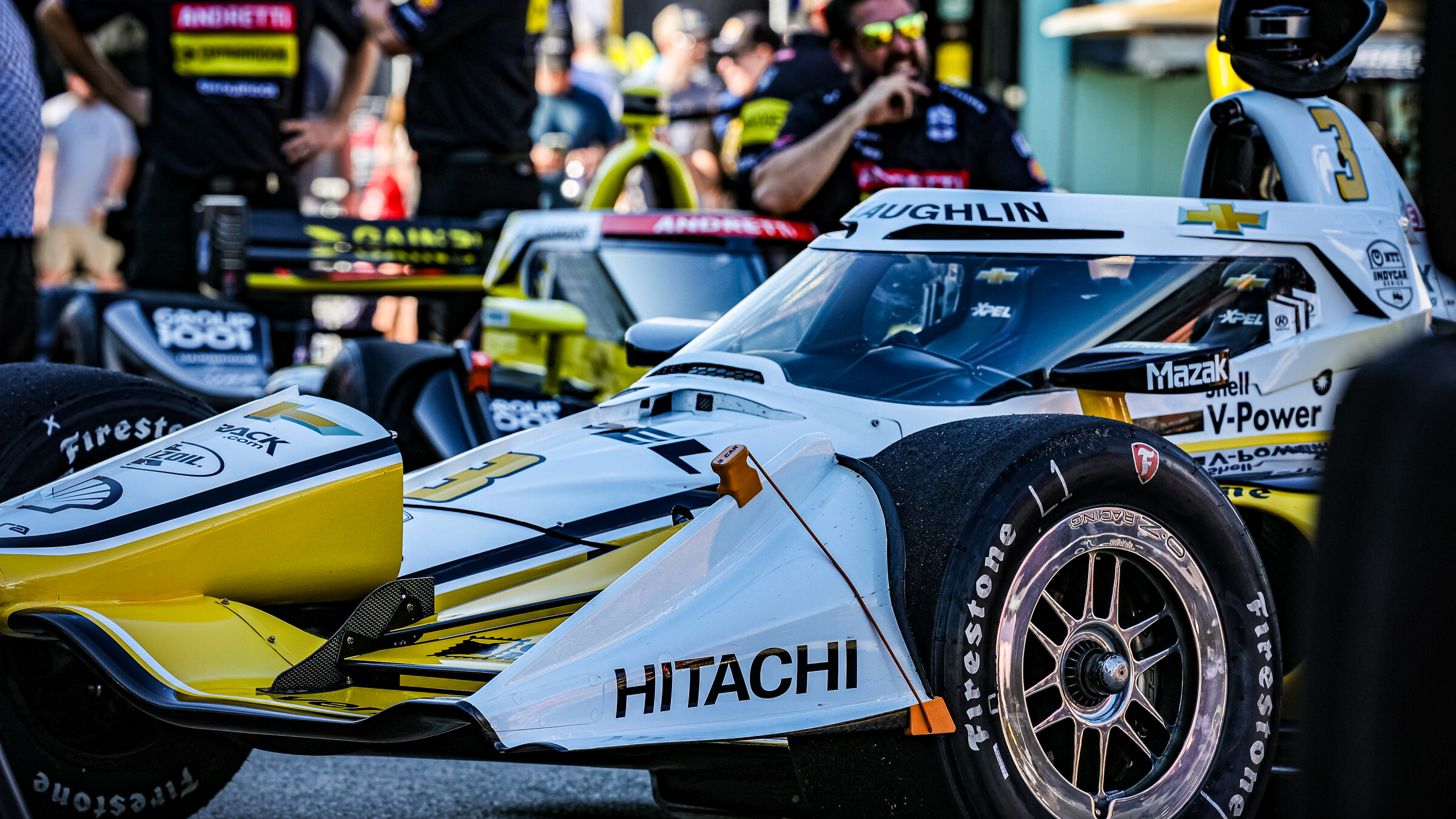
Hitachi and Team Penske have extended an INDYCAR sponsorship that began in 2012. The visible asset is straightforward: Hitachi branding will remain on the front wings of the No. 2, No. 3 and No. 12 Chevrolet entries during 2027.
The more consequential part of the renewal sits outside the race cars. Hitachi says its wider work with Penske Transportation Solutions has generated more than $18 million in annualised savings, helped prevent more than 90,000 vehicle breakdowns and cut about 15 minutes from each repair through faster diagnostics and predictive maintenance.
Those are unusually specific operating claims for a motorsport partnership announcement. They turn the renewal from a conventional exposure story into a useful test of how a business-to-business sponsor can build a rights programme around a live client relationship.
They also require discipline. The reported savings, avoided breakdowns and repair-time reduction relate to Penske Transportation Solutions, which operates and maintains a fleet of more than 370,000 vehicles. The release does not say that the technology is installed on Team Penske's INDYCAR machinery, used in race strategy or supplied to the championship. The racing rights and the enterprise deployment reinforce each other, but they are not the same product.
That distinction is the commercial model. Team Penske provides visibility, hospitality, access and a performance setting. The wider Penske group provides a large operational environment in which Hitachi can develop and demonstrate services. The renewal joins those assets into one relationship while preserving the boundaries a buyer, supplier and audience need to understand.
The renewal sells proof, not only reach
Most sponsorship renewals are announced through duration, branding position and optimistic language about shared values. This one includes an operating case.
Since 2018, Hitachi Digital Services and GlobalLogic have worked with Penske Transportation Solutions across application development, digital engineering, cybersecurity, data and artificial intelligence, and managed services. The companies describe that work as an extension of Penske's engineering organisation.
Published applications include AI-assisted guided repair, proactive vehicle diagnostics, modernisation of a rental platform, digital engineering in procurement and generative-AI tools intended to make contracts and vendor records searchable. Hitachi also says an enterprise agentic-AI platform is in active development.
The disclosure gives the sponsorship a business narrative with three measurable outputs: cost avoided, failures prevented and time removed from a repair process. An independent HFS Research videocast previously reported the 90,000-breakdown figure and said the partnership had enabled more than 117,000 efficient repairs. That does not amount to an audit, but it shows the fleet work existed as a documented case before the renewal release.
For Hitachi, the commercial benefit is not that a logo proves the technology works. It is that a high-profile sports property gives the supplier a platform through which to discuss a client deployment. For Penske, the value is not limited to sponsorship income. The group can use the relationship to support its fleet operations while Team Penske supplies attention, occasions for executive engagement and a visible proof-of-relationship asset.
This is the difference between an endorsement and a reference account. An endorsement says the parties are associated. A reference account gives prospective customers a reason to ask how the work was scoped, measured and governed.
Keep the race rights and the technology deployment separate
The renewal announcement calls the sponsorship a cornerstone of a multifaceted relationship. That language is important because it avoids making the race programme carry claims that belong to the transport business.
On the racing side, the confirmed 2027 inventory is front-wing branding across all three Team Penske INDYCAR entries. The parties say the sponsorship supports brand activation and client and partner engagement. They do not disclose the fee, the complete contract term, a primary-livery schedule, hospitality quantities, content rights, data access or activation budget.
On the enterprise side, Hitachi describes work with Penske Transportation Solutions, a separate operating business with more than $13 billion in annual revenue and a fleet exceeding 370,000 vehicles. That scale matters because predictive-maintenance economics depend on the size, use and service history of the vehicle population. It cannot be translated directly into the economics of three racing cars.
The $18 million figure is therefore not a return-on-sponsorship calculation. It is a partner-reported operating result from the wider fleet relationship. The 90,000 avoided breakdowns are not racing reliability statistics. The roughly 15-minute improvement is a repair-process claim, not a pit-stop gain.
Clear separation protects both sides. If the race team implied a technical deployment it could not substantiate, the case study would become vulnerable. If the technology supplier treated motorsport only as media space, it would understate the role of hospitality, customer contact and the Penske relationship in supporting sales conversations.
The practical lesson for rights holders is to map every claim to the entity and system that produced it. A group may contain a race team, transport operator, dealer network, finance business and event assets, but a benefit recorded in one business should not be presented as evidence from another.
The $18 million figure changes the renewal conversation
Annualised savings give procurement and finance teams a metric they can interrogate. They do not, by themselves, prove value.
The announcement does not publish the measurement period, starting baseline, method for attributing savings, cost of implementation, fleet segment covered or whether the calculation was independently reviewed. It does not state how many of the 370,000 vehicles were exposed to each tool, how an avoided breakdown was defined or whether all 15-minute reductions occurred in the same process.
Annualised figures can be particularly sensitive to assumptions. A result observed across one period may be projected to a full year; an avoided cost may not equal cash released; a prevented event depends on a counterfactual. The figure is useful because it is concrete, but a sponsor deck should not turn it into audited fact without the underlying method.
For renewal planning, the correct response is to build a measurement schedule that sits alongside the rights schedule. The commercial agreement can specify which operating indicators may be used publicly, who validates them, how often they are refreshed and what happens if the underlying technology or fleet changes.
Teams should also distinguish between value created for the sponsor and value captured by the rights holder. Hitachi may generate client revenue, product learning and a marketable case study. Penske may receive sponsorship income, technology capability and operating savings. Those benefits can coexist, but they should not be added together without removing overlap.
The strongest renewal case will connect four layers: the contracted racing inventory, the activity delivered through that inventory, the business opportunities generated and the operating outcomes achieved elsewhere. Skipping a layer makes attribution harder. A logo impression does not cause a breakdown to be prevented, but a hospitality meeting or case-study conversation may help move a qualified enterprise opportunity.
A B2B rights stack around three cars
The front-wing placement gives Hitachi continuity across Team Penske's full INDYCAR entry. It is small compared with a primary livery, but it appears on every car named in the renewal and can create repeated visual association across the season.
For a B2B supplier, that exposure is one layer of a broader stack:
1. **Identity rights.** Branding connects Hitachi with Team Penske and gives the company a recognised sports platform for communications. 2. **Access rights.** Race events create occasions for customers, prospects, partners and employees to meet around a scarce experience. 3. **Content rights.** The relationship can support material about engineering culture, operational resilience and the fleet case, provided each claim is accurately attributed. 4. **Reference rights.** With client approval, Hitachi can point to Penske Transportation Solutions as evidence that its services operate at scale. 5. **Co-innovation access.** The wider relationship places supplier teams close to operational users and data, allowing new tools to be developed against real workflows.
That stack is more defensible than impressions alone because different departments can own different returns. Marketing can evaluate reach and engagement. Sales can track qualified accounts and pipeline influenced by events. Delivery teams can measure adoption and operating performance. Human resources can monitor employee participation and recruitment effects.
It also gives the rights holder more renewal levers. If media value varies with sporting performance, the relationship can still deliver executive engagement and client work. If a technology programme changes, the racing inventory remains a distinct contracted asset rather than being treated as a free extension of consulting work.
The structure is relevant to teams with group-company links and to independent teams without them. A team does not need a 370,000-vehicle affiliate to offer B2B value. It does need a credible route from racing access to a sponsor's commercial objective, and it must avoid promising operational proof that belongs to another company.
What teams can productise
Teams often describe themselves as innovation platforms but sell inventory by logo size and car position. The Hitachi-Penske renewal suggests a more useful product catalogue.
The first product is an executive programme built around race events. It can include a defined number of hosted guests, technical briefings, workshops and follow-up sessions. The deliverable is not simply admission; it is a structured route for the sponsor to convene customers and internal decision-makers.
The second is a governed content programme. Subject-matter experts from the sponsor and partner can explain a verified business problem, the intervention and the measured result. Editorial review should test whether a claim belongs to racing, another group company or the sponsor's general product portfolio.
The third is a co-innovation process. This requires more care than a workshop labelled as innovation. The parties need a problem owner, access rules, a development budget, decision gates and an agreement on what can move from experiment to production.
The fourth is an account-based commercial programme. The sponsor selects prospects relevant to its offer, the team allocates appropriate rights and both sides record meetings, follow-up and pipeline. Privacy and consent rules still apply; a guest list is not automatically a sales database.
The fifth is workforce engagement. Engineering, operations, cybersecurity and data specialists can use the partnership for recruitment and retention activity. Again, the useful measures are defined outcomes—applications, participation, retention or skills development—not a general statement that motorsport inspires employees.
Packaging those products creates supplier demand inside the team. Hospitality operations, content production, customer-relationship systems, data governance, event logistics and measurement become part of sponsorship delivery. A partner-services department must be able to execute them repeatedly, not invent them after the contract is signed.
Suppliers need a measurement architecture
The fleet case also shows what a technology supplier should establish before using an operating claim in a motorsport campaign.
A baseline comes first. Repair time, breakdown frequency, vehicle availability and maintenance cost need definitions that remain stable across the measurement period. If the process or fleet composition changes, the analysis must say so.
Attribution comes next. Predictive maintenance may interact with vehicle age, parts availability, technician training, weather, duty cycle and changes in operating policy. A supplier should document which portion of a result it claims and which factors sit outside the deployment.
Adoption is the third layer. A diagnostic tool can exist without being used consistently. Measurement should show eligible vehicles, active users, recommendations accepted, repairs completed and exceptions. This reveals whether the result depends on software performance, operational behaviour or both.
Financial translation is the fourth layer. Avoided downtime, labour minutes, towing, replacement vehicles and customer disruption have different economic values. Annualised savings should specify whether they represent cost reduction, loss avoidance, productivity capacity or a combination.
Governance completes the model. The supplier and client should agree who owns raw data, derived models, prompts, maintenance knowledge and public case-study material. Cybersecurity responsibilities, retention periods and incident handling matter more when an enterprise-AI platform draws on contracts, vendor records and operational information.
The release says Hitachi's role is expanding from delivery partner to co-innovation engine. That can deepen the relationship, but it changes the risk profile. A supplier helping design processes and agentic systems may influence decisions rather than merely provide tools. Contracts need to allocate accountability for recommendations, human approval, system access and model change.
For motorsport rights holders, the implication is simple: do not promise access to data or systems as a generic sponsorship benefit. Any technical collaboration should have its own scope, security review and intellectual-property terms, even when it is marketed alongside the sponsorship.
Disclosure limits matter
The renewal provides enough evidence for a commercial analysis, but not enough to calculate sponsorship return.
No contract value is disclosed. The complete term is not stated beyond the confirmed 2027 branding. No schedule identifies when Hitachi will receive primary car inventory, if any. The volume and type of hospitality, content and customer activity are not published.
The operating claims are supplied by the partners. Neither the announcement nor the supporting INDYCAR report provides an independent audit, measurement window, project cost, denominator for the breakdown figure or a bridge from gross benefit to net savings.
HFS Research supplies useful independent context and repeats the 90,000-breakdown result while adding the figure of more than 117,000 efficient repairs. Its item is an interview-led case discussion, not an assurance report. It should be treated as corroborating evidence that the programme and claims pre-dated this week's renewal, not as verification of every calculation.
The image of the No. 3 Hitachi car is evidence of a visible racing association, not of the fleet technology. It was photographed at Road America in June 2025 and is used under a Creative Commons licence. The current renewal confirms front-wing branding for 2027, but the image should not be read as a promise that the same full livery will appear at a particular future round.
Stating those limits does not weaken the story. It identifies the information a team, sponsor or procurement function would need before treating the case as a benchmark.
A renewal test for teams and sponsors
The strongest B2B partnerships can answer five questions.
First, what racing rights were purchased? Here, the published answer includes 2027 front-wing branding on three INDYCAR cars and a platform for activation and engagement.
Second, what business activity did those rights enable? The public record points to client and partner engagement, but it does not quantify events, guests, leads or content delivery.
Third, what separate commercial or technical relationship exists? Hitachi has worked with Penske Transportation Solutions since 2018 across engineering, cybersecurity, data, AI and managed services.
Fourth, what outcomes are claimed and by whom? The partners report more than $18 million in annualised savings, more than 90,000 avoided breakdowns and about 15 minutes removed from each repair.
Fifth, can an external reader reproduce the calculation? Not from the information released. That is the next maturity step if the parties want the case to influence enterprise buyers beyond the awareness created by the team.
Rights holders can use the same test before renewal. If only the first question has an answer, the property is selling exposure. If the first two are measured, it has an activation programme. If the commercial relationship and operating outcomes are also defined, it has a B2B platform. Reproducible measurement turns that platform into a reference case.
The value is in the connection—and the boundary
Hitachi's renewal demonstrates why a long-running motorsport sponsorship can become more valuable as it moves beyond logo placement. Team Penske supplies a durable public identity and high-value business setting. Penske Transportation Solutions supplies an operating environment at fleet scale. Hitachi supplies technology and services whose results can be discussed through the relationship.
The reported $18 million saving gives the story substance, while the 90,000 avoided breakdowns and 15-minute repair improvement make the operational problem understandable. Those figures will be most useful if future disclosures add measurement periods, baselines and assurance.
For teams, the opportunity is to sell a structured route from attention to access, activity and evidence. For suppliers, it is to attach motorsport rights to a client outcome without asking the race programme to prove a technical claim it did not produce. For sponsors, it is to negotiate rights and operating work as connected but separately accountable investments.
That is the model worth copying. The sponsorship earns attention; the client deployment earns credibility. The renewal becomes stronger because the two reinforce each other, and more trustworthy because the boundary between them remains visible.