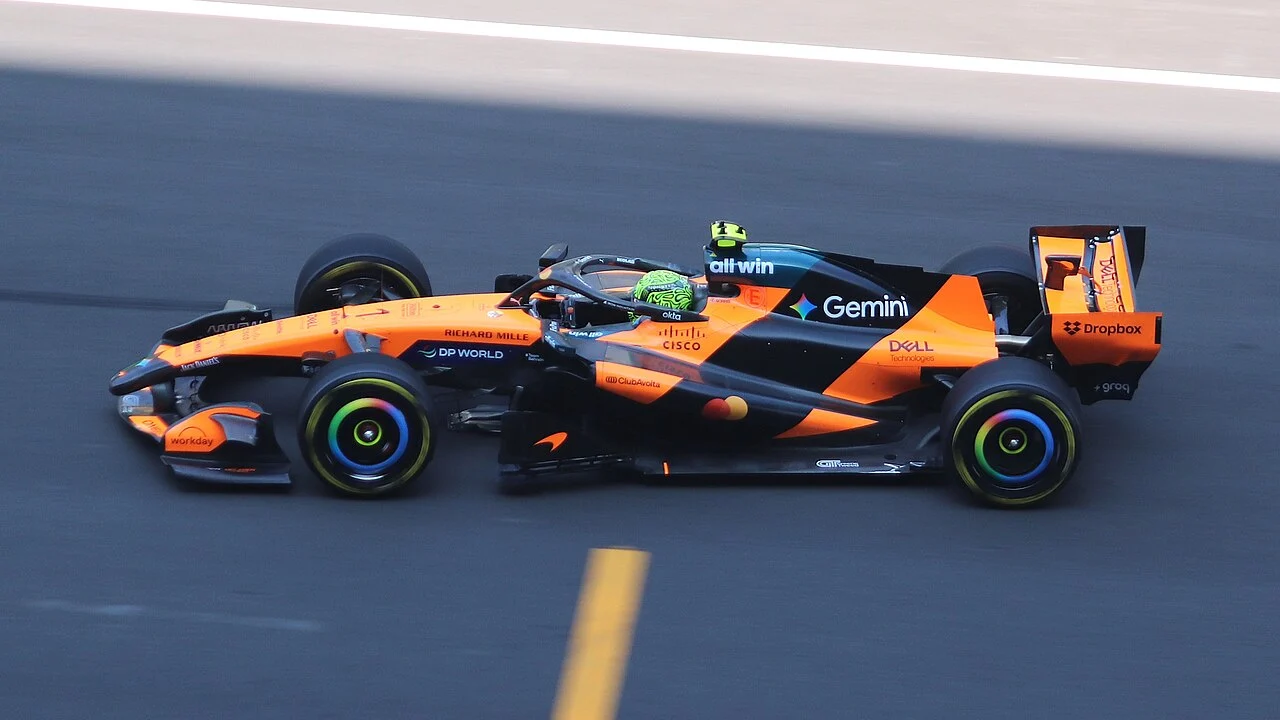
OKX has extended its primary partnership with McLaren Racing for another three years, giving both organisations a longer runway for a sponsorship platform that has already expanded well beyond logo placement.
The technology company announced the renewal on 27 November. Its original release says the relationship, which began in 2022, will continue for a further three years. An independent report published the following day also describes a three-year extension. Neither party has disclosed the fee, payment structure, category-exclusivity provisions, detailed rights inventory or activation budget.
That absence of financial detail prevents a credible valuation of the agreement. The more useful business question is what continuity changes operationally. McLaren and OKX have already built a repeatable programme of special liveries, race-weekend campaigns, digital collectibles and fan experiences. A new term allows them to reuse the production knowledge, approval routes and audience data generated by those projects rather than rebuilding the partnership from zero.
The renewal therefore protects an operating system as much as a sponsor position. For McLaren, it retains an established primary partner with experience of the team's brand, calendar and content process. For OKX, it preserves access to a global racing property and a campaign format that can be adapted across markets. For agencies and suppliers, it creates a multi-season pipeline, but only if the partners translate the headline extension into defined briefs, budgets and delivery dates.
The relationship accumulated rights before it accumulated time
McLaren announced OKX as a primary partner in May 2022. The initial agreement covered the Formula 1 team and McLaren Shadow esports operation, with branding on the cars, driver helmets, team kit and esports kit. The parties described fan experience and product innovation as central to the relationship from the beginning.
In March 2023, McLaren announced an expansion. OKX received increased car visibility, including sidepod branding at seven races, while its mark remained on driver suits and team overalls through the season. That update showed that the property was capable of changing its inventory after launch rather than remaining fixed at the level agreed in year one.
The 2024 programme added two important forms of activation. The Senna campaign at Monaco used a bespoke heritage livery, while Race Rewind offered free-to-mint digital collectibles linked to every remaining race and attached prizes including merchandise, visits to the McLaren Technology Centre and race experiences. McLaren's announcement said OKX branding also appeared on the sidepods at 20 races that season.
In 2025, a Riviera-inspired treatment ran at Monaco and the Spanish Grand Prix. McLaren connected that campaign to OKX's European market launch and to the team's M7A heritage. In 2026, the partners created another livery enhancement for Monza and Madrid, again using a limited run across two race weekends.
This sequence matters because a sponsor renewal is easier to justify when it retains working assets rather than merely preventing empty bodywork. The partners now have documented experience in car design, heritage approvals, driver content, prize fulfilment, digital products, regional market launches and multi-race storytelling. Those capabilities can reduce planning friction in the new term, but they do not guarantee that future campaigns will perform.
Special liveries have become a product, not a novelty
McLaren and OKX have treated livery changes as short-duration media products. Each design creates a reveal, photography, video, merchandise or collectible potential, race-weekend coverage and a second wave of content when the car competes.
The format is commercially attractive because it concentrates attention. A logo that appears in the same place for a full season may become part of the visual background. A temporary car design creates a reason for publishers, fans and the team's own channels to revisit the sponsor story.
The production load is substantial. A special livery requires design, legal and brand approval, technical checks on materials and weight, physical manufacture, application to multiple chassis and spare bodywork, racewear coordination, image production and a controlled launch schedule. It may also create new merchandise, hospitality material, partner toolkits and market-specific advertising.
Four years of collaboration should make that work more predictable. McLaren knows which internal departments need to approve an OKX concept; the sponsor understands the lead times and constraints of a race team; specialist suppliers know the required file formats, colours, materials and delivery windows. Continuity can therefore lower execution risk even when the public rights package appears unchanged.
The risk is repetition. A temporary livery cannot be treated as a success simply because it generates social attention. Each activation needs a distinct commercial purpose: a market launch, product education, customer acquisition, hospitality programme, retail drop, business-development event or measurable shift in brand consideration. Without that purpose, a design change becomes expensive content with an uncertain return.
Three years creates planning capacity
A multi-season term changes what can be commissioned. Annual or uncertain agreements encourage short campaigns because neither party wants to fund systems that may outlive the contract. A three-year runway can support more durable infrastructure: shared customer-data rules, recurring content formats, supplier frameworks, hospitality calendars and measurement systems that follow the same audience over time.
It also allows the partners to separate experiments from established programmes. One season can test formats, a second can refine the strongest ones and a third can scale them. That is particularly useful when a campaign crosses several jurisdictions, languages and product-availability regimes.
Teams benefit from revenue visibility, but the value is not limited to cash flow. A known primary partner can be incorporated earlier into car launches, racewear, content calendars, fan events and commercial planning. Other sponsors gain more certainty about category boundaries and collaborative opportunities. Suppliers can reserve capacity instead of responding to late one-off briefs.
OKX gains continuity across the Formula 1 calendar and McLaren's owned channels. It can build campaign recognition rather than repeatedly explaining why it is present. The company's announcement says the next phase will continue to reach new audiences and communities and create distinctive fan experiences. Those are strategic intentions, not delivery commitments, because no calendar, market list or performance target accompanied the release.
The term also creates concentration risk. If either brand's priorities change, a longer relationship can become harder to reposition. Contracts normally manage that through rights reviews, conduct provisions, regulatory clauses and exit mechanisms, but none of those terms is public. MRI has not inferred them.
The crypto category requires market-by-market execution
OKX describes Formula 1 as a global platform for introducing its technology and the role it can play in managing and moving money. The company's own renewal page also states that products may not be available in every region and includes risk and jurisdiction disclaimers.
That gap between global media rights and local product availability is an operating issue for the partnership. A race can deliver awareness in a market where the sponsor's services, promotions or customer journey differ from those offered elsewhere. The call to action therefore cannot be copied unchanged across every grand prix.
The new term needs a market matrix that connects each race and digital campaign to the products, claims and customer actions permitted in that location. Legal review must sit inside the creative process rather than appear at the end. Hospitality and business-development programmes may be useful in markets where a mass-consumer acquisition campaign is not appropriate.
The team also has to distinguish sponsor messaging from editorial and sporting communication. Clear labelling, approved language and age-appropriate targeting are basic controls when a financial-technology category is connected to a broad fan audience.
This does not make the category unusable. It makes operational discipline part of the rights value. A partner that can activate accurately across many markets gives a team more reliable revenue and fewer last-minute changes. Agencies and production suppliers that understand the regulatory map become part of the commercial infrastructure, not simply creative vendors.
What the announcement does not establish
The renewal confirms duration and primary-partner continuity. It does not establish that the rights package is identical to the current agreement.
No announcement identifies the exact car positions, number of primary-livery races, team-kit assets, driver rights, hospitality allocation, content volume, merchandise permissions, esports scope or regional exclusions for the new term. The companies also have not said whether the fee changes by season, whether part of the consideration is paid through services or digital assets, or which performance measures govern renewal or termination.
The partners have not published audience conversion, customer acquisition, hospitality usage, brand-lift studies or revenue attributed to previous campaigns. McLaren described the 2024 Senna design as one of its most successful campaigns and said it generated an extraordinary global response, but the 2026 livery announcement did not provide the underlying measures.
Those omissions do not weaken the fact of the renewal. They limit what can be claimed about its economics. A three-year extension is evidence that both parties see continuing value; it is not proof of a specific return, market price or customer outcome.
For sponsors evaluating a comparable programme, the lesson is to separate public visibility from the private business case. Benchmarking should compare inventory, activation obligations, production cost, hospitality, content access, exclusivity and measurement support, not only logo size or reported contract length.
The supplier opportunity sits behind the visible rights
Every activation creates work for organisations that may never appear in the announcement. Livery production requires designers, printers, materials specialists and installers. Content needs photographers, film crews, editors, rights managers and localisation. Fan programmes add event staff, data systems, prize fulfilment, travel, merchandise and customer support.
A longer term lets McLaren and OKX procure that work more efficiently. Framework agreements can define standards, turnaround times, approval responsibility and usage rights. Suppliers can invest in repeatable templates and quality controls because the relationship is less likely to end after one campaign.
The best commercial structure avoids locking the programme into a single creative idea. Core suppliers can provide continuity while local agencies adapt activity to individual markets. Asset ownership and usage rights should be agreed before production so that photography, video and design files can be reused throughout the term without disputes or emergency relicensing.
Image licensing is a small but visible example. MRI's thumbnail for this article uses a 2026 McLaren photograph released under Creative Commons Attribution 4.0. The licence permits reuse and adaptation with credit and a record of the change. That clarity makes the asset distributable. Sponsor content needs the same discipline if teams want partners, markets and publishers to extend its reach.
Teams should also protect supplier capacity around the busiest events. Monaco, Singapore and season launches already compress production schedules. Adding a special livery, merchandise and hospitality programme can create failure points unless sign-off dates and contingency stock are fixed months in advance.
A useful 2027–29 measurement framework
The first measure should be rights delivery. McLaren and OKX need a shared record of every contracted car, kit, content, hospitality and event asset, including whether it was delivered on time and in the correct markets.
The second is activation cost. The sponsorship fee alone does not capture the total investment. Design, production, media, travel, merchandise, staffing, legal review and technology all need to be counted against each programme.
The third is audience quality. Reach and impressions should be separated between existing McLaren followers, existing OKX customers and genuinely new audiences. Duplicate exposure across the team, driver, sponsor and championship channels should not be counted as four different people.
The fourth is action. Campaigns should define what a fan or business customer is expected to do: visit an owned page, register for an experience, enter a permitted product journey, attend an event, join a community or request a commercial conversation. Conversion can then be assessed against cost and market eligibility.
The fifth is asset productivity. A livery or film becomes more valuable when it supports several channels and markets without losing relevance. The partners should measure the number of approved uses, useful lifespan and localisation cost of each major asset.
The sixth is hospitality and B2B development. Attendance alone is weak evidence. The useful measures are meetings held, opportunities created, relationships advanced and business concluded over an appropriate time period.
The seventh is brand and trust. Repeated independent studies can show whether association with McLaren changes awareness, consideration or confidence among the audiences OKX prioritises. The method and sample should remain consistent enough to identify movement rather than produce a new headline every year.
The eighth is supplier performance. On-time delivery, rework, rights errors, localisation speed and sustainability data can reveal whether the activation system improves over the term.
None of these measures needs to be published in full. They do need to exist if the next renewal is to be judged on evidence rather than familiarity.
Continuity is the asset; conversion is the test
The three-year extension is commercially meaningful because McLaren and OKX are not starting a new sponsorship. They are extending a platform that already has car inventory, team-kit presence, heritage campaigns, digital programmes and a proven process for temporary liveries.
That continuity preserves knowledge and reduces the cost of relearning how to work together. It also creates a clearer pipeline for creative, production, hospitality, data and event suppliers. A longer term can support better measurement and more ambitious programmes than a sequence of uncertain annual deals.
The renewal still leaves the most important economic questions unanswered. The fee, revised inventory, activation budget, market plan and performance targets remain private. Previous campaigns have generated visible attention, but the parties have not published a consistent chain from exposure to business outcome.
For McLaren, the task is to convert partner stability into reliable multi-market delivery without allowing the format to become repetitive. For OKX, it is to turn a global association into relevant, compliant customer and business activity in the markets where it operates. For suppliers, the opportunity is to build a repeatable activation system that can move from concept to race weekend without wasting time or rights.
The partnership has already proved that it can make distinctive material. The next three years will show whether that material functions as a measured commercial platform rather than a sequence of well-received reveals.
Sources and further reading
- OKX partnership-renewal announcement, 27 November 2026 ↗
- McLaren Racing original OKX partnership announcement, 3 May 2022 ↗
- McLaren Racing partnership expansion, 30 March 2023 ↗
- McLaren Racing Race Rewind announcement, 6 June 2024 ↗
- McLaren Racing Riviera livery announcement, 21 May 2025 ↗
- McLaren Racing 2026 OKX livery announcement, 1 September 2026 ↗
- SportsMint Media independent report, 28 November 2026 ↗
- Wikimedia Commons image and licence record ↗