Dodge’s 2027 NASCAR Cup Series return is more than a fourth badge on the grid. It is a test of whether a manufacturer can build its way into the top series by first installing an anchor team, workforce and factory operating rhythm one level below it.
The programme announced on 2 November will put two Dodge Chargers into Cup competition with Kaulig Racing, beginning at the Daytona 500 on 21 February. Dodge will join Chevrolet, Ford and Toyota, becoming the first additional manufacturer in NASCAR’s top division since Toyota entered in 2007.
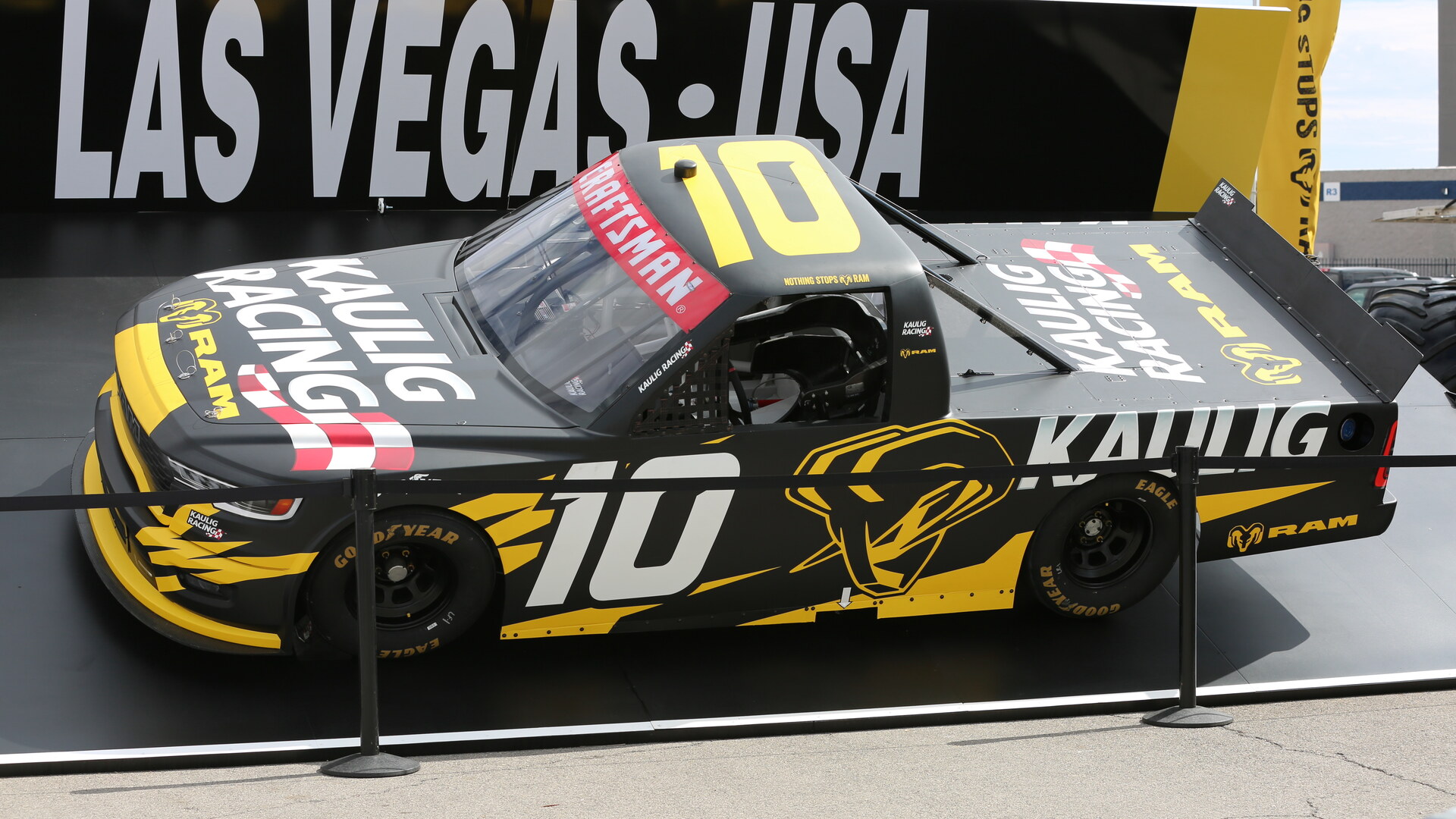
Kaulig is not starting the relationship from zero. The team already built and launched five factory-backed Ram entries for the 2026 Craftsman Truck Series after signing that programme in the previous summer. Stellantis now describes Kaulig as the anchor team for both Dodge and Ram, with Dodge SRT Racing directing the group’s North American motorsport activity.
That sequence matters to teams and suppliers. A conventional Cup entry would require a manufacturer to establish technical governance, choose teams, recruit specialists, qualify vendors, create parts flows and learn NASCAR’s approval processes at the same time. Stellantis has used the Ram year to bring much of that operating system into production before adding the more commercially valuable Cup layer.
The arrangement does not remove execution risk. NASCAR says a completely new Cup body normally goes through about 18 months of computational-fluid-dynamics and wind-tunnel work. Dodge has completed the wind-tunnel phase, but production panels were still due for a mid-November conformity check when the announcement was made. The engine configuration was not disclosed.
For the industry, the opportunity sits in the gap between a confirmed entry and a complete race-ready supply system.
The Truck programme became an industrial pilot
Kaulig’s Ram launch shows what the anchor model can deliver quickly, and what it consumes.
In March, NASCAR documented how the organisation went from having no Truck inventory to placing five new Rams on the Daytona grid within months. The build required new engineers, fabricators and body-hangers, a dedicated fabrication shop, parts arriving in December and work continuing through the holiday period. Kaulig described the launch as an undertaking whose scale was not always visible outside the team.
That investment created more than five vehicles. It established personnel who understand Stellantis engineering interfaces, component release, body fit, race support and reporting. It also gave the manufacturer a live environment in which to test decision speed, technical escalation and marketing activation before committing the Dodge badge to Cup.
The Cup announcement therefore converts sunk learning into a larger platform. Kaulig’s factory relationship, data routines and supplier contacts can be extended rather than recreated. Dodge can also observe the team’s ability to carry a multi-car programme through a full season before its first Cup points race.
There is a commercial logic to the sequence. Truck competition gave Ram a prominent national programme and a five-entry activation surface, while Cup gives Dodge the higher-reach property associated with NASCAR’s top championship. The group can assign different brand stories to each division while centralising motorsport leadership under Dodge SRT Racing.
This is not proof that every asset will be shared. Cup and Truck vehicles have different technical, staffing and inventory requirements. But common ownership and one anchor team reduce the number of organisational boundaries through which specifications, approvals and factory decisions must travel.
Kaulig becomes the integration point
An anchor-team designation changes the supplier map. Kaulig is no longer only a customer assembling cars from approved parts. It becomes the point at which manufacturer intent, NASCAR compliance, race-car production and trackside performance have to meet.
That makes programme-management capacity as important as headline engineering. The team must maintain version control as Dodge’s body is signed off, turn approved geometry into repeatable panels and assemblies, establish spares levels, validate service lives and build a reliable replenishment loop before Daytona.
The supplier opportunity is consequently broader than large visible components. It includes tooling, fixtures, composites, machining, metrology, simulation, data systems, transport, trackside service and quality assurance. Firms able to support controlled change at short notice may be more valuable during the launch than vendors offering a single low-cost part.
The purchasing risk is equally clear. A compressed programme can create expensive expedites, duplicated tooling and inventory that becomes obsolete after a specification change. Vendors should seek clear release authority, change-control terms, minimum quantities and responsibility for scrap before adding capacity. A factory-backed badge does not by itself protect a supplier from working-capital pressure.
For Kaulig, the operational challenge is to preserve the Truck capability that created the platform while adding two Cup cars. The public announcement does not disclose staffing levels, capital expenditure, supplier awards or how facilities will be divided between the programmes. Those are the numbers that will determine whether shared infrastructure creates efficiency or congestion.
The team also enters a transition year. Its 2026 Cup operation competes with Chevrolets while the new factory role points to Dodge for 2027. Managing information, people, inventory and partner obligations across that change will require boundaries as well as collaboration.
Homologation is only one critical path
Passing NASCAR’s wind-tunnel phase is a major technical milestone, but it is not the same as having a durable fleet.
Production panels still have to demonstrate that the physical car remains inside the approved performance window. After that, the programme must turn a compliant reference into enough bodies, assemblies and spares for two cars across a full Cup season. Repeatability, repair time and supply continuity will matter alongside peak aerodynamic performance.
NASCAR has not disclosed Dodge’s engine configuration. Series officials said only that the planned engine will comply with the rulebook and left the commercial announcement to Dodge and Kaulig. That makes any public conclusion about the engine builder or supplier structure premature.
The omission is material because the powertrain affects integration, dyno capacity, spares, trackside engineering and intellectual-property boundaries. Suppliers should distinguish between confirmed work and market speculation until the parties publish the programme.
Time is the fixed constraint. The body reveal is scheduled for 4 December at the Snowball Derby, and the points debut follows at Daytona in February. A reveal car can be prepared before the complete race and spares fleet is mature, so the industry should not treat the marketing milestone as evidence that every production task is closed.
Useful indicators over the next three months will include the engine announcement, recruitment activity, the number of completed chassis and bodies, test mileage, pit-equipment preparation and the lead times being offered to replacement-part suppliers. The first races will then show whether the fast-track approach has created a resilient operation or merely reached the grid.
A fourth manufacturer expands commercial inventory
NASCAR has wanted another Cup manufacturer for years. Adding Dodge gives the rights holder a fourth factory story to distribute across broadcast, digital, hospitality, retail and event promotion. It also creates additional competition for team affiliation, engineering talent and supplier attention.
For sponsors, the value is not limited to car branding. The launch offers a sequence of activation moments: the SEMA announcement, driver confirmation, the December race-car reveal, Daytona and the first season of results. Dodge can connect those moments to dealers, performance products and its wider SRT and Direct Connection activities. Kaulig can package access to a manufacturer return rather than selling only conventional team inventory.
The first-new-OEM-since-2007 distinction also gives NASCAR a proof point when speaking to other automotive groups. The governing body can show that a prospective entrant does not necessarily need a long period of public preparation before racing, provided it commits early enough to the technical work and installs an organisation capable of carrying it.
There are limits to that argument. Dodge is a returning brand with existing NASCAR history, and Stellantis used a full Truck programme to establish people and processes. The path is faster than a clean-sheet arrival partly because the group chose an expensive live pilot.
No party has disclosed the factory budget, team-support package, rights value or term of the agreement. Kaulig’s reference to stability and support signals the strategic importance of the relationship, but it should not be converted into an assumed financial figure.
What teams and suppliers should take from the model
The immediate lesson is that manufacturer entry can be staged. A lower-series programme can be used to qualify an anchor team and operating model before the top-level commitment becomes public. That can reduce organisational risk even when the technical programme remains compressed.
The second lesson is that scale arrives before certainty. Suppliers may be asked to reserve capacity while designs, volumes and delivery schedules are still moving. The strongest bids will combine technical capability with disciplined configuration control, transparent lead times and credible contingency stock.
Third, factory status changes a team’s commercial proposition but also its accountability. Kaulig gains a distinctive manufacturer story and a longer platform for sponsors. In return, it becomes responsible for translating a public promise into two competitive Cup cars while sustaining the Ram programme that made the expansion possible.
Finally, industry participants should separate what is confirmed from what remains open. The two-car entry, anchor-team structure, completed wind-tunnel phase and February debut are firm. The engine supplier, driver lineup, detailed component awards, programme economics and final production capacity are not yet public.
Dodge has chosen to compress planning, testing and competition into a visible launch cycle. That creates a valuable new factory programme for NASCAR and a meaningful order pipeline for the supply chain. It also moves risk downstream to the organisations that must turn homologation, parts and people into repeatable race weekends. Kaulig’s Ram year is the reason the timetable is plausible; how well that platform scales will determine whether it is successful.
Sources and further reading
- NASCAR Dodge Cup return announcement, 2 November 2026 ↗
- Kaulig Racing and Dodge announcement, 2 November 2026 ↗
- NASCAR report on Kaulig’s five-truck Ram build, 19 March 2026 ↗
- NASCAR Ram–Kaulig launch record, 23 August 2025 ↗
- RACER independent report, 2 November 2026 ↗
- Wikimedia Commons image record ↗
- Creative Commons Attribution-ShareAlike 4.0 licence ↗