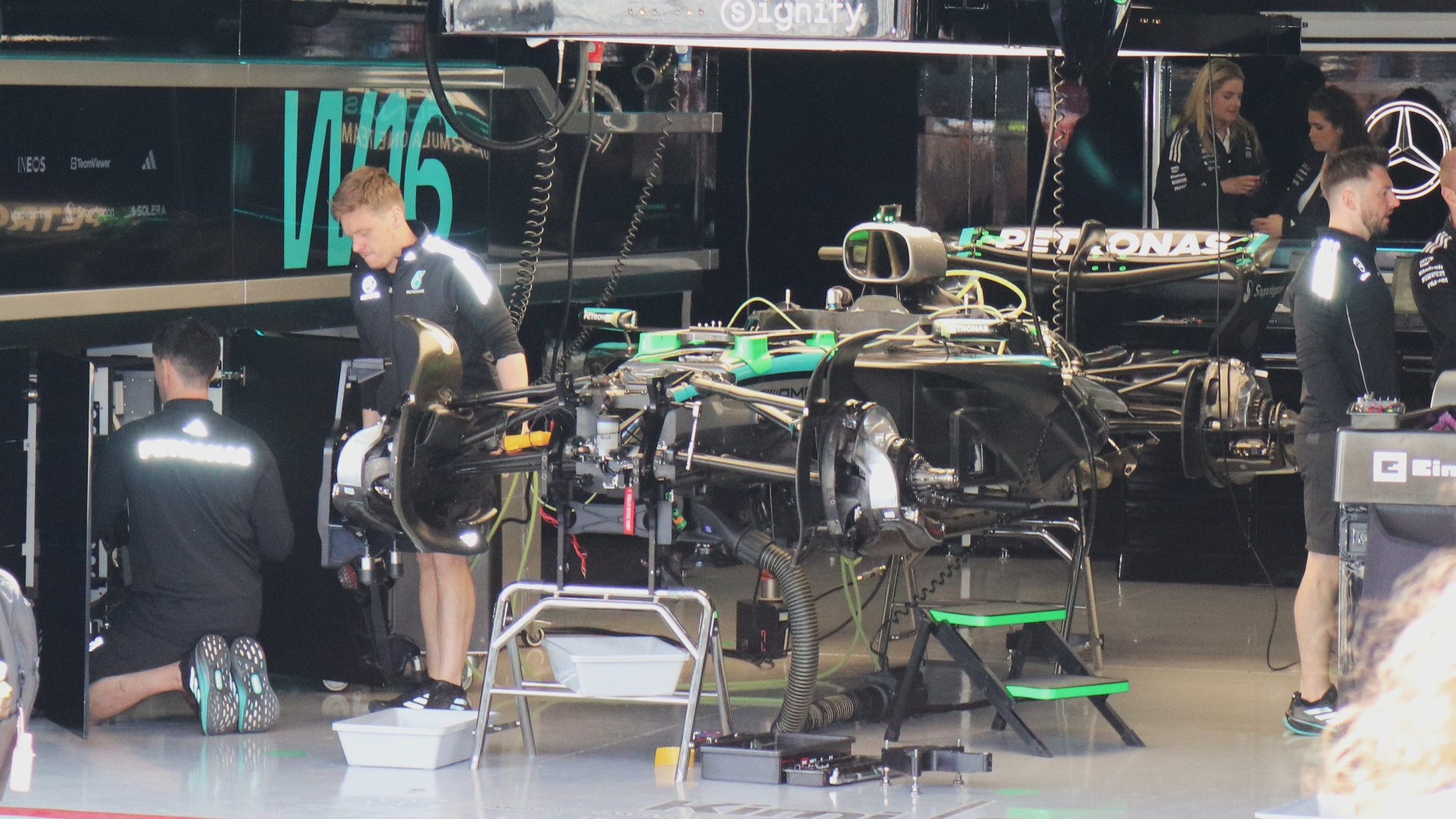
Mercedes-Benz Grand Prix Limited paid £125 million to its shareholders during 2025, almost matching its £125.9 million profit after tax. Read in isolation, that looks like a simple extraction story. Read alongside the rest of the audited accounts, it is a more useful benchmark for how the economics of a front-running Formula 1 operation have changed.
The group generated £633.378 million of revenue in the year to 31 December 2025, only £1.261 million more than in 2024. Operating profit nevertheless rose from a restated £156.152 million to £166.707 million, while profit after tax increased from £116.899 million to £125.905 million. Cost of sales fell by £25.836 million to £423.537 million.
That combination matters more than revenue growth. Mercedes produced a 26.3% operating margin from a year in which turnover was effectively flat, finished second in the constructors' championship and received a smaller share of television coverage. The company then returned £125 million to its three shareholder groups from distributable funds, up from £100 million a year earlier.
Yet the same balance sheet also shows continued investment. Property, plant and equipment increased from £120.401 million to £144.418 million. Total assets rose from £439.248 million to £509.259 million, and net assets increased to £239.983 million. Cash and cash equivalents fell from £52.613 million to £29.489 million, a reminder that profit, investment, working capital and shareholder distributions must be read together.
For teams, suppliers, sponsors and investors, the accounts are not merely a record of one wealthy entrant. They show the operating model that Formula 1's financial regulations have helped make possible: competition spending is constrained, commercial revenue is not, and a team can allocate capital between performance capability, customer programmes and owner returns.
Flat revenue, stronger conversion
Mercedes' £633.378 million turnover was just 0.2% above the prior year. Operating profit increased by 6.8%, and post-tax profit increased by 7.7%. The improvement came through conversion rather than top-line expansion.
Gross profit rose by £27.097 million to £209.841 million as cost of sales decreased. Administrative expenses increased by £16.542 million to £43.134 million, absorbing part of that gain, but the net result was still a £10.555 million rise in operating profit.
The distinction is important for suppliers. A customer with more than £600 million of revenue is not automatically a customer with a relaxed procurement process. Mercedes identifies close control of the cost base as a contributor to the result. In practical terms, vendors are selling into an organisation that can afford sophisticated engineering, software, logistics and manufacturing services but is also demonstrating that it expects those inputs to improve performance or efficiency measurably.
The strongest supplier proposition is therefore unlikely to be framed only around technical superiority. It needs to show lifecycle cost, installation burden, lead-time security, inventory exposure, support response and the effect on scarce engineering hours. Under a cost-limited sporting model, a product that releases people or test capacity can be more valuable than one that is simply cheaper.
The accounts do not disclose a procurement saving programme, supplier margin targets or contract-level spending. Cost of sales is also an accounting category, not a map of the Formula 1 cost cap. It would be wrong to infer from the £25.8 million reduction that Mercedes cut regulated car-development expenditure by the same amount. The useful conclusion is narrower: the group converted nearly unchanged revenue into materially more profit while preparing for a major rules change.
Commercial income is the stabiliser
Mercedes says sponsorship and licensing supplied more than £415 million of 2025 income. That is at least 65.5% of total revenue. The team ended the year with 24 premium global brands in its partner roster, including new relationships with adidas, Meta AI and Nasdaq.
At the same time, the team's share of Formula 1 television coverage fell from 15.5% to 13.2% as McLaren took 24% of the total. Mercedes' stated television advertising-value equivalent for partners and shareholders declined by 2% to $5.66 billion.
The figures demonstrate commercial resilience, but not immunity from sporting performance. Mercedes does not publish partner-by-partner revenue, rights fees, renewal rates or activation returns. Nor does it split the £415 million between sponsorship and licensing. The accounts therefore cannot prove that a larger partner roster fully replaced lost exposure, or that every agreement generated the same margin.
They do show that the business held total revenue broadly level despite a weaker broadcast share. For sponsors, that underlines why a modern Formula 1 agreement is built across more than television visibility. Mercedes expanded its Club hospitality offer in Miami, Silverstone, Las Vegas and Abu Dhabi, added four million social-media followers during the year and continued to develop the Mercedes-AMG World of Performance in Qiddiya.
Those channels let a rights package combine trackside branding with guest programmes, digital content, licensing, retail and market-specific experiences. The financial result does not disclose the return from any one channel, but it reinforces the case for activation plans that can still deliver when the car is not receiving the highest share of the world feed.
For the team, a diversified rights package also makes partner income less dependent on one inventory line. For agencies and activation suppliers, it creates more workstreams but also more measurement obligations. Hospitality occupancy, content distribution, lead generation, product sell-through and employee engagement need to be tracked separately if a sponsor is to understand what it is buying.
The dividend did not stop asset growth
The £125 million distribution equalled 99.3% of profit after tax. That ratio is striking, but it does not mean the company stopped reinvesting or paid the dividend directly out of year-end cash.
The accounts state that the distribution came from distributable funds. They also show property, plant and equipment rising by £24.017 million, intangible assets increasing to £3.195 million and the group's total asset base expanding by £70.011 million. Mercedes' official description of Brackley says the 60,000-square-metre technology centre contains a wind tunnel, dynos, a driver-in-loop simulator and manufacturing resources supporting continuous development.
Year-end cash fell by £23.124 million, or 44%, to £29.489 million. That movement should not be assigned to the dividend alone: the cash-flow statement, working capital, capital expenditure, tax and financing all affect the closing balance. It is nevertheless an important counterweight to the profit headline. A company can be highly profitable while choosing to keep less cash on its balance sheet because it is investing, distributing capital or both.
The directors said their base and reasonably possible downside forecasts, which excluded revenue agreements not yet signed, showed sufficient funds through the assessment period ending 31 March 2027. They also expected the revolving credit facility to remain undrawn. That is the relevant solvency context for the payout.
For team owners, the lesson is not that annual profit should always be distributed. It is that a mature operation can support both capital investment and cash returns when commercial income, cost control and forward contracts are strong enough. Younger teams, new entrants and expanding suppliers will sit at a different point in the cycle and may rationally retain more cash.
Cost cap accounts and company accounts are different systems
Mercedes says it was confirmed as fully compliant with the 2024 FIA Financial Regulations following the audit process. That statement belongs beside, not inside, the statutory profit calculation.
The FIA cost cap is a regulatory measure of relevant costs under defined rules. Mercedes-Benz Grand Prix's consolidated accounts cover the wider group and use accounting standards designed for shareholders and creditors. They include commercial activities and categories of expenditure that the sporting rules may exclude, adjust or treat differently.
That means £166.707 million of operating profit is not evidence that the team had unused cost-cap headroom. It also means the reduction in statutory cost of sales cannot be translated into extra permitted aerodynamic development, parts production or trackside spending. Staff exclusions, marketing, heritage activity, finance costs, tax, certain property costs and other defined items make a simple reconciliation impossible from the public accounts.
This boundary is central to Formula 1's new economics. The cap limits a large component of the competitive cost base, while sponsorship, licensing, hospitality and other income can keep growing. Once a team has funded the regulated programme and the excluded infrastructure around it, additional high-margin commercial revenue can flow into retained investment capacity or shareholder returns.
Suppliers should not confuse that profitability with an unlimited technical budget. A purchase still has to sit within an internal allocation, and the buyer must determine whether the cost is regulated, excluded or shared across activities. Proposals that identify the likely regulatory treatment and document allocation assumptions can reduce friction for finance and compliance teams.
Customer programmes widen the revenue logic
Mercedes' business is not limited to its own race entries. The strategic report says the group continued to deliver assemblies and services to Williams and would supply Alpine from 2026. It also says the Applied Science division was refocused after Aston Martin moved toward Honda powertrain supply and INEOS ended its intended challenge for the 38th America's Cup.
No segmental revenue is given for those activities, so the accounts do not reveal the profitability of customer supply, applied science or the works team separately. Still, the mix matters for capacity planning.
A Formula 1 team with customer agreements can use specialist engineering, manufacturing and support capability across more than one programme. That can improve utilisation, deepen manufacturer relationships and create B2B revenue less directly tied to the works car's weekly result. It also introduces delivery obligations that compete for people, inventory and management attention.
For component and service suppliers, customer-team programmes change the buying conversation. Forecast volumes may reflect several cars or organisations; technical approval can involve the works team, power-unit operation and customer; spares resilience becomes more important; and failures can affect more than one sporting programme. Contract terms around traceability, change control, intellectual property and incident response matter as much as unit price.
The 2026 technical project increases that pressure. Mercedes described the simultaneous chassis, power-unit and fuel changes as the largest combined regulatory reset in the sport's history and said the programme required close work with Mercedes-AMG High Performance Powertrains and PETRONAS. Strong 2025 profitability gave the group resources, but not relief from the execution risk of multiple new systems arriving together.
The risk disclosures belong in commercial planning
The filing identifies sponsor credit, foreign exchange, reputation and geopolitics as material operating risks.
Mercedes says it conducts appropriate credit checks on potential sponsors and escalates specific risks during negotiations. That is a useful reminder that signing a large rights agreement does not make the revenue risk-free. Payment schedules, guarantees, termination rights and brand-safety provisions determine how much of the headline contract becomes dependable cash.
The group also receives revenue and incurs costs in currencies other than sterling, with exposure monitored monthly. Teams and suppliers that quote across dollars, euros and pounds need aligned hedging, escalation clauses and purchasing assumptions. An apparently profitable multi-year agreement can change quickly when revenue and the supply base sit in different currencies.
Geopolitical disruption is now an explicit commercial issue. Mercedes cites the cancellation of the Bahrain and Saudi Arabian Grands Prix as examples of sudden disruption capable of reducing participation, deferring revenue, raising logistics costs and impairing sponsor, promoter or supplier arrangements. The company says it uses contingency planning and flexible operations but cannot fully remove the risk.
For promoters and partners, that disclosure argues for contracts that specify substitute inventory, force-majeure treatment, guest relocation, content alternatives and payment timing before a calendar disruption occurs. For logistics suppliers, it raises the value of rerouting capability and visibility over freight already in transit.
What the numbers do and do not prove
The accounts establish that Mercedes-Benz Grand Prix was highly profitable in 2025, invested in its asset base and returned substantial capital to shareholders. They also show that commercial income remained powerful while television exposure declined.
They do not disclose the value of the team, the economics of individual sponsors, the cost or return of specific facilities, the margin on customer supply, or the amount of spending recognised under the FIA cost cap. The 2024 comparatives were restated as part of the transition from FRS 102 to UK-adopted IFRS, so comparisons should use the restated figures printed in the 2025 accounts rather than older reports.
The next test is whether the model holds through the 2026 reset. Mercedes entered the year with new partners including Microsoft, Nu and Zuma, a new Alpine supply relationship and a larger property and equipment base. It also entered with less cash on the balance sheet and a technical programme described as unprecedented in scope.
For the wider industry, the result is a capital-allocation benchmark. Formula 1 teams are no longer judged only by whether they can survive a season or find enough sponsor money to build the next car. The strongest operations now have to decide how much to invest, how much capacity to sell, how much risk to retain and how much cash to return.
Mercedes' £125 million dividend is the most visible answer. The £633 million revenue platform, 26.3% operating margin and simultaneous growth in productive assets explain how it became possible.
Sources and further reading
- Mercedes-Benz Grand Prix Limited 2025 group accounts, filed 7 June 2026 ↗
- Companies House filing history for Mercedes-Benz Grand Prix Limited ↗
- Mercedes-AMG Petronas F1 Brackley headquarters ↗
- FIA 2026 Formula 1 Financial Regulations, issue 07, 25 June 2026 ↗
- BlackBook Motorsport independent financial report, 9 June 2026 ↗
- Wikimedia Commons image record ↗