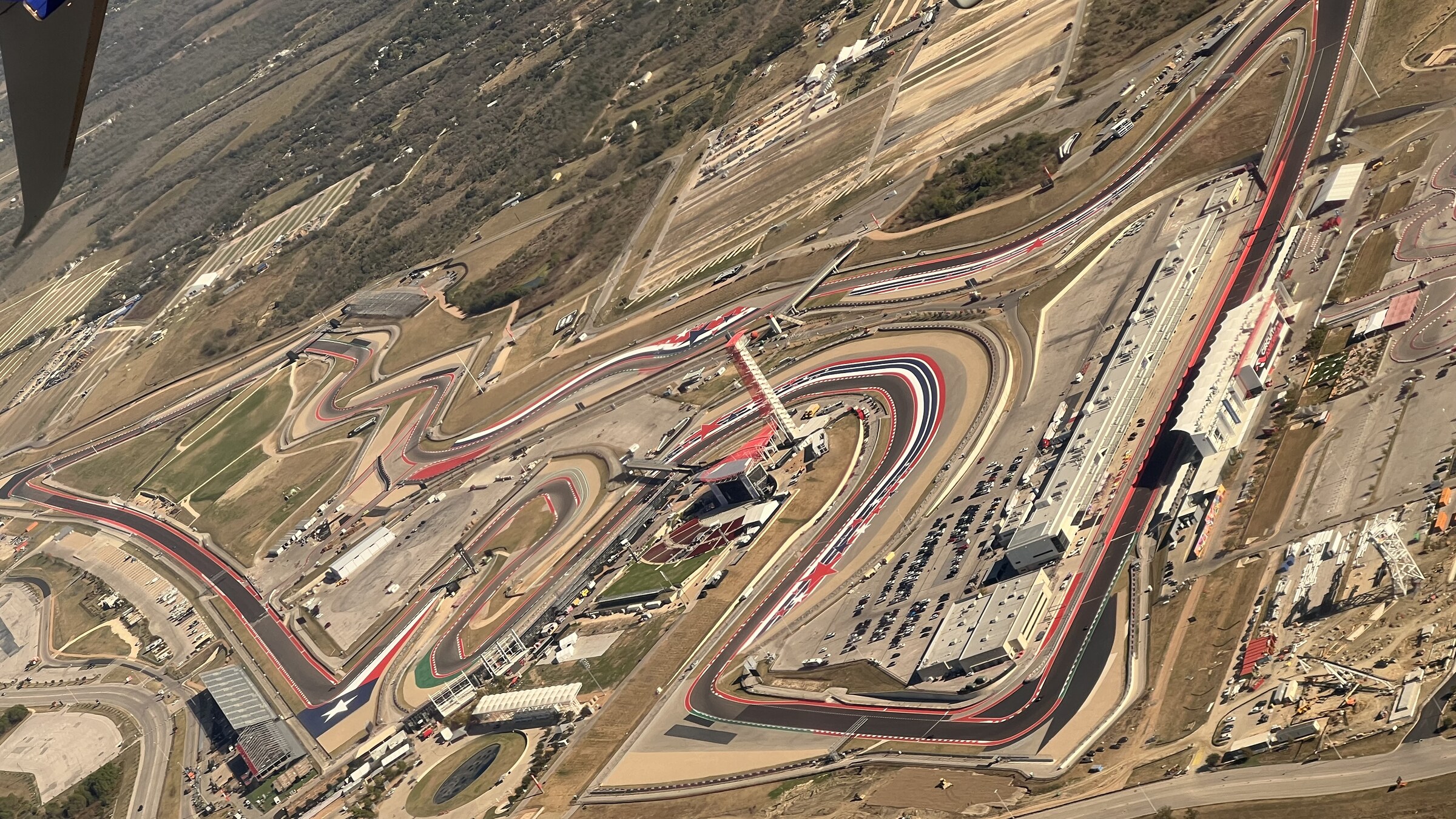
MotoGP will put four premier-class motorcycles on track during Formula 1's United States Grand Prix this weekend, turning one of the largest crowds in motorsport into a live audience-acquisition test.
The high-speed demonstration is scheduled for Saturday, 24 October from 11:40am to noon local time at Circuit of The Americas, immediately before Formula 1 Free Practice 3. MotoGP says it is the first time the championship has been included on track during a Formula 1 Grand Prix weekend.
Dani Pedrosa will ride for KTM, Nicolo Bulega for Ducati, Andrea Dovizioso for Yamaha and Lorenzo Savadori for the US-based SuperFile Trackhouse MotoGP Team. A dedicated MotoGP area in the F1 Fan Zone will display the four bikes throughout the weekend, with MotoGP teams and riders present from Thursday to Sunday.
The official announcement expects more than 400,000 people across the event. It also points directly to MotoGP's next US race at COTA on 23–25 April 2027. That sequence is the business story: use F1's existing footfall to demonstrate a different product, deepen contact away from the track, then give interested fans a defined event to buy.
This is not a joint championship round, a shared ticket or proof that Formula 1 followers will convert into motorcycle-racing customers. None of those outcomes has been published. It is a relatively contained first test of how Formula 1 and MotoGP can exchange attention now that both sit inside Liberty Media's Formula One Group.
A borrowed audience with a next step
An exhibition run normally produces awareness. Austin gives MotoGP a chance to build a simple conversion path because the venue, market and next product are already known.
Formula 1 said COTA had drawn more than 430,000 people in recent years when it extended the United States Grand Prix through 2034. MotoGP's current forecast is more than 400,000 for the 2026 weekend. The motorcycle championship is therefore inserting itself into an audience measured in hundreds of thousands without staging a second standalone festival or waiting for its own 2027 race weekend.
The demonstration is the attention layer. Four motorcycles running at racing speed supply a sensory product that a static display cannot reproduce. MotoGP says its machines exceed 225mph, lean beyond 60 degrees and can produce more than 130 decibels. The 20-minute slot before a Formula 1 session puts that product in front of spectators who are already seated or moving toward viewing areas.
The Fan Zone is the consideration layer. It extends a brief track appearance across four days and creates space for closer inspection, staff interaction, content capture and future calls to action. The announced 2027 Grand Prix date supplies the conversion opportunity.
Public information does not show whether MotoGP will sell tickets in the activation, capture contact details, promote VideoPass, distribute an offer code or direct visitors into its app and newsletter. Without one or more of those mechanisms, the weekend could generate strong visibility but little owned data. The difference between a spectacle and a sales funnel will be decided in that final metre.
Why COTA makes the experiment efficient
Austin is the only current US Formula 1 venue that also hosts MotoGP. That gives the test a degree of operational and commercial continuity that Miami or Las Vegas cannot offer.
COTA's permanent road course is familiar to motorcycle teams, riders and fans. The venue will stage MotoGP again six months after the Formula 1 weekend, so every piece of audience education can point to the same location. A spectator does not need to learn a second city, circuit or travel pattern before considering the 2027 event.
The choice also lets the promoter connect two established customer bases around one venue. A fan who has already navigated parking, seating, food, access and accommodation at COTA has fewer unknowns when evaluating a second race weekend. That does not guarantee a purchase, but it reduces the practical distance between interest and attendance.
Operational familiarity should not be confused with zero cost. The public announcement does not identify who is paying for freight, motorcycle preparation, rider appearances, safety cover, insurance, track operations, Fan Zone construction or hospitality. It also does not disclose whether the activation is part of a broader commercial agreement among MotoGP, Formula 1 and COTA.
Those omissions matter to any promoter considering a repeat. Austin may be efficient because the circuit already hosts both championships, but the actual cost per engaged fan cannot be calculated from the published information.
The product comes before the logo
The activation is notable for leading with machinery rather than branding. Four manufacturers are represented, and the bikes will run rather than appear only as display objects.
That makes the championship itself the product. KTM, Ducati, Yamaha and Aprilia-linked Trackhouse collectively demonstrate variety while preventing the session from reading as a campaign for one manufacturer. Pedrosa and Dovizioso bring established names; Bulega connects the display with the 2027 grid; Savadori and Trackhouse give it a current US-team link.
The rider selection is also a consequence of the calendar. MotoGP's championship is racing at Phillip Island on the same weekend, so current full-season riders and their principal race crews are occupied in Australia. Independent reporting has identified the clash as a logistical complication. Using test riders and a future entrant keeps the Austin programme separate from the title contest, but it still requires manufacturers to divide equipment, people and attention across continents.
For suppliers, that creates a useful distinction between demonstration support and race support. Show bikes still need transport, preparation, tyres, fluids, charging or starting equipment, telemetry decisions, protective equipment and technical staff. The performance target is different from a Grand Prix, but reliability and presentation standards remain high because a failure would occur in front of a large new audience.
No supplier appointments or technical partners for the showcase have been announced. Businesses should therefore treat the programme as evidence of a new activation format, not evidence of an open tender or a recurring contract.
Common ownership creates distribution leverage
Liberty Media completed its acquisition of MotoGP commercial-rights holder Dorna in July 2025. Its official corporate description now places Formula 1, MotoGP and hospitality business Quint as subsidiaries inside the Formula One Group.
Austin is the clearest public example so far of how that structure can create distribution leverage without combining the sporting products. Formula 1 supplies a large US event audience. MotoGP supplies an adjacent premium racing experience. COTA provides a venue with a direct connection to both.
The arrangement does not mean the championships share a budget, sales team, sponsor inventory or regulatory structure. MotoGP remains a distinct rights business, and the two series serve different teams, manufacturers, broadcasters and commercial partners. Rights conflicts, category exclusivity and brand approvals still have to be managed.
The opportunity is more precise. Common ownership can make it easier to identify where one property has underused attention and another has relevant content. It can also reduce the organisational distance involved in scheduling a demonstration, coordinating communications and agreeing which audience may be marketed to, subject to privacy and contract limits.
For Liberty, the value of cross-promotion is not merely larger crowds on one weekend. It is the possibility that marketing inventory already funded by one property can lower the acquisition cost of another. That thesis remains unproven in Austin because no budget, media value or conversion target has been disclosed.
What each stakeholder can gain
MotoGP gets a physical introduction to an F1-heavy US audience ahead of its next COTA round. The immediate objective appears to be discovery: let spectators experience speed, sound and manufacturers in person rather than asking advertising alone to explain the product.
Formula 1 and the United States Grand Prix add content to a Saturday schedule without presenting another competitive race. The demonstration can increase perceived value for ticket holders, create social material and offer a differentiating moment around Free Practice 3.
COTA can market a second major event to customers already on site. The circuit also gains an opportunity to learn which F1-ticket segments show interest in MotoGP, provided its commercial systems are allowed to measure that behaviour.
Motorcycle manufacturers receive exposure in a market that the industry continues to treat as strategically important. The four-brand format can expand category awareness, while each participant can build its own content and dealer-facing activity around the appearance. The public announcement does not say whether local dealers, customers or prospects are included.
Sponsors could gain hospitality and storytelling across two premium properties, but only where rights permit. A partner of a MotoGP team does not automatically receive branding inside an F1-controlled environment. An F1 event partner does not automatically acquire motorcycle rights. The practical value depends on negotiated inventory, category conflicts, media access and the ability to reuse content.
Suppliers gain a potential new class of short-duration deployment: equipment and personnel supporting a demonstration inside another championship's event. If the format scales, demand could extend to freight, temporary garages, display build, fan engagement, data capture, guest management, production and technical support. One event is not enough to forecast a market, but it reveals the operating package that would need to be standardised.
The measurement gap is the commercial risk
The announcement describes the audience and activity but publishes no key performance indicators. That makes disciplined measurement more important, not less.
The most basic metric is reach: how many F1 attendees were in viewing areas during the 20-minute run, and how many unique visitors entered the MotoGP Fan Zone? Footfall alone is insufficient. Dwell time, bike interactions, staff conversations and content scans would show whether the activation held attention.
The next measure is owned-audience growth. MotoGP should be able to isolate US newsletter registrations, app installs, account creation, VideoPass trials and social follows attributable to the Austin activity. Unique links, QR codes and event-specific offers can separate direct response from the general uplift created by race-week coverage.
The decisive measure is 2027 demand. Traffic to the COTA MotoGP ticket page, presale registrations, ticket conversion, hospitality enquiries and geographic origin should be compared with baseline periods and with audiences not exposed to the F1 activation. A ticket sale six months later is more valuable evidence than a same-day video view.
Sponsors and manufacturers need their own outcomes. Brand recall, dealer leads, guest attendance, earned-content use and US-market engagement should be separated by participant. A combined reach number cannot tell a partner whether its rights worked.
None of these systems has been confirmed publicly. MRI is identifying the measurements required to judge the programme, not reporting undisclosed plans.
Delivery will determine whether the format can travel
The schedule gives MotoGP 20 minutes between major Formula 1 activities. That is enough to create impact, but it leaves little tolerance for a delayed course handover, mechanical issue, debris, recovery or barrier problem.
Event operators need clear responsibility for track inspection, rider briefing, marshalling, communications, medical cover, noise management and the transition back to the Formula 1 timetable. Broadcast and public-address teams must explain unfamiliar riders and machinery quickly if the audience is to understand what it is seeing.
The Fan Zone needs the same discipline. Static motorcycles can draw a crowd, but the commercial result depends on staffing, queue design, accessibility, lead capture, merchandise or ticket links and content that remains useful after the bikes leave the circuit.
Manufacturers must also protect the intellectual property and technical condition of prototype machinery shown outside a normal MotoGP paddock. Decisions about bodywork, electronics access, photography, security and data logging become part of the activation plan.
If the weekend works, organisers will still need to distinguish what is repeatable from what is unique to Austin. A permanent circuit shared by both championships offers advantages that F1's US street venues do not. Future demonstrations elsewhere may require different machines, lower-speed formats or city-centre activations rather than a direct copy.
A test, not yet a template
The Austin programme is material because it joins three stages that motorsport promotions often leave separate: live product proof, extended fan contact and a dated future purchase.
It is also deliberately limited. Four motorcycles, one 20-minute slot and one Fan Zone do not create a merged Formula 1–MotoGP proposition. No joint ticket, sponsor bundle, broadcast package or recurring calendar has been announced.
That restraint makes the experiment easier to evaluate. If MotoGP can show that F1 spectators became identifiable followers, subscribers, guests or 2027 ticket buyers, the case for further cross-property work becomes much stronger. If it produces only a short burst of social attention, the format will need a better conversion layer before it travels.
For teams, suppliers, sponsors and promoters, that is the practical significance of Austin. Common ownership has produced access to a valuable audience. The next task is to prove that access can be converted into durable demand without diluting either championship's rights or identity.
Sources and further reading
- MotoGP official Austin showcase announcement, 20 October 2026 ↗
- Liberty Media acquisition completion, 3 July 2025 ↗
- Formula 1 United States Grand Prix extension and attendance context, 19 October 2025 ↗
- The Race independent report, 20 October 2026 ↗
- AS independent report, 20 October 2026 ↗
- Circuit of The Americas 2026 United States Grand Prix event page ↗
- Wikimedia Commons image record ↗