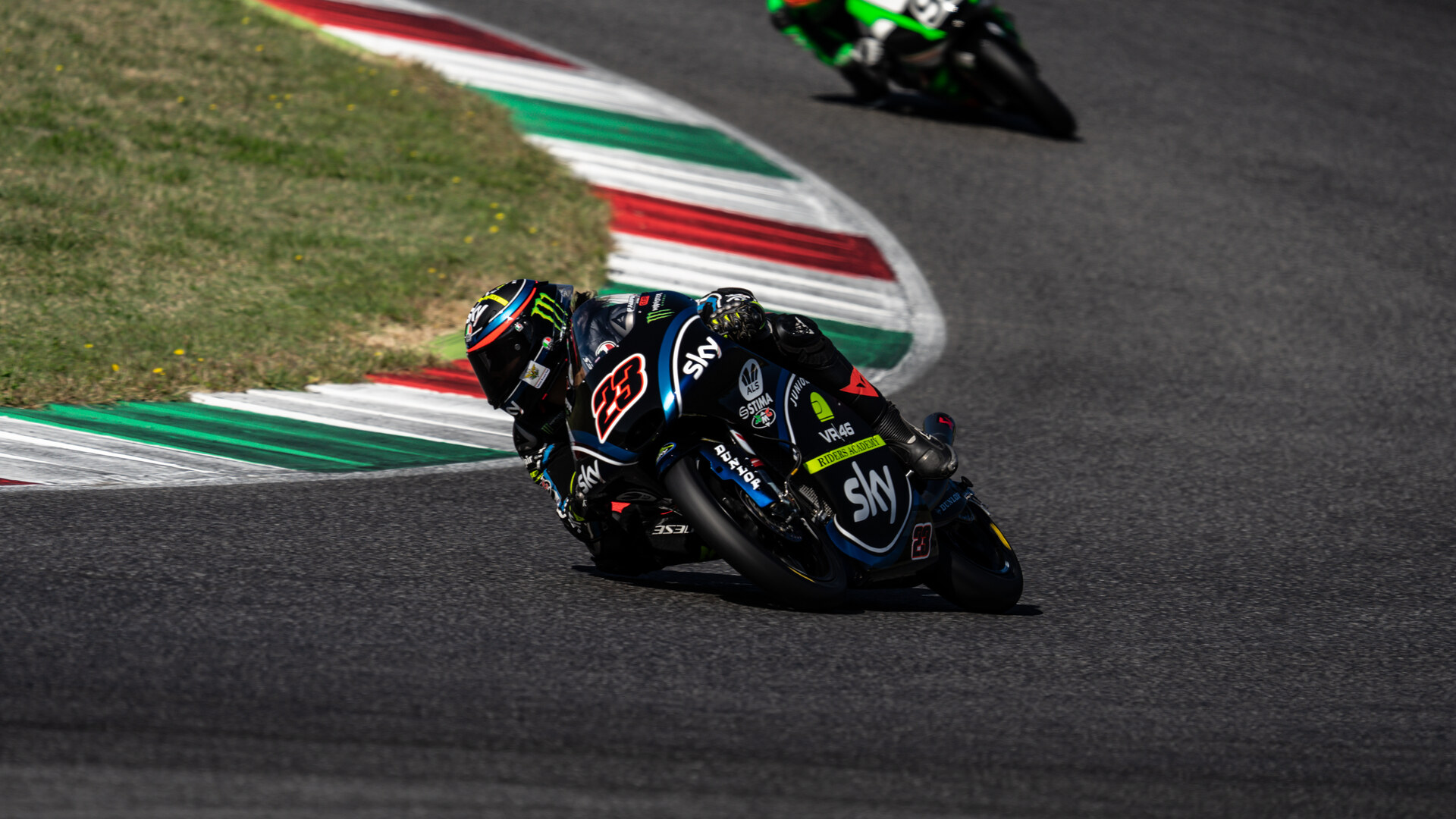
Dunlop Motorcycle Europe has extended its title sponsorship and exclusive tyre supply of Italy's Campionato Italiano Velocità for four seasons, from 2027 through 2030. The announcement made at EICMA on 5 November covers Superbike, Supersport, Sportbike, Moto3 and Moto4, with Dunlop engineers supporting competitors at the track.
That is the headline. The business structure underneath it is more revealing.
Before the renewal was announced, the Federazione Motociclistica Italiana published a competitive tender for a single company to occupy two roles: title sponsor of the CIV and exclusive tyre supplier to all five classes. The tender set a minimum total sponsorship offer of €1 million plus VAT, maximum race-tyre prices of €500 per set for Superbike and Supersport and €400 for the other three classes, and extensive event-service obligations. It weighted the award 70 points for the economic offer and 30 for technical quality.
The winning financial terms have not been published. The €1 million figure is therefore a bid floor, not the disclosed value of Dunlop's contract. Final team prices, annual tyre volumes and the cost of delivery are also undisclosed. Even with those gaps, the tender and renewal together show the commercial architecture: sponsorship cash, compulsory product supply, paddock service and race-derived development have been contracted as one platform through 2030.
One agreement, four operating roles
The first role is conventional title sponsorship. Dunlop's name remains attached to the championship, and the tender grants the selected company visibility in federation communications, event material, media activity and the end-of-season ceremony. Those rights make the technical relationship legible to spectators and the wider motorcycle market rather than leaving it as a paddock supply arrangement.
The second role is exclusive supply. Every competitor in the five specified classes must use the appointed supplier, creating a defined installed base. For Dunlop, that offers recurring product demand and comparable feedback across different motorcycles, teams and circuits. For the promoter, one control supplier can simplify eligibility, event servicing and sporting administration.
The third role is operational. The tender does not allow the supplier to deliver tyres and disappear. It requires attendance at six race meetings and two collective tests, separate paddock service areas for the senior and junior categories, at least one technician for each category, and at least four tyre-fitting staff. The supplier must provide the fitting equipment, staff and transport at its own cost, apart from electricity supplied by the circuits.
The fourth role is product development. Dunlop says the KR111 front tyre will replace the KR109 in 2027 after a version identified as G2_01 VAL4 was raced in the 2026 Supersport class. A new KR108 rear is also being developed for Supersport. This gives the renewal a direct link between championship competition, engineering validation and the future race-tyre range.
Bundling those roles reduces the number of commercial interfaces for the federation. It also concentrates exposure. If supply, service or product performance falls short, the technical issue is attached to the title sponsor's brand and affects every class in the package.
The tender disciplines both price and specification
Control-tyre agreements can lower procurement complexity, but exclusivity removes teams' ability to shop between rival brands. FMI's tender attempts to balance that by setting both technical and commercial constraints.
The tyres must represent current technology and recent design, and their availability has to be guaranteed for the contract period. The tender requires the supplier to discount its published list prices by at least 40 per cent. It permits a list-price update no more than once a year and links any change to inflation. Most visibly, it caps the price of a dry-and-wet set at €500 including VAT for Superbike and Supersport, and €400 including VAT for Sportbike, Moto3 and Moto4.
Those ceilings are not proof of the actual prices Dunlop will charge. A competitive bid may be lower, and the final contract has not been released. They do, however, give teams an outer boundary for a major consumable while giving the supplier a defined framework for forecasting inventory, staffing and freight.
The tender estimates at least 500 sets for each class in each season, including dry and wet tyres, but explicitly says that the quantity is not guaranteed and that the supplier receives no compensation if actual demand is lower. That distinction matters. The estimate is useful for capacity planning; it is not a minimum-purchase commitment or a reliable basis for calculating contract revenue.
For the smaller classes, the selected company must also supply wheels with tyres mounted and balanced. That extends the package beyond rubber into ready-to-use assemblies, equipment control and paddock handling. It can reduce variation for entrants, but it increases the supplier's working-capital and service obligations.
The economics should therefore be read as a portfolio rather than a simple sponsorship fee. Dunlop must fund the rights payment, hold stock, move equipment, staff eight race or test attendances and support five classes. Against that, it receives championship visibility, exclusive product sales, a stable multi-season relationship and a high-frequency technical feedback environment.
Economic weighting makes the rights contest explicit
FMI's selection formula assigned 70 of 100 points to the economic proposal and 30 to technical quality, with a minimum overall score of 70. The economic portion covered both the sponsorship contribution and tyre prices. The technical portion included the product range, service structure and support offered to competitors.
That weighting shows the federation was not procuring only a technically compliant control tyre. It was selling a marketing asset while buying a supply and service system, and it used the bid to make competitors' costs part of the commercial evaluation.
The structure also creates cross-subsidy questions that teams and rival suppliers will watch. A supplier can value title rights, tyre margin, research data and market activation together, whereas a pure product vendor might assess only tyre sales. That favours organisations able to monetise several layers of the platform. It can also produce a stronger package for the championship if the technical and commercial incentives remain aligned.
The tender limits the exclusivity to the CIV roles covered by the award; it does not grant blanket exclusivity across every FMI activity. That boundary protects the federation's ability to work with other companies elsewhere while preserving a clear proposition for the national championship.
There is also a possible extension beyond the initial four seasons. The tender reserves a unilateral option for the federation to renew for up to two additional years. Dunlop's announcement commits through 2030 and does not state that the option has already been exercised. Any 2031–32 continuation should therefore be treated as a procurement possibility, not part of the announced term.
Trackside engineering is part of the product
For teams, the most valuable part of a control-tyre deal is often not the headline brand or even the nominal unit price. It is whether the correct tyres arrive in the right quantity, whether fitting queues are controlled, whether compound advice is consistent and whether problems are resolved without sacrificing track time.
The staffing requirements in the tender make that service measurable. Category technicians need enough authority and information to advise teams consistently. Fitting crews need capacity for schedule peaks, especially after weather changes or incidents. Inventory controls must distinguish allocation, return, wet-weather contingency and any development material.
Suppliers serving Dunlop and the championship should expect multi-year requirements around freight, temporary structures, tyre-handling equipment, generators or electrical interfaces, data capture, workforce travel, waste management and recycling. The contract's continuity can justify better equipment and documented processes, but vendors should confirm which entity buys each service and whether demand is guaranteed before committing capital.
Teams should ask for the operational detail that the public documents do not provide: order deadlines, cancellation rules, emergency stock, allocation limits, fitting hours, damaged-tyre policy, traceability, rain-tyre availability, service escalation and the treatment of test mileage. A price cap does not by itself prevent a lost session or a stock imbalance.
The championship must also manage perceived neutrality. An exclusive supplier receives data from multiple competitors while developing its own products. Clear rules are needed for what information technicians collect, how it is aggregated, who can access it and how development tyres are allocated. The announcement and public tender do not disclose those governance terms.
CIV becomes a development channel
Dunlop's product plan is the clearest evidence that the agreement is intended to do more than place logos. The company says a development version of the KR111 front was used in CIV Supersport during 2026 and that the tyre will replace the KR109 in 2027. The new KR108 rear remains under development for the same class.
That sequence creates a useful commercial loop. A prototype or pre-production specification is exposed to varied riders, motorcycles, setups and circuits; engineers compare feedback and wear; the resulting product enters the range; the title sponsorship then provides a platform to explain that provenance to customers.
For a tyre manufacturer, a national series can be particularly useful because it offers repeated running across several classes without the cost structure of a global championship. The value depends on disciplined experiment design. Race results alone cannot isolate tyre performance from motorcycle, rider, setup and conditions. Development work must distinguish controlled evidence from promotional narrative.
For the championship, the R&D story can attract technically minded partners and suppliers. It also raises the standard of disclosure expected from the control supplier. Teams need timely bulletins, construction identifiers, pressure and temperature guidance, transition plans and equal access when products change. A new tyre creates value only if the paddock can adopt it safely and fairly.
The 2027 calendar begins at Misano on 24–25 April before rounds at Mugello, Cremona, Imola and Vallelunga, followed by the Misano Racing Night. That gives Dunlop a six-event operational programme plus the two collective tests specified in the tender. Pre-season stock validation, equipment commissioning and technician training will need to be complete before the first collective running, not merely the opening race.
What teams, suppliers and partners should watch
The first evidence point is pricing. The public tender provides ceilings and discount rules, but the signed schedule has not been published. Entrants should compare the final dry and wet allocations, fitting charges and test supply with the caps rather than assuming every cost is included.
The second is service capacity. Five classes can generate sharp demand peaks. Queue times, fitting throughput, technician coverage and weather contingency will show whether the paddock operation matches the scale promised in the bid.
The third is product transition. The KR111's move from a 2026 development specification into the 2027 range should be tracked through technical bulletins and team feedback. The KR108 programme will show how visibly CIV data feeds the next product rather than remaining an unmeasured marketing claim.
The fourth is commercial activation. A title sponsor with a mandatory product role has access to teams, riders and engineering stories throughout the season. The strongest programme will turn that access into useful technical content, dealer engagement and customer education without blurring sporting impartiality.
Finally, watch the undisclosed contract terms. The winning sponsorship amount, actual tyre prices, performance remedies, data rights, insurance, termination provisions and intellectual-property ownership will determine much of the real risk allocation. None should be inferred from the €1 million tender floor.
Dunlop's renewal gives CIV continuity through 2030, but continuity is only the starting point. FMI has combined a revenue-producing title asset with a cost-sensitive control product and a labour-intensive service operation. Dunlop has accepted a platform that can generate sales, evidence and brand reach at the same time. If the paddock delivery is strong, the agreement becomes more than a tyre contract; it becomes an integrated route from race series to product development and market.
Sources and further reading
- Dunlop Motorcycle Europe announcement, 5 November 2026 ↗
- Federazione Motociclistica Italiana procurement notice, 10 August 2026 ↗
- Federazione Motociclistica Italiana tender document, 10 August 2026 ↗
- GPOne independent report, 5 November 2026 ↗
- Motopress independent report, 5 November 2026 ↗
- CIV official championship website ↗
- Licensed image record: Sergio bertozzi, CC BY-SA 4.0 ↗