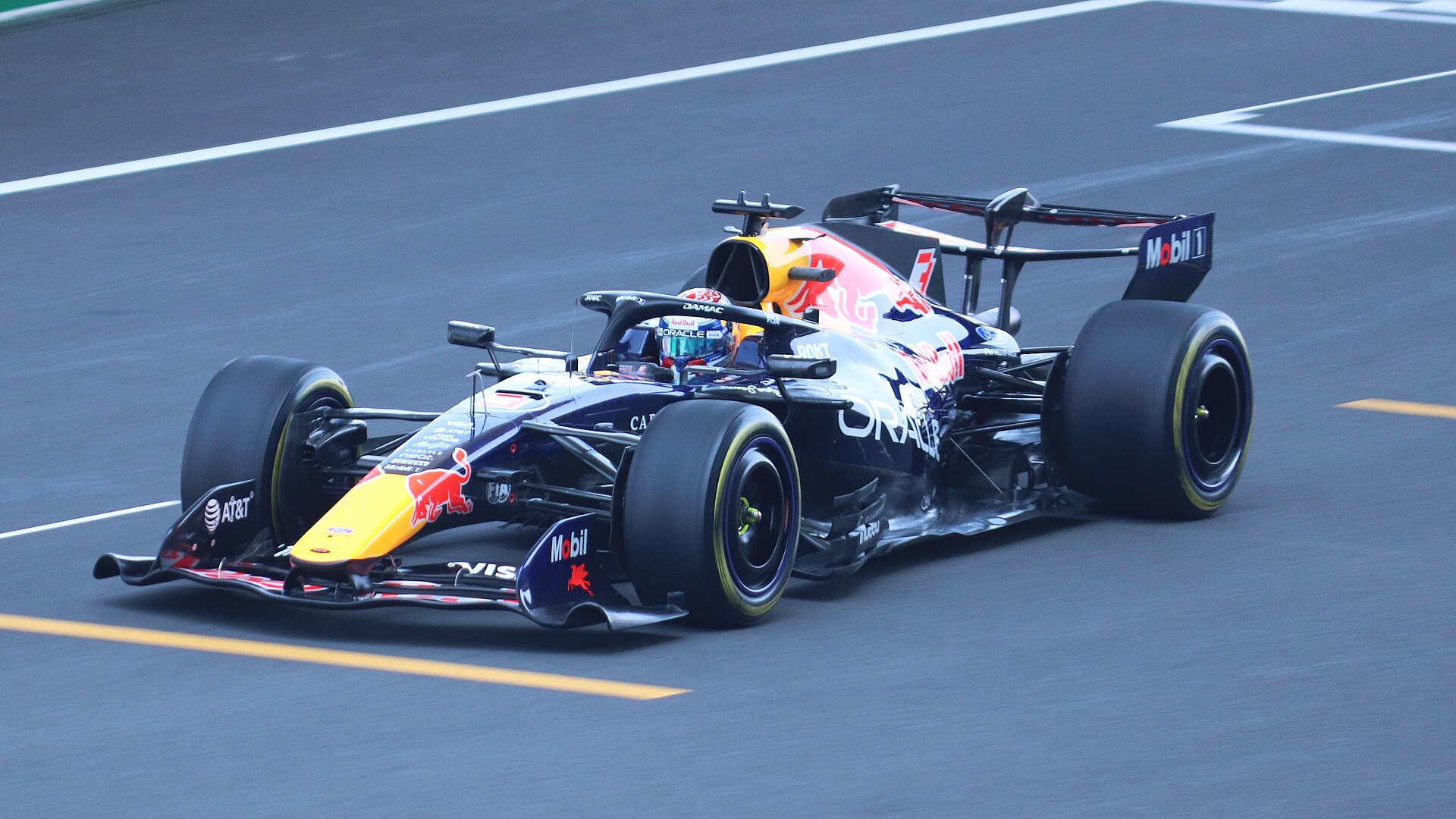
Red Bull's decision to become a Formula 1 power-unit manufacturer is usually framed as a technical gamble. Its latest UK accounts show that it should also be understood as the creation of a sizeable industrial business.
Red Bull Powertrains 2026 Limited reported turnover of £153.1m for the year ended 31 December 2025, up 9.5% from £139.8m. Average employment rose from 565 to 611, while total assets increased from £296.8m to £322.0m. Operating profit advanced from £9.2m to £12.3m, although gross profit fell from £36.5m to £24.6m.
Those figures were filed at Companies House on 5 October. They describe the dedicated company established for Red Bull's new-generation engine programme before the Red Bull-Ford power unit began racing in 2026. They do not disclose a standalone programme valuation, the division of investment between Red Bull and Ford, or the unit cost of an engine. They do, however, expose the operating scale behind a works-powertrain strategy that is often discussed only through lap time.
From customer spend to controlled capability
The strategic logic is straightforward. A customer team buys supply, service and a bounded degree of influence. A manufacturer controls architecture, integration priorities, development sequencing and a much larger share of the intellectual property. Red Bull chose the second model when the 2026 regulations created a clean-sheet opportunity and the power-unit cost cap placed a ceiling on recurring development expenditure.
The accounts show what that choice required before the first competitive season: a workforce larger than many specialist motorsport companies, an asset base above £300m and annual turnover above £150m. This is not a small engineering cell attached to a race team. It is a manufacturing and development enterprise with its own financial profile.
For suppliers, the distinction matters. A new manufacturer creates demand across casting, machining, test systems, battery technology, controls, metrology, simulation and quality assurance. Yet it also changes the relationship. Red Bull's objective is to internalise the capabilities that most directly determine power-unit performance and car integration. External companies therefore have to offer scarce process knowledge, capacity or speed that the in-house operation cannot reproduce economically.
Ford's published account of the partnership illustrates that boundary. The manufacturer says its advanced manufacturing support reduced one prototype-part lead time from 16 days to five, while its engineers were contributing to components for the combustion engine, charge-air system and energy-recovery systems. Red Bull Powertrains describes Ford's role more broadly across hybrid systems, batteries, controls, internal-combustion development and supply-chain expertise.
The value is not simply a badge or a cheque. It is access to industrial methods and global capability without surrendering control of the programme.
The balance sheet shows concentration as well as scale
Red Bull Powertrains 2026 ended 2025 with £18.3m of net assets, up from £12.9m. At the same time, it reported £294.5m of current liabilities and net current liabilities of £210.6m. Those figures should not be read as a conventional credit verdict on a standalone supplier. The company sits inside the wider Red Bull structure and the accounts need to be interpreted alongside related-party funding, contracted programme revenue and group support.
They nevertheless make a practical point for the supply chain: large, well-funded motorsport programmes can still be highly concentrated operating environments. A supplier assessing the opportunity should look beyond headline brand strength to payment terms, ownership of tooling, change-control obligations, forecast visibility and the consequences of a regulatory reset.
The company's government-reported payment-practices data adds useful context. For the six months to 30 June 2026, it reported an average payment time of 34 days. Seventy-four per cent of invoices were paid within 30 days, 21% in 31 to 60 days and 5% later than 60 days; 11% were not paid within the agreed terms. That is not a substitute for contract-level diligence, but it is a more relevant supplier signal than the team's sporting results.
Headcount is the durable investment
The 46-person increase in average employment is modest beside the total workforce, but strategically important. Facilities can be bought and equipment can be commissioned. A complete power-unit organisation needs combustion, electrical, controls, manufacturing, validation and programme-management expertise to work as one system.
That integration is the part competitors cannot quickly copy. Red Bull has placed chassis and powertrain development on the same Milton Keynes campus, shortening the organisational distance between the vehicle and engine groups. The 2026 regulations increase electrical output and make energy deployment central to lap-time delivery, so packaging and controls decisions cannot be cleanly separated from vehicle design.
The supplier opportunity therefore moves upstream. Winning work is less likely to depend on offering a generic component at the lowest price and more likely to depend on joining a tightly managed development loop: traceable materials, controlled manufacturing data, rapid iteration and the ability to validate changes without compromising homologation or cost-cap reporting.
Profit is useful, but capability is the real return
An £8.6m pre-tax profit on £153.1m of turnover is not the reason Red Bull built an engine company. The financial return has to be judged across the race teams, the Ford relationship, sponsor inventory, technical independence and the long-term value of the intellectual property.
The accounts cover 2025, before the power unit's first racing season, so they are a development-stage snapshot rather than a verdict on the programme. Turnover can include intra-group or programme-related activity that does not behave like external customer sales. The filing does not disclose the commercial value of branding, technology transfer or competitive advantage.
What it does show is that vertical integration is not synonymous with doing everything alone. Red Bull owns the programme architecture and employs the core workforce, while Ford supplies expertise, equipment access and manufacturing acceleration. Specialist suppliers remain necessary, but their value must be expressed in lead time, yield, repeatability and proprietary knowledge.
What teams and suppliers should take from it
For teams considering whether to internalise a critical system, Red Bull's numbers suggest three tests.
First, control must justify the fixed cost. More than 600 employees and £322m of assets create strategic freedom, but also a utilisation requirement that lasts beyond one regulation cycle.
Second, the boundary between owned capability and partner capability must be explicit. Ford's contribution works because it complements the programme rather than creating another layer of command.
Third, supplier governance becomes as important as supplier selection. The closer a vendor sits to performance-critical intellectual property, the more important data rights, change records, cyber security, tooling ownership and continuity planning become.
The same lesson applies to sponsors. Ford's role is commercially visible because it is technically credible. A partner that can point to a five-day prototype cycle, battery-system expertise or supply-chain capacity has a stronger activation story than one relying on logo exposure alone.
Red Bull's engine project began as an answer to dependency. The latest accounts show the price and the prize: a new industrial operation of meaningful scale, built to turn race-team demand into controlled intellectual property. Its success will ultimately be judged on track. For the motorsport industry, the more immediate consequence is a new buyer, manufacturer and talent centre whose supply-chain decisions will shape business well beyond two Formula 1 cars.
Sources and further reading
- Red Bull Powertrains 2026 Limited filing history, accounts filed 5 October 2026 ↗
- Red Bull Ford Powertrains official overview ↗
- Ford Racing powertrain manufacturing case study, 14 January 2026 ↗
- Formula 1 cost-cap explainer ↗
- CompanyStack accounts summary and payment-practices record ↗
- Wikimedia Commons image record ↗
- Creative Commons Attribution 4.0 licence ↗