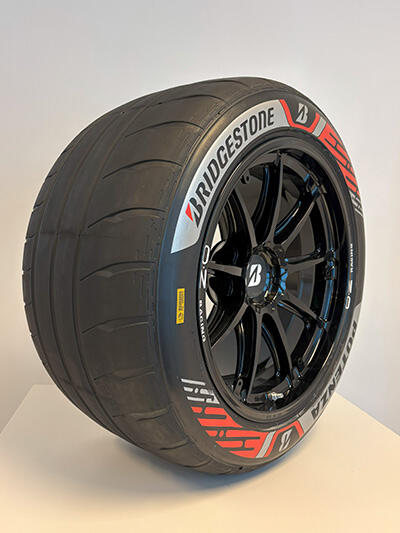
Bridgestone has converted its Formula E tyre contract into something broader than a component-supply programme. From the 2026/27 season it will provide every team with two GEN4 tyre specifications while also holding title rights to four race weekends across Mexico City, Berlin, Shanghai and Tokyo.
The company publicly presented the POTENZA GEN4 range in Rome on 30 September and published the programme details on 1 October. Its selection as Formula E's future sole supplier was announced in 2023, so the material development is not the award itself. It is the completed product launch, the disclosure of the manufacturing and logistics proposition, and the addition of a four-event commercial platform around the supply role.
For teams, the immediate issue is the delivery of a tyre for Formula E's largest performance step. For Bridgestone, the programme connects engineering evidence, sustainability claims, consumer-brand positioning and event rights. For Formula E and its promoters, the agreement puts a technical supplier into the commercial inventory of four different markets.
One contract, two jobs
The standard POTENZA GEN4 is an all-weather competition tyre intended to combine grip, durability and adaptability across street circuits and permanent venues. A separate POTENZA GEN4 for TYPHOON TYRE has been developed for heavy rain and standing-water conditions.
That two-product approach changes the operational model used in Formula E. Teams will need clear crossover guidance, allocation rules, temperature information and procedures for switching to the heavy-wet product. The series and promoters gain a better-defined option for severe weather, but they also add another product to transport, store, fit and manage at events.
The tyre is being introduced with a car that Formula E and Bridgestone say can accelerate from zero to 100km/h in 1.8 seconds, reach 335km/h and deliver 600kW, or 815bhp, through permanent active all-wheel drive. Those are published specifications rather than independently verified MRI test results. They nevertheless explain why tyre construction, heat control and load management become central to the GEN4 package.
Sole supply gives Bridgestone consistent exposure to every team and manufacturer, but it also concentrates accountability. Product consistency, wet-weather decisions, production continuity and trackside service will be judged across the whole championship. A problem cannot be isolated to one customer programme when the same supplier supports the entire grid.
The sustainability claim is now a procurement specification
Bridgestone says recycled and renewable materials account for 65% of the material allocated to every GEN4 tyre. The disclosed inputs include carbon black derived from end-of-life tyre pyrolysis oil, silica made from rice husks and natural rubber sourced through supply chains that have undergone the company's due-diligence process and third-party verification against the Global Platform for Sustainable Natural Rubber assurance system.
The company also says 100% renewable energy is allocated to the heat and electricity used in production. Formula E says freight will use lower-carbon logistics solutions with DHL.
These claims matter commercially because they move the tyre beyond a branding statement. Material traceability, energy procurement, certification and logistics reporting become part of what Bridgestone must deliver to the championship and what Formula E can present to manufacturers, sponsors and host cities.
The public releases do not include a full life-cycle assessment, tyre mass, expected number of sets per car, wear data or a like-for-like comparison with the outgoing product. The 65% figure should therefore be understood as an allocated material ratio under the disclosed certification approach, not as proof of a 65% reduction in total environmental impact.
That distinction is important for suppliers. Motorsport sustainability claims increasingly depend on auditable boundaries: which material is counted, how renewable energy is allocated, what mass-balance method is used and whether freight reductions are measured against a published baseline. The engineering story is strongest when the supporting procurement data can survive the same scrutiny as the performance data.
Four event titles make the supply visible
Bridgestone will hold title rights to Formula E's Mexico City round on 16 January 2027, Berlin double-header on 8-9 May, Shanghai double-header on 10-11 July and Tokyo finale on 24-25 July.
The selection gives the company four different commercial settings. Mexico City provides a major consumer and automotive market. Berlin links the programme to a European manufacturing and policy audience. Shanghai provides a Chinese technology and mobility platform. Tokyo gives Bridgestone a home-market finale with the championship narrative at its peak.
Those race titles allow the supplier to explain the product at the point of use. Trackside demonstrations, technical content, customer hospitality, dealer engagement and employee programmes can all be built around the same tyre that every car is running. The company is not activating an unrelated sponsorship beside its engineering work; it is buying event inventory that makes the engineering work easier to show.
Neither Bridgestone nor Formula E has disclosed the supply-contract value, title-rights fees, activation budget, hospitality allocation or exact term beyond describing the relationship as multi-year. The four events should not be treated as evidence of the full commercial value without those details.
What teams and promoters have to deliver
Teams will need representative tyre information early enough to shape simulation, suspension set-up, energy management and driver preparation. A new tyre arriving with a higher-output car can change the validity of existing models. The separate heavy-wet specification also requires procedural practice because performance, pressure and temperature behaviour will differ from the standard product.
For promoters, the title partnership adds deliverables beyond venue signage. Each market must translate the global agreement into usable local assets: customer programmes, retailer or dealer participation, technical storytelling, fan education and hospitality. The Tokyo finale may support a different audience and objective from Berlin or Mexico City even though the same master brand is present.
Formula E must coordinate those local plans while protecting the neutrality expected of a sole supplier. The event platform should create commercial value for Bridgestone without compromising consistent technical service to teams or implying that the title races receive a different competition product.
Specialist suppliers will sit underneath both sides of the programme. Tyre fitting equipment, transport, temperature monitoring, event branding, content production, measurement and hospitality all require delivery across multiple jurisdictions. Businesses that can document emissions, trace materials and maintain identical operating standards between events will be more valuable than vendors offering only a low unit price.
Measurement should connect engineering and rights
The programme creates several layers of return that should be measured separately. Technical measures could include batch consistency, operating-window accuracy, wet-weather performance, failure rates, fitting time, freight reliability and team satisfaction. Sustainability measures need documented material allocation, verified supply-chain compliance, production-energy accounting and logistics emissions.
Commercial measures can then track event reach, hospitality attendance, customer and dealer participation, content engagement, brand consideration and the performance of each title market. Combining all of those measures into one exposure figure would hide whether the supply programme and the event programme are doing their respective jobs.
The most useful result for Bridgestone will be a repeatable chain of evidence: a tyre developed for GEN4, produced and moved under defined sustainability controls, proven across the championship and explained through four high-profile event platforms. Formula E gains a supplier capable of carrying technical and commercial responsibility at the same time.
That makes the agreement a useful model for other championships. A sole-supply contract can create more value when the supplier receives carefully selected rights to demonstrate the product and engage customers. The risk is that every extra right adds delivery work and measurement obligations. Bridgestone's Formula E return will be judged not only by the tyre's pace, but by whether the technical, sustainability and event programmes operate as one credible system.