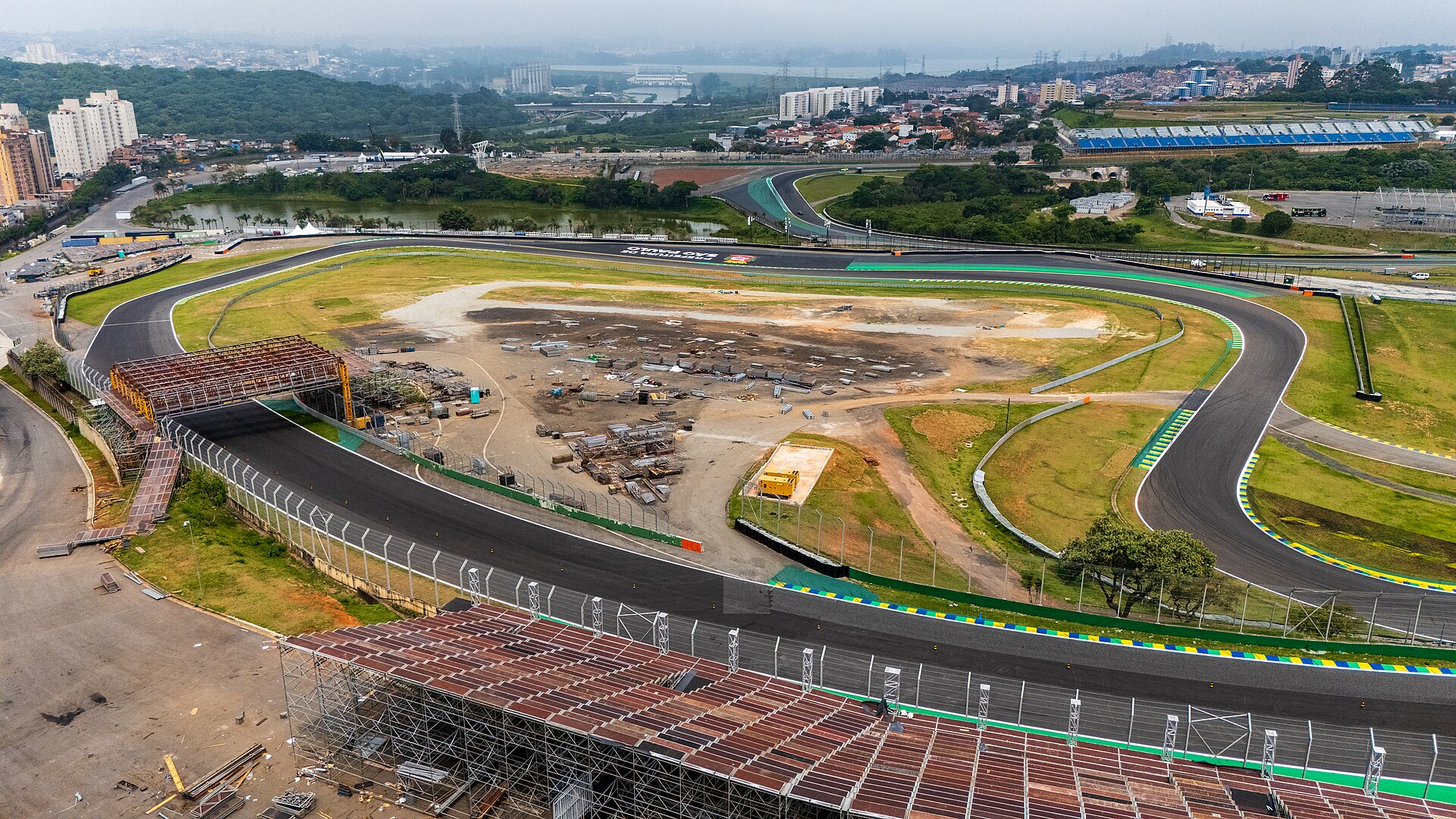
Formula 1 will continue racing at Interlagos through 2035 after signing a five-year extension with the São Paulo Grand Prix and the city of São Paulo.
The announcement on 7 November extends an agreement that previously ran to 2030. Because the 2026 event has now taken place, the new horizon gives the promoter nine guaranteed annual editions from 2027 through 2035. São Paulo says it has already directed R$500 million to modernising the municipal circuit, while Formula 1 says the mayor’s office will continue making significant investments under the extended relationship.
Those figures do not disclose what the race rights cost. Neither Formula 1, the city nor the promoter published the sanctioning fee, escalation formula, public subsidy, revenue share, termination rights, delivery obligations or future capital budget. The R$500 million is a disclosed venue-modernisation programme, not a stated payment to Formula 1.
That distinction is essential. The commercial importance of the extension is not that it proves a return on every real invested. It is that a municipal owner and private promoter now have enough calendar certainty to plan infrastructure, hospitality, ticketing, supplier contracts and sponsor inventory as a multi-year asset programme rather than a sequence of annual events.
Nine editions create an investment runway
São Paulo Grand Prix chief executive Alan Adler described the agreement as nine years in which the organisation can plan, execute and improve. That is the operational value of the early renewal.
Major venue projects rarely fit neatly inside one race cycle. Design, approvals, procurement, construction and commissioning can cross multiple seasons. A promoter facing a short rights horizon must either delay work, demand rapid payback or accept that an asset may outlive the event contract that justified it. Extending to 2035 reduces that mismatch.
Dividing the disclosed R$500 million modernisation programme by the nine guaranteed post-2026 editions produces a rough planning denominator of R$55.6 million per event. It is not an annual expense, an accounting allocation or a rights fee. The work has already been delivered in stages, will benefit other events and leaves a public asset after each Grand Prix. The calculation simply shows how much more manageable a large capital base looks when commercial use is secured across nine editions rather than renegotiated close to expiry.
For contractors, the longer horizon can change the shape of bids. Temporary structures can be compared with permanent construction over a known period. Maintenance packages can span several events. Suppliers can invest in reusable stock, local labour and storage. The promoter can sequence upgrades between race dates instead of attempting every improvement in one off-season.
Certainty does not remove political or execution risk. The circuit is city-owned, public investment remains subject to budgets and oversight, and Formula 1 standards can continue to change. The parties have not disclosed whether the extension contains minimum capital commitments or milestones. A nine-year horizon is therefore an opportunity to plan, not a guarantee that every proposed project will be funded.
The capital programme expands sellable capacity
The city’s R$500 million programme includes track resurfacing, modernised pit facilities and a 22,000-square-metre Hospitality Center with capacity for 6,000 people. Grandstands in sectors A, D and OTC/Laranjinha received 7,812 additional seats. São Paulo estimates daily event capacity can increase from 97,000 to about 110,000, a 13.4 per cent rise.
This is not merely an attendance project. Each type of capacity produces a different commercial product. Grandstand seats create ticket yield. Hospitality space can be packaged for teams, series partners, local sponsors, corporate buyers and tourism programmes. Better garages and working areas improve the delivery environment for competitors and technical suppliers. Permanent facilities can support non-F1 events, conferences and track activity outside Grand Prix week.
The new hospitality footprint is especially significant. Six thousand guests represent a substantial B2B inventory pool if the space can be segmented, serviced and sold at appropriate price points. The extension gives the promoter time to build renewal data: which clients return, how suites are used, what food-and-beverage and transport services they require, and which event-day experiences create repeat demand.
That information matters to sponsors. A long-term partner can plan client programmes over several seasons rather than treating each year as a fresh launch. Rights can be linked to fixed spaces, recurring guest allocations, content production and local business events. Suppliers can quote against a more predictable operating model for catering, fit-out, signage, connectivity, security, cleaning and guest transport.
The city has also identified separate work outside the venue, including R$100.5 million for 9.1 kilometres of the Interlagos–Teotônio Vilela corridor and a planned R$57.9 million duplication of the Jurubatuba bridge. These figures should not be added automatically to the R$500 million circuit programme without examining project scope and accounting treatment. They show, however, that event delivery depends on an urban system as well as the gates of the track.
For other promoters, this is a useful procurement lesson. Increasing venue capacity without addressing arrival, public transport, pedestrian flow and post-event dispersal can transfer the bottleneck outside the circuit. São Paulo says 68 per cent of the 2025 audience used public transport. That makes mobility performance part of the event product and a measurable input to future capacity decisions.
Growth gives the extension a commercial base
Formula 1 and the city cite 303,627 attendees for the 2025 weekend, up from 291,717 in 2024. The municipal series says attendance grew from 181,711 in 2021 to 303,627 in 2025, an increase of about 67 per cent. That is equivalent to compound annual growth of roughly 13.7 per cent across four years.
The same official data put economic impact at R$960 million in 2021 and R$2.3 billion in 2025, an increase of about 140 per cent, while associated jobs rose from 9,100 to 23,700, about 160 per cent. Formula 1 says the 2025 economic-impact figure was 9.7 per cent above the previous record.
These are organiser and municipal impact figures, not audited event revenue. Economic impact measures activity across hotels, restaurants, transport, retail and services; it is not the promoter’s turnover, the city’s tax receipt or cash available to repay capital expenditure. Comparing R$500 million of multi-year public assets directly with R$2.3 billion of one-year gross economic activity would therefore be misleading.
What the figures do demonstrate is demand growth at a scale that can support more inventory. Attendance increased before the newly disclosed daily capacity is fully exploited. The promoter can now test whether additional seats, hospitality and fan products convert that demand into sustainable yield without weakening experience quality.
The official São Paulo GP partner material adds another commercial measure. It says the 2025 event generated US$516 million in media return for the city, reached more than 180 countries, injected more than R$2.3 billion into the local economy and supported 23,683 jobs. The promoter does not publish the valuation methodology, so the media-return number should be treated as its claim rather than a directly comparable cash benefit.
Formula 1 also reports a Brazilian fanbase of 75.8 million, with women representing 44 per cent and people under 35 accounting for 41 per cent. For partners, that demographic profile supports a broader proposition than traditional motorsport reach. The value can extend into consumer products, financial services, technology, travel, entertainment and recruitment, provided each sponsor has an activation plan rather than relying on aggregate audience size.
Contract duration can improve supplier economics
The extension is relevant beyond the rights holder and promoter. A Grand Prix operates through layered supply chains that include temporary structures, power, broadcast infrastructure, timing, telecommunications, catering, security, transport, sanitation, ticketing, credentialing, signage and specialist labour.
When the event horizon is short, suppliers often price in mobilisation risk and protect themselves against uncertain renewal. Longer visibility can support framework agreements, reusable assets and workforce development. It may also justify local inventory that would be uneconomic for a one-off event.
The benefit is not automatic. Multi-year contracts can lock in weak specifications, reduce competition or expose suppliers to inflation and currency movements. São Paulo and its promoter will need packages that preserve performance incentives and allow scope to evolve. Formula 1’s technical, hospitality and broadcast requirements in 2035 will not be identical to those in 2027.
Good procurement would separate stable requirements from fast-changing ones. Civil maintenance, venue cleaning and certain logistics can be forecast over several years. Digital systems, fan data, broadcast connectivity and security technology may need shorter review cycles. The rights horizon should permit better contracting, not nine-year commitments for every category.
Teams can also benefit from predictable venue standards. Modernised pits, reliable connectivity, access planning and freight procedures reduce operational friction. Those gains are difficult to monetise publicly, but they influence how many temporary fixes teams and championship suppliers must bring to an event.
The promoter can sell continuity, not only scarcity
Interlagos has historically benefited from scarcity: it is Formula 1’s only current South American round. The 2035 agreement adds continuity to that position.
For sponsors, a guaranteed annual platform allows campaigns to mature. A brand can begin with trackside or hospitality rights, test customer and employee programmes, then expand into fan zones, content, city activations or regional distribution. The promoter can create renewal ladders instead of reselling the entire proposition each year.
The fixed horizon also supports destination marketing. Hotels, airlines, tourism bodies and corporate travel providers can build products farther in advance. Calendar certainty is particularly valuable when room blocks, premium transport and large client programmes compete with other city events.
There is still a concentration risk. Formula 1 is the anchor that helps justify venue investment and drives premium demand. A long contract may encourage the operator to optimise too heavily around one weekend. The more durable strategy is to use F1-funded improvements to widen the circuit’s year-round event base, including other championships, testing, corporate activity and non-racing uses.
São Paulo already hosts Formula E and the World Endurance Championship as well as Formula 1. Shared infrastructure can improve utilisation, but each event has different audience, paddock and commercial needs. The city and circuit should measure how capital assets perform across the calendar rather than attributing every benefit to one race.
What the industry should watch
The first indicator is the next capital plan. Formula 1 says significant investment will continue, but no future amount or timetable was announced. Promoters and suppliers should watch for procurement notices, permanent-versus-temporary decisions and upgrades that expand commercial capacity rather than simply maintaining compliance.
The second is yield. More seats and hospitality only create value if they are sold at sustainable prices and delivered without damaging access, service or viewing quality. Attendance totals need to be read alongside average ticket value, hospitality occupancy, renewal and guest satisfaction, none of which was disclosed.
The third is utilisation. A 22,000-square-metre hospitality asset has a stronger business case if it earns revenue beyond Formula 1 week. The number of non-F1 event days, corporate bookings and repeat users will show whether the investment behaves as a venue asset or an annual Grand Prix cost.
The fourth is supplier structure. Multi-year visibility should create opportunities for local businesses and specialist motorsport vendors, but only if packages are accessible, requirements are published early and performance is measured. Large bundled contracts can provide efficiency while excluding smaller capable suppliers.
The fifth is public accountability. The city’s economic-impact and employment claims are central to the extension narrative. Publishing consistent methodology, actual spending, tax outcomes and asset utilisation would allow residents and the industry to distinguish gross economic activity from public financial return.
Finally, watch the undisclosed rights economics. A long agreement can reduce calendar risk but may include fee escalation and delivery obligations that grow faster than revenue. Without the sanctioning fee and contract terms, it is impossible to assess the promoter’s margin or the city’s full exposure.
The São Paulo renewal is therefore best understood as an asset-duration decision. Formula 1 secures a strategically important market and a proven crowd. The promoter gains nine editions of planning certainty. The city gets a longer commercial runway for a R$500 million venue programme whose value depends on hospitality yield, supplier efficiency and use beyond race weekend. The next test is not whether Interlagos can fill the grandstands. It is whether that certainty can be converted into durable venue economics.
Sources and further reading
- Formula 1 official contract announcement, 7 November 2026 ↗
- Formula 1 corporate announcement, 7 November 2026 ↗
- City of São Paulo contract and investment announcement, 7 November 2026 ↗
- City of São Paulo Interlagos investment report, 5 November 2026 ↗
- São Paulo Grand Prix official commercial overview, 4 November 2026 ↗
- Folha de S.Paulo independent report, 7 November 2026 ↗
- ge independent report, 7 November 2026 ↗
- Agência Brasil independent report, 7 November 2026 ↗
- Licensed image record: ProtoplasmaKid, CC BY-SA 4.0 ↗