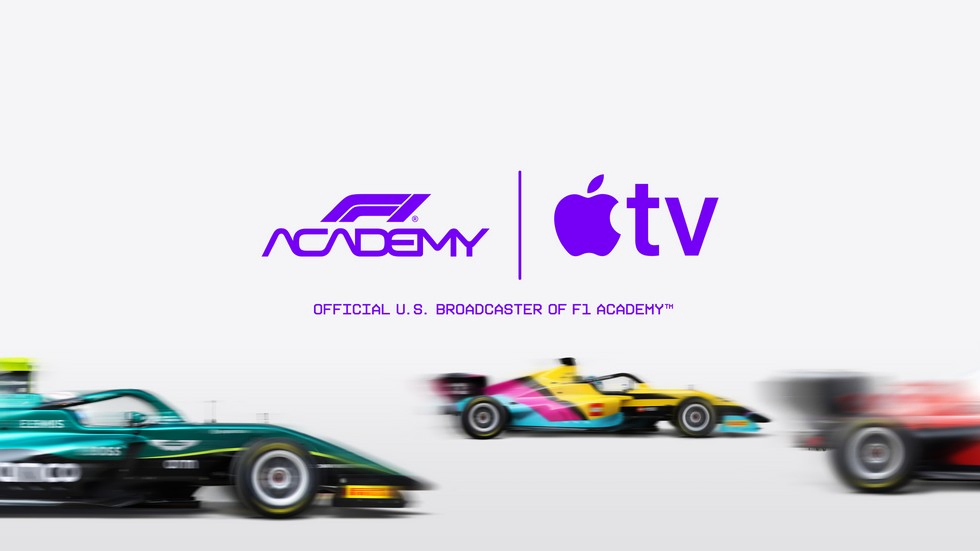
Apple has extended its Formula 1 relationship to F1 Academy, making every qualifying session and race in the all-female development series available exclusively on Apple TV in the United States from 2027.
The agreement is narrower than Apple's five-year Formula 1 contract and potentially more important than its size suggests. It adds a complete championship to an existing subscription relationship without requiring another top-tier rights acquisition. For F1 Academy, it places live racing inside the same U.S. platform that already carries Formula 1 and gives teams, drivers and partners a clearer route to a large motorsport audience.
The announcement does not disclose a rights fee, contract duration, production obligations, audience guarantees, advertising inventory, data access or whether the F1 Academy term ends with Apple's Formula 1 agreement. Apple and the series also do not state how much promotion F1 Academy will receive inside the service or whether any sessions will be available free.
Those omissions matter because availability is not the same as discovery. A support championship can sit inside a major platform and still be difficult to find. The business test is whether Apple treats F1 Academy as a distinct live product with its own entry points, promotion and measurement, or simply as additional content attached to Formula 1.
For teams, sponsors and promoters, the new arrangement creates opportunity but not yet a valuation. The value will emerge from how many U.S. viewers watch, how often they return, what they watch beyond the race, whether commercial partners can activate around that audience and how the series reports performance without hiding behind Formula 1's much larger numbers.
A rights extension, not a new standalone platform
Apple's original Formula 1 agreement runs for five years from 2026 and covers every practice, qualifying session, Sprint and Grand Prix in the United States. Formula 1 said selected races and all practice sessions could be made available free in the Apple TV app, while F1 TV Premium would be included for Apple TV subscribers.
The F1 Academy announcement uses different language. It confirms every qualifying session and race from 2027 and calls Apple TV the exclusive U.S. home, but it does not describe a five-year term, free windows or an F1 TV entitlement. The commercial perimeter should therefore be read from the F1 Academy agreement itself rather than assumed from the Formula 1 contract.
That distinction protects both buyer and seller. Apple can add a related property without publicly committing to the same economics as Formula 1. F1 Academy can gain distribution without implying that its rights have been absorbed into the senior championship for the full term.
The structure also leaves room for later expansion. Apple could add shoulder programming, driver profiles, archive content or integrations with its wider Formula 1 coverage. F1 Academy could use U.S. performance to support negotiations in other markets. None of those outputs is guaranteed by the announcement.
For rights holders, this is an example of controlled product expansion. The initial anchor property establishes the platform, production workflow and subscriber relationship. A related series can then be added with lower distribution friction. The incremental cost may be smaller than launching an unrelated sport, but the buyer still needs editorial, scheduling, metadata, quality-control, customer-support and promotion capacity.
Seven rounds create more than race inventory
F1 Academy's 2027 calendar contains seven rounds, all on Formula 1 weekends. Jeddah, Shanghai, Montreal, Silverstone and Budapest are followed by two U.S. rounds at Austin and Las Vegas. Each event creates live qualifying and race inventory, but the commercial opportunity extends across the full week.
Apple can use the series to lengthen engagement around a Grand Prix weekend. A viewer who enters for Formula 1 can be shown an earlier F1 Academy session, a driver feature or a replay. A viewer who follows an F1 Academy driver can be directed toward the senior championship. That reciprocal discovery is one of the main reasons a related rights extension can be worth more inside a bundle than on a separate service.
The schedule also creates a repeated narrative. Drivers accumulate results across seven markets, teams develop competitive arcs and partner-backed cars remain visible through a season rather than a one-off event. Live sport is useful to subscription platforms partly because it creates appointments; a development series adds more of them around an already established weekend.
The two U.S. rounds have a separate role. Austin and Las Vegas give Apple, F1 Academy and commercial partners physical activation opportunities in the same market as the media agreement. Hospitality, retail, driver appearances, partner content and customer acquisition can be coordinated with the stream. The other five rounds can still serve U.S. subscribers, but require stronger time-zone communication and on-demand presentation.
Teams and sponsors should not count every session as equal exposure. Start times, home-page placement, push notifications, replay prominence and the gap to Formula 1 programming will affect actual consumption. A rights package measured only by the number of hours supplied can overstate the commercial result.
The series already carries sellable brand inventory
F1 Academy is not arriving on Apple TV as an unbranded feeder category. All current Formula 1 teams have reaffirmed multi-year support for a driver and livery, and Cadillac is due to join the sponsorship structure in 2027. Official partners also back drivers, cars and series-level programmes.
That model makes distribution directly relevant to partner value. A logo on a car or race suit becomes more useful when live sessions have a predictable U.S. home. Driver stories can support partner content, social activity and hospitality, while the link to Formula 1 teams gives existing sponsors a recognisable entry point.
The challenge is rights separation. A Formula 1 team sponsor, an F1 Academy driver backer, a series partner and Apple may each have different permissions around footage, marks, data, talent and paid media. The new distribution agreement does not automatically expand those permissions.
Commercial teams should map each asset before selling an activation. They need to know whether a partner may use race clips, whether Apple branding can appear in campaign material, whether drivers are available, which territories are covered, how long content may remain live and whether exclusivity conflicts with another category partner.
The same discipline applies to visibility claims. Formula 1 team involvement can make F1 Academy attractive, but a sponsor should not be sold the total Formula 1 audience as if every viewer will see the support series. The defensible metric is the audience and engagement generated by the F1 Academy content and activation itself.
Discovery is now the most important product decision
Apple has already built a dedicated Formula 1 experience with live events, replays and multiple feeds. F1 Academy can benefit from that infrastructure only if the service gives it a clear route into the interface.
The minimum product should include its own series page, complete schedule, notifications, live tiles, replays, standings and driver information. Cross-promotion from Formula 1 event pages can create discovery, but F1 Academy also needs a destination that does not disappear when the Grand Prix becomes the dominant live event.
Metadata quality becomes commercial infrastructure. Correct driver names, teams, partner-backed liveries, session labels and start times allow search, recommendations and automated promotion to work. Weak metadata can reduce discoverability even when the video is technically available.
On-demand presentation is especially important for Jeddah, Shanghai and European rounds viewed from U.S. time zones. Spoiler control, condensed replays and clearly separated sessions can convert an inconvenient live start into useful viewing. The announcement does not specify those features for F1 Academy.
Free sampling is another open question. Apple's Formula 1 agreement includes selected free access, but the F1 Academy release only says that a U.S. Apple TV subscription is required. A free race, qualifying session or short-form window could widen the top of the funnel; a fully paid position could strengthen subscription value. Either strategy can work, but teams and sponsors need to know which audience is realistically reachable.
Measurement must separate reach from bundle value
Apple and F1 Academy have not announced audience targets. That is commercially prudent at launch, but the partners will need a measurement framework before sponsors renew or increase spending.
The first layer is reach: unique viewers, average minute audience, peak concurrency and replay consumption. The second is depth: sessions watched per user, completion, repeat viewing and movement between F1 Academy and Formula 1 content. The third is commercial action: partner-content engagement, ticket or merchandise referrals, hospitality leads and other agreed conversions.
Demographic data can help explain whether the property is adding an audience or merely serving existing Formula 1 subscribers. Apple's announcement cites the 2025 Global F1 Fan Survey, in which 23% of surveyed fans said they followed F1 Academy and the figure reached 42% among women. Those survey results establish interest, not 2027 U.S. viewing, and should not be used as a substitute for platform data.
Partners also need comparable definitions. A live start, a two-minute view and a completed replay are different outcomes. Social clips and Apple TV streams should not be combined into one number without explaining the units. Exposure estimates based on logo duration should be separated from attention and brand-lift research.
Apple may reasonably protect subscriber-level data. F1 Academy and its commercial partners still need an agreed reporting layer that allows them to evaluate the property. Aggregated, privacy-safe reporting can show programme performance without transferring customer identities.
Production and editorial control shape sponsor value
The agreement does not say who pays for or controls the 2027 world feed, commentary, studio presentation, graphics or additional features. Those decisions affect both cost and commercial opportunity.
A clean international feed can deliver efficient distribution, while a U.S.-specific presentation can provide stronger context for new viewers. Driver features and technical explainers may make the series easier to follow, but require production resources beyond carrying the live pictures.
Editorial independence also matters. Teams and sponsors benefit from visibility, but viewers need credible competition coverage rather than a sequence of partner messages. The strongest commercial product will integrate brands around the sport without weakening the reason people watch.
F1 Academy's personal stories are a valuable part of the property. An independent interview published with the announcement emphasised the role of driver narratives in building fan bases. Apple can develop that layer through interviews, profiles and cross-promotion, but the drivers should have clear consent, usage and compensation arrangements when content moves beyond ordinary race coverage.
Teams should plan for additional media demand. A larger platform can create more requests for access, interviews, archive footage and social collaboration. That opportunity requires staff, approvals and a calendar that protects preparation time. Small development-series operations can be commercially stretched if new rights are activated without new resources.
The 2026 distribution baseline needs a clean transition
F1 Academy's published 2026 viewing guide listed live distribution through its social channels and F1 TV, with Apple and a C15 FAST channel identified for the United States. The 2027 announcement says Apple TV will be the exclusive U.S. home.
The parties will need to explain the transition before the first round. Fans should know whether U.S. access through social platforms, F1 TV or FAST distribution changes. Partners need the same clarity because campaign plans, audience expectations and clip distribution can depend on the previous model.
Exclusivity can concentrate marketing and make the destination easier to understand. It can also reduce casual reach if open streams disappear. The commercial balance depends on Apple's promotion, any free sampling and the conversion rate from existing Formula 1 subscribers.
Internationally, the agreement is not a template unless separate rights are available and local market conditions support it. F1 Academy continues to need broad distribution outside the United States. A sponsor with global rights should receive a territory-by-territory plan rather than an assumption that Apple carries the series everywhere.
What teams, partners and promoters should negotiate now
Teams should request a 2027 media calendar with session windows, production deadlines, talent obligations and the expected promotional moments around each event. They should also identify which driver and team assets may be used by Apple and F1 Academy, for how long and in which media.
Sponsors should add distribution-specific measures to their agreements. Useful clauses include minimum reporting frequency, access to aggregated audience data, treatment of cancelled sessions, make-good principles, clip and still-image permissions, partner-content slots and approval times.
Promoters at Austin and Las Vegas should connect on-site activation to the stream. A physical experience is more valuable when remote viewers can understand it and attendees can continue the story after the event. Promoters outside the U.S. can still benefit from Apple's coverage, but should distinguish U.S. media value from local ticketing and host-market broadcast objectives.
F1 Academy should preserve its own rights history. Separate reporting, production records and commercial outcomes will help the series price future U.S. and international agreements. If all value is reported only inside Formula 1 or Apple TV totals, the property may gain reach while losing evidence of what it contributes.
Apple should define discovery ownership. Someone needs responsibility for placement, notifications, search, cross-promotion and the on-demand shelf after every event. A distribution contract can secure carriage; a product operating plan secures attention.
The 2027 scorecard
The first indicator will be interface prominence before Jeddah. A visible series page, pre-season promotion and an understandable schedule will show that Apple is treating F1 Academy as a product rather than a file delivery.
The second will be the U.S. access model. The industry should watch whether Apple offers free sessions or highlights, how F1 TV is presented and whether former social or FAST access remains available.
The third will be audience separation. F1 Academy needs its own reach, viewing and retention data, even if the series also contributes to a wider Formula 1 bundle.
The fourth will be sponsor integration. Measurable content, hospitality and customer activity will matter more than the number of logos transferred into the broadcast.
The fifth will be driver storytelling and resource. More coverage should create opportunities for drivers, but those opportunities need clear rights, scheduling and operational support.
The sixth will be renewal evidence. By the end of 2027, the series should be able to show whether Apple TV generated new viewers, deeper Formula 1 engagement, stronger partner outcomes or some combination of the three.
From visibility promise to rights product
The Apple agreement gives F1 Academy something many development series lack: a simple U.S. destination aligned with the top championship its audience already follows.
That is a meaningful commercial step, but the platform name alone does not create value. Discovery, editorial treatment, rights clarity and separate measurement will determine whether the series becomes a real part of the subscription proposition.
For Apple, the extension can increase live inventory and deepen the Formula 1 relationship without building another sports destination from zero. For F1 Academy, it can turn growing interest into a more dependable media product for teams, drivers and sponsors.
The opportunity is strongest if both sides resist the convenience of aggregate claims. Formula 1's reach can open the door, while F1 Academy's own audience and stories must justify what happens next. If the 2027 reporting can demonstrate that contribution, the agreement will do more than improve visibility. It will give the series evidence with which to sell its next rights cycle.
Sources and further reading
- Apple official F1 Academy media-rights announcement, 19 November 2026 ↗
- F1 Academy official U.S. Apple TV announcement, 19 November 2026 ↗
- Apple official Formula 1 U.S. broadcast agreement, 17 October 2025 ↗
- F1 Academy official 2027 calendar, 9 November 2026 ↗
- F1 Academy official 2026 viewing guide ↗
- F1 Academy official Formula 1 team-support announcement ↗
- Teen Vogue independent interview with F1 Academy leadership and drivers, 18 November 2026 ↗