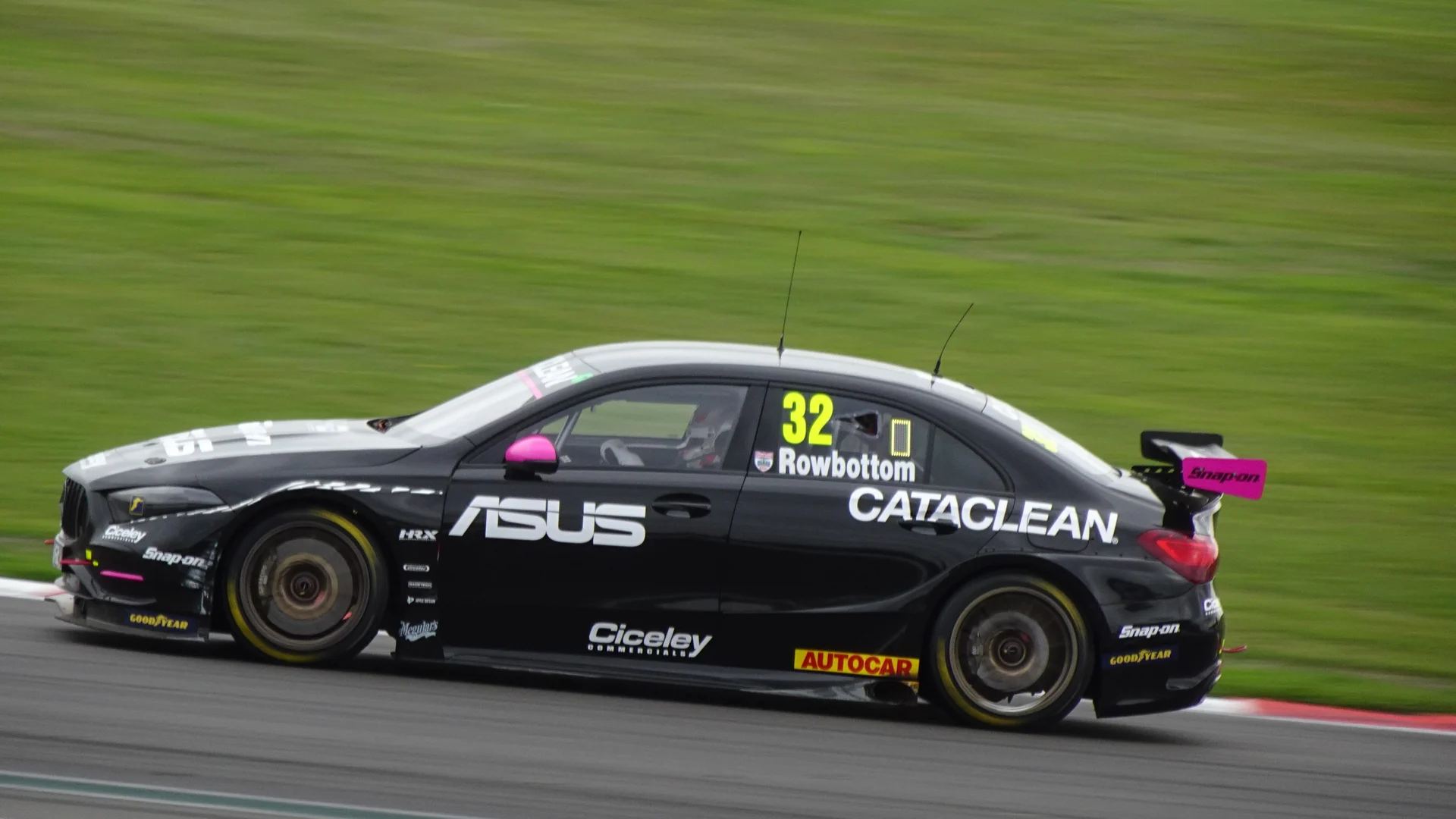
Cataclean has acquired the business structure, two Mercedes-AMG A35 race cars and associated equipment used by CPRL in the British Touring Car Championship. The transaction moves the physical platform out of Plato Racing Limited's administration, but it does not yet guarantee a 2027 programme.
That distinction is the central business issue. Cataclean told TouringCarTimes that it wants the team back on the grid in 2027 and beyond, while also saying commercial and operational considerations must be resolved before it makes a definitive commitment. The acquisition preserves the means to race; it does not, by itself, fund the next season.
The deal also closes a loop in which Cataclean was sponsor, majority shareholder, secured lender, rescue financier and ultimately buyer. The administrator's proposals say Cataclean held 51% of Plato Racing, was owed about £3.2 million when the company entered administration and advanced further money so the team could finish 2026.
The sale price has not been disclosed. Cataclean has also declined to say how the transaction affects its secured creditor claim. Those omissions prevent a reliable calculation of recovery, acquisition cost or the capital still required for 2027.
An asset rescue, not a rescue of the old company
The transaction should be read as an acquisition of assets and operating infrastructure, not as evidence that Plato Racing Limited has been restored as a going concern.
The administrator's 6 November proposals state that rescuing the company itself was not achievable because of its liabilities and the absence of further investment. The intended route was to continue trading, preserve value and sell the business or assets for a better creditor outcome than a break-up liquidation.
Cataclean's purchase appears to complete that sale process. The administrator's next report is expected to disclose the purchaser and consideration to creditors, but that report was not available with the acquisition announcement. Until it is published, outsiders cannot determine whether cash changed hands, debt was set off, liabilities transferred or other terms formed part of the consideration.
This matters to suppliers. Buying cars, equipment and an operating structure does not automatically mean assuming every obligation of the company in administration. Creditors need the administrator's report and their own contracts to understand whether they have a claim against the old company, a new agreement with the buyer or both.
The legal entity, championship entrant and trading identity for any 2027 programme have also not been named. TOCA said in August that the team would operate through a new entity without Jason Plato's further involvement in management or ownership, but Cataclean has not published the final ownership, board or management structure.
The filing shows why sponsorship alone was insufficient
Plato Racing was incorporated in July 2025 to launch a two-car BTCC programme for 2026. The administrator's proposals say the team recorded losses of about £917,000 from incorporation to administration, excluding approximately £2.3 million of capital expenditure related to building the race cars.
The filing says the business expected sponsorship agreements to be its primary funding source, but received only limited sponsorship income. Cataclean supplied secured lending under a March 2026 debenture and was owed about £3.2 million by 12 August. RML Group, which built and supported the cars, was owed more than £350,000.
Those figures are extracted from unreconciled company records and were not audited by the administrators. They nevertheless show the scale mismatch that the buyer now has to solve: a competitive two-car programme carried substantial fixed investment and operating cost, while external commercial income did not develop quickly enough.
The lesson for new teams is not simply that BTCC is expensive. It is that capital expenditure, race operations and sponsorship timing must be financed as one system. Cars and workshop capability have to be paid for before a new property has produced a full season of results, content, hospitality and partner renewals.
For sponsors considering ownership or secured funding, the case shows how quickly exposure can move beyond a rights fee. Cataclean's brand was already on the cars, but it also became the principal lender and ultimately controlled the rescue process as qualifying floating-charge holder.
That can protect continuity and create influence. It also concentrates risk. A sponsor-led owner needs motorsport governance, cash forecasting and asset security alongside marketing expertise.
Finishing 2026 protected the asset base
The administrators chose to keep the team racing after their appointment rather than close immediately. Cataclean provided a non-recourse facility of up to £500,000, with provision for further lending. By 6 November, the filing says £515,000 had been advanced.
The trading account recorded £145,859.71 of receipts and £609,879.21 of costs, producing a provisional £464,019.50 deficit before Cataclean's funding. Those numbers were still subject to reconciliation and the trading period had not fully closed.
Commercially, the deficit bought continuity. Staff and contractors remained engaged, the cars completed the season under the CPRL name, suppliers continued supporting the programme and the assets were demonstrated in competition rather than parked in a workshop.
The result was a stronger sale proposition. Motorsport assets lose value when the people who understand them leave, spares become incomplete and championship relationships go cold. Keeping the programme active preserved operating knowledge as well as hardware.
It also increased the rescue exposure. Every additional event required parts, insurance, transport, labour and supplier support. Cataclean's willingness to finance the completion of the season therefore became part of the acquisition strategy, even though the buyer did not know publicly at that stage what final structure would emerge.
The two cars are only the visible part of the purchase
The confirmed asset perimeter includes the two Mercedes-AMG A35 race cars and associated equipment. Cataclean also described acquiring the business structure and infrastructure, language that suggests an operating platform wider than the vehicles alone.
The administrator's filing identified three employees at appointment, supported by contractors, and a base at RML's Wellingborough premises. Cataclean says safeguarding employment was a priority, but it has not disclosed how many people transferred, which contractor relationships continue or where the 2027 operation would be based.
The status of the RML concession and future technical support is equally important. The cars were built and supported under an agreement with RML, and the administrator identified RML as the principal supplier. Ownership of the physical cars does not answer who will engineer, manufacture parts for or maintain them next season.
TOCA licences are another separate asset class. Plato Racing was awarded two licences for 2026, but Cataclean has not said whether those rights transferred, will be reissued or require a new application. A buyer can possess cars and equipment without yet possessing every permission needed to enter them.
The same applies to data and intellectual property. Setup history, simulation models, component drawings, software access and supplier know-how may be controlled by different agreements. A credible 2027 plan needs a documented right to use the technical information required to operate the cars, not just physical custody of them.
A sponsor-to-owner model changes the commercial proposition
Cataclean entered the project as the title sponsor and majority shareholder. Acquiring the assets gives it a chance to rebuild the team around a clearer ownership and funding structure, but the commercial proposition has to move beyond preserving its own branding platform.
A sustainable programme needs multiple revenue lines: partner rights, hospitality, business development, driver-linked funding, merchandise and possibly technical or customer services. The administrator's account of limited sponsorship income makes commercial diversification a first-order requirement.
The brand can use the team as a product and retailer activation platform, but ownership changes the measurement standard. Media value is no longer enough. Cataclean needs to compare the incremental sales, distribution opportunities and customer relationships created by racing with the full capital and operating cost of the team.
External partners will also want clarity on governance. A sponsor buying rights from a team owned by another sponsor needs confidence that category exclusivity, activation access and reporting will be managed fairly. The title brand's priorities cannot consume all useful inventory.
There is also a naming decision. The CPRL identity allowed the team to complete 2026 after the management change. A 2027 name must balance Cataclean's investment with recognition of the operating team and any new commercial partners. Changing identity again creates production and communication cost, but retaining a temporary name can leave ownership unclear.
What must be funded before a 2027 commitment
Cataclean's direct statement is appropriately conditional. Owning the asset base reduces entry cost, but several expenditure categories arrive before the first race.
The programme needs a confirmed premises plan, permanent and event staff, engineering and parts support, engine and component service agreements, tyre testing, freight, insurance, entry fees, data systems, crash reserves and working capital. It also needs commercial staff able to replace the sponsorship income that failed to materialise in the previous structure.
The historic £2.3 million car-build expenditure should not be treated as the cost of returning. Much of that capital is now embodied in the acquired assets. Equally, it should not create the illusion that the new operation can race cheaply: the administrator's trading figures show a material event-delivery cost even after the cars existed.
The right decision gate is a funded season budget with contracted revenue and committed shareholder support. Announcing drivers or a livery before those elements are secured would recreate the sequencing problem visible in the administration filing.
Suppliers should look for deposits, purchase-order authority and clear legal counterparties. The new operation can earn favourable terms through transparency, but the old company's administration gives vendors a rational reason to tighten credit until the buyer demonstrates payment performance.
The 2027 scorecard
The first measure is completion of the transaction record. The administrator's next report should disclose consideration, purchaser identity and creditor outcomes sufficiently for stakeholders to understand the sale.
The second is the operating entity. Cataclean needs to identify who owns and manages the programme, which organisation signs contracts and where staff are employed.
The third is championship eligibility. Confirmation of two entries, TOCA licences and the technical-support arrangement will turn ambition into a deliverable programme.
The fourth is supplier continuity. RML support, spares access, data rights and service agreements must be in place early enough for winter preparation rather than reconstructed close to the opening round.
The fifth is funding quality. A larger proportion of contracted external revenue, clearer shareholder commitments and an event-level cash plan would show that the new structure has addressed the mismatch identified by the administrators.
The sixth is workforce retention. Cars can be bought in one transaction; the knowledge required to run them is more fragile. The number and seniority of retained engineers, mechanics and operational staff will be a leading indicator of readiness.
The seventh is commercial proof. Partner renewals, new categories and business outcomes should be measured against the complete ownership cost, not only against exposure delivered by the livery.
Productive capacity has survived; the business model still needs rebuilding
Cataclean's acquisition is significant because it prevents a recent, competitive BTCC asset base from being broken up. The cars, equipment and operating infrastructure create a faster route back to the grid than starting again.
The transaction does not erase the economics that put Plato Racing into administration. The old company incurred substantial launch cost, depended heavily on one shareholder-lender and did not secure enough sponsorship income. The buyer now controls the assets but still has to design a funded operating company around them.
For teams and suppliers, the case is a reminder that continuity has a price and that sponsor capital can become rescue capital very quickly. For promoters, it shows the value of keeping a programme active while ownership is resolved. For commercial partners, it demonstrates why the identity of the contracting entity and the source of working capital matter as much as the badge on the car.
If Cataclean reaches the 2027 grid with a clear entity, committed funding, retained people and stable supplier agreements, the acquisition will have converted a distressed asset sale into a viable second season. Until those elements are confirmed, it is best understood as a preservation of capacity rather than a completed sporting recovery.
Sources and further reading
- Plato Racing administrator proposals filed at Companies House, 18 November 2026 ↗
- TouringCarTimes direct Cataclean confirmation, 25 November 2026 ↗
- Motorsport News independent report, 23 November 2026 ↗
- BTCC official continuity statement, 18 August 2026 ↗
- Wikimedia Commons image record and CC BY 4.0 licence ↗