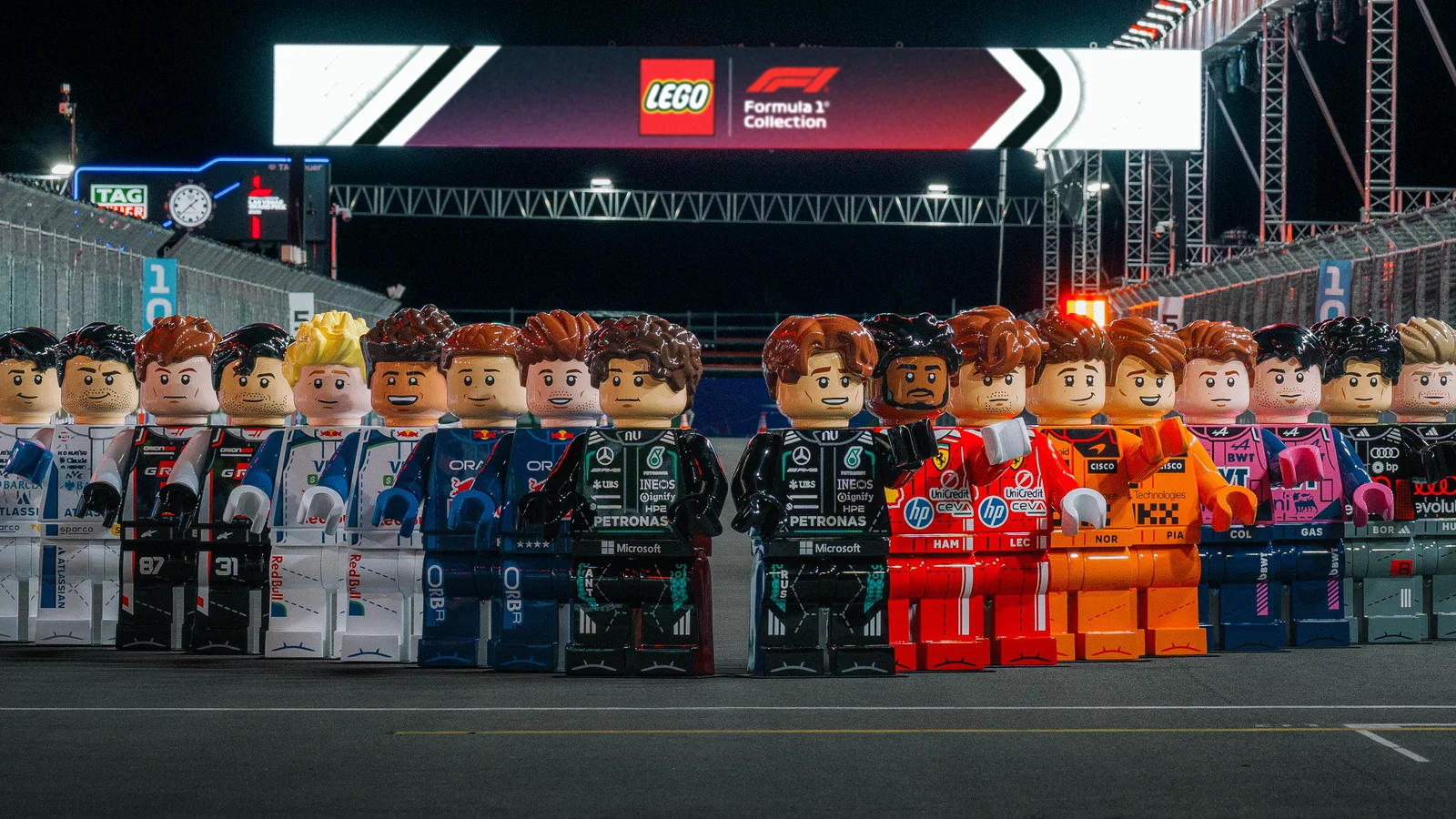
Formula 1 and the LEGO Group have converted the 2026 grid into a coordinated 2027 retail range: 11 Speed Champions cars, one for every team, each supplied with both of that team’s drivers as minifigures.
The products will be released globally on 1 March 2027 and were opened for pre-order in selected markets during the Las Vegas Grand Prix. LEGO lists every United States set at $29.99. At that price, buying the full grid would represent $329.89 before tax or delivery, creating a clear collection ladder rather than a single licensed purchase.
The commercial development is not simply that Formula 1 cars are available as toys. LEGO already launched a multi-team Formula 1 portfolio in 2025. The change is that named driver identity now sits inside every team product: printed race suits and helmets, driver numbers and the choice of which team-mate occupies the cockpit.
That moves the licence from vehicle representation towards a three-layer system of championship, team and athlete intellectual property. It also connects product to event activation. LEGO is running a pre-race Las Vegas demonstration with 11 full-size brick-built team cars, while the retail range uses the same full-grid idea at shelf scale.
Neither party has disclosed licence fees, royalty rates, minimum guarantees, revenue shares, approval costs, sales forecasts, production volumes, retailer allocations or the treatment of driver changes after the 2026 season. No financial return should be inferred from the number of products or the visibility of the launch.
The disclosed structure is nevertheless useful for motorsport businesses because it shows what becomes possible when a rights holder can coordinate the entire field. Formula 1 and LEGO are not asking consumers to understand a fragmented set of separate deals. They are presenting one system with common timing, dimensions, pricing and product logic, while preserving the colour, team and driver choices that make each SKU distinct.
Driver identity completes the product
The previous generation of Formula 1 Speed Champions products proved that team cars could be merchandised as a common collection. The 2027 range adds the two people most closely associated with each car and lets buyers select the appropriate race-number sticker.
That matters because a racing car is not the only consumer asset in a championship. Drivers carry personal followings, narratives, national markets and changing competitive status. Packaging both team-mates in one set allows LEGO to offer the full team story without forcing a buyer to choose one driver at the point of purchase.
The design also protects the base product from one form of demand concentration. If one driver is more popular, the same car SKU still serves supporters of both. The alternative would be separate driver editions, doubling the number of variants and making forecasting, shelf space and residual stock harder to manage.
There is a trade-off. Including two named drivers increases the rights and approval surface. Faces, names, numbers, helmet graphics, race suits and team liveries may each involve different approvals. Sponsor marks visible on the physical product can add further category and territory constraints. The public announcements do not identify the approval workflow or which marks have been omitted, simplified or separately licensed.
For teams, the range demonstrates why driver agreements and commercial-rights schedules need to be written with consumer products in mind. A driver may compete for one team during the season represented by the toy but move before the product reaches the end of its retail life. Contracts should address sell-off periods, packaging already in production, digital product images, replacements and use of historic team associations.
The same applies to sponsors. A logo on a race car can become part of a product sold for months in countries where the sponsor has no business or faces advertising restrictions. Teams need a marks matrix that identifies which partners may appear by product category and market, who supplies approved artwork and how quickly an approval can be withdrawn.
LEGO’s solution is operationally elegant because it keeps the product architecture consistent. Every team receives one car set and two drivers. The retailer receives an 11-SKU family at a common US price. The fan sees a complete grid. Behind that simplicity is a substantial coordination task that other licensees should price before promising a championship-wide launch.
One grid creates a collection economy
A full-grid range changes the commercial question from whether a fan will buy a set to how far that fan will travel through the collection. Some buyers will choose one team. Others may add a favourite driver’s former or rival team. A smaller group will seek all 11.
That creates useful pricing and merchandising options without requiring Formula 1 to sell an official bundle. Retailers can display the cars together, rotate the lead team by local market, build race-week selections and use completion messaging as new stock arrives. The fixed price also makes comparison easy and reduces friction between teams at the shelf.
Collection economics should be measured carefully. Eleven products do not mean eleven times the demand of one product. Team support is uneven, some buyers may see the cars as substitutes, and a full set occupies meaningful budget and space. The relevant indicators are unit sell-through by team and market, attachment rates between SKUs, the share of customers purchasing more than one, reorder speed, markdown exposure and stock remaining after the 2027 season.
The range also gives Formula 1 a way to observe the relative pull of team and driver identity through retail data. If data-sharing terms allow it, LEGO and the rights holder can compare markets where nationality, team history or current performance produces stronger demand. Those observations can guide future products, event assortments and marketing, but they should not be mistaken for a complete measure of fandom. Availability, shelf position and local promotion can shape sales as much as sporting preference.
For team commercial departments, the lesson is to negotiate reporting rather than accept a royalty statement with one aggregate number. Useful reporting separates SKU, country, channel, full-price sales, returns and markdowns. It should also distinguish wholesale shipments from consumer sell-through. A product can appear successful when it enters retail inventory even if it later requires discounting.
Licensees need a similar discipline in forecasting. A full-grid promise increases range credibility but also creates a long tail. The most popular cars can be replenished quickly while slower teams tie up working capital. Production plans should include minimum efficient quantities, regional reallocation, replenishment lead times and a defined exit path for each SKU.
The public product pages provide a clean starting point: all 11 teams, all 22 drivers, a common $29.99 US price and one global launch date. They do not disclose production quantities or retailer commitments. Commercial teams should therefore treat completeness as a consumer proposition, not evidence that demand will be evenly distributed.
Las Vegas links media, event and retail
The product reveal is embedded in the Las Vegas Grand Prix rather than separated into a conventional toy launch. Pre-orders opened around the event, the collection was shown within the race-week environment and LEGO scheduled an on-track activation using drivable brick-built cars representing all 11 teams.
This turns one creative platform into several assets. The full-grid idea appears as physical products, social content, a live spectacle, photographs and broadcast-adjacent entertainment. Each layer promotes the others. The event creates attention for the range; the products extend the event into homes; the drivers provide recognisable characters; and the teams supply colour and rivalry.
For promoters, the model is attractive because a partner activation becomes part of the show rather than an isolated hospitality or display area. The partner receives an audience and content. The promoter receives pre-race entertainment. Formula 1 receives a consumer-product story with a sales action already available through pre-orders.
The cost base is also larger than a standard sponsorship activation. Full-size cars made from more than 28,000 bricks, transport, storage, engineering, drivers, safety review, rehearsal and track time all sit behind the visible lap. Formula 1 and LEGO have not disclosed those costs or how they are allocated.
Promoters considering similar programmes should separate production value from media value. A spectacular installation can generate extensive coverage but still be inefficient if it is built once, hard to transport or disconnected from a product people can buy. LEGO can reuse the full-grid concept across races and product channels, improving the chance that the investment has a life beyond one weekend.
The Las Vegas timing also matters for retail planning. Opening pre-orders more than three months before the March release gives LEGO an early demand signal, although pre-order data can be distorted by initial publicity and limited allocations. The company can observe team mix and regional interest before the launch window, then adjust marketing and distribution within the limits of manufacturing lead time.
Teams and sponsors should ask which event assets they receive from such a launch. Participation may include car appearance, driver presence, social clips, product photography and retail display. Those uses should be scheduled and valued individually. A team logo appearing across all launch content is different from a team receiving dedicated storytelling or access to transaction data.
Rights coordination is the competitive advantage
The hardest part of a full-grid product is not producing eleven variations of a similar car. It is aligning the permissions, artwork, timing and approvals of Formula 1, 11 teams, 22 drivers and the brands visible on their equipment.
Formula 1’s central commercial rights make the championship a natural coordinator, but teams and drivers retain commercially meaningful identities. The range shows that a partner can access those layers in a consistent consumer proposition. The public material does not explain whether LEGO contracted through one master agreement or a combination of arrangements, so the legal structure should not be assumed.
What can be observed is the output: a common template, simultaneous reveal, complete roster and unified retail date. That consistency is valuable because fragmented licensing often produces incomplete grids, different scales, mismatched launch timing or products that omit less commercially prominent participants.
For another supplier, achieving the same result would require an early rights map. The map should cover championship marks, team marks, car designs, liveries, sponsor logos, driver names and likenesses, helmets, apparel, race numbers, photography, video, territories, channels and duration. Each asset needs an approval owner, delivery date and fallback if approval is late.
The fallback is important. Product development operates on fixed manufacturing and shipping deadlines while motorsport rosters and liveries can change late. A supplier needs rules for placeholder artwork, generic components, sticker updates, packaging sleeves or delayed SKUs. Without them, one unresolved approval can break the promise of a complete range.
Data rights are another layer. LEGO controls direct transactions through its own stores and website, while retailers control other purchases. Formula 1 and teams will want insight into audience and product performance. Any sharing must reflect privacy consent, retailer contracts and competition concerns. The announcement does not disclose the data model.
The commercial advantage is therefore not only the popularity of LEGO or Formula 1. It is the ability to make a complex rights environment look simple to the customer. That capability can be more difficult to copy than the physical object.
The market context supports the expansion
Independent toy-market evidence helps explain why the partners are deepening the range. Circana reported that global toy sales across its tracked markets grew 9.5% in the 12 months to June 2026. It also said licensed products, pop-culture relevance and demand from teenagers and adults contributed to the industry’s 2025 recovery.
Formula 1 already produced evidence inside the category. Circana’s 2025 industry awards named LEGO Formula 1 the global winner in building sets. Awards do not disclose revenue or margin, and they do not guarantee success for a new range, but they show that the earlier products achieved measurable retail performance rather than visibility alone.
LEGO’s 2025 annual report said its portfolio reached a record 868 products and specifically identified Formula 1 products and race activations as part of its brand programme. The new full-grid range is therefore an extension of an operating model that already combines product breadth with live marketing.
For Formula 1, the licensing case is broader than toy sales. A building set gives the championship a family-accessible and display-friendly product at a relatively low price compared with tickets, hospitality or premium models. Driver minifigures add personality without changing the basic product category. That can help the rights holder serve existing fans and provide an entry point for younger or more casual consumers.
The risk is portfolio saturation. Formula 1 now supports products across apparel, collectibles, games, models and numerous team ranges. More licensed items do not automatically create more demand. They can compete for the same fan budget, duplicate team imagery and shorten the useful life of each launch.
The answer is not fewer products by default but clearer roles. The Speed Champions range has a defined proposition: the complete current grid at a consistent scale and price, with both drivers included. That is more defensible than another generic logo product because completeness and customisation are built into the design.
What the industry should measure
Formula 1, LEGO and the teams should begin with sales quality. Unit sales, net revenue, gross margin, returns, markdowns, inventory age and replenishment should be reported by SKU, market and channel. Pre-orders should be separated from delivered sales, and wholesale shipments should not be confused with consumer purchases.
The second measure is collection behaviour. The partners need to know how many customers buy one team, multiple teams or the full grid; which teams are commonly purchased together; and whether driver-focused campaigns change that mix. Those findings can improve later assortments without turning product sales into a simplistic popularity table.
The third measure is activation efficiency. The Las Vegas programme should be assessed against reach, content use, earned media, on-site engagement, pre-order conversion and the reusable life of the large cars. Production and logistics costs belong in that calculation. Impressions alone cannot show whether the activation helped sell product or deepen the partnership.
The fourth is approval performance. Time from artwork submission to approval, number of revisions, late changes and rework cost should be visible across the rights network. A full-grid launch that arrives on time is evidence of operating capability; repeating it annually without escalating cost is the stronger test.
The fifth is roster resilience. The 2027 product represents the 2026 cars and drivers. The partners should disclose the sales window clearly and manage any driver or sponsor changes without implying that the product reflects a later grid. Historic accuracy can preserve value, while ambiguous dating can create consumer confusion.
The sixth is benefit distribution. Formula 1 will receive value from the championship licence, LEGO from product sales and brand activity, and teams and drivers from the use of their identities under whatever agreements apply. Because those economics are undisclosed, outsiders cannot assess whether the platform shares growth in proportion to the rights it uses. Teams should evaluate that question inside their contracts.
A template beyond toys
The most transferable feature of the LEGO programme is the architecture. One partner uses a championship-wide template, preserves team and driver distinction, launches every participant together and connects the product to a live event.
That structure can apply to other categories: digital collectibles, gaming content, technical apparel, educational products, hospitality merchandise or business-to-business tools. The specific rights and economics will differ, but the operating requirements remain similar: complete data, consistent specifications, central coordination, local differentiation and measurable sell-through.
Suppliers should notice that completeness is a service. Producing for the whole grid requires capacity, version control, artwork governance and contingency. A supplier that can manage those functions offers more than manufacturing. It becomes part of the rights holder’s commercial infrastructure.
Teams should notice that their driver and sponsor data need to be product-ready. Approved logos, colour standards, helmet files, number artwork, territory rules and contract dates should be maintained in a controlled system. Slow or uncertain asset delivery can reduce a team’s visibility even when the championship has secured a global partner.
Promoters should notice the link between spectacle and transaction. The Las Vegas activation is not only a branded moment; it supports a range already open for pre-order. Event concepts become more commercially accountable when the audience has a clear next action and the partner can measure it.
Formula 1 and LEGO have not published enough information to calculate the value of the programme. They have published enough to show its design. The 11 products use the full grid as a collection, the 22 drivers add personal identity, common pricing makes the range legible, and the Las Vegas event supplies attention before a global release.
That is the business development the industry should watch. The physical sets are the visible output. The more valuable asset is a repeatable system for turning a complicated field of championship, team, driver and sponsor rights into one product family that a retailer and a fan can immediately understand.
Sources and further reading
- The LEGO Group official product and media announcement, 18 November 2026 ↗
- Formula 1 official licensing announcement, 19 November 2026 ↗
- Official LEGO product and pricing page ↗
- License Global independent report, 19 November 2026 ↗
- Circana global toy-market report, 10 August 2026 ↗
- Circana 2025 global toy performance awards, 28 January 2026 ↗
- The LEGO Group 2025 annual report ↗