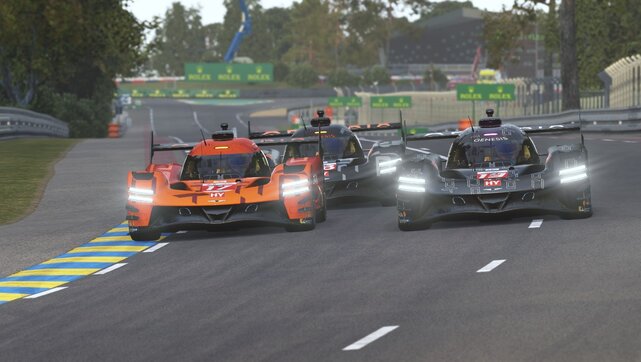
Genesis Magma Racing has made its virtual GMR-001 Hypercar the centre of an eight-week esports competition that links talent recruitment, brand exposure and player acquisition before the manufacturer's real-world endurance programme enters its second season.
The GMR Esports Series will begin qualifying in Le Mans Ultimate on 6 October. Drivers will use the GMR-001 at a different circuit each week, with their best six results from eight rounds counting towards qualification. The top 20 eligible drivers globally and the top 10 registered Korean drivers will advance to a four-race main series.
The winner will be offered a full-time place in the GMR Esports roster for 2027. That gives the programme a defined employment outcome rather than a conventional cash-prize headline, although Genesis has not disclosed the contract value, salary, detailed terms or the complete prize structure.
For teams, sponsors and rights holders, the more consequential feature is how the competition has been assembled. Genesis is using one licensed digital car across open qualifying, a broadcast championship and a works-team recruitment process. Each stage serves a different commercial purpose, but all of them reinforce the same product and racing identity.
Lower friction widens the recruitment funnel
Le Mans Ultimate normally reserves its online championship qualifying mode for RaceControl Pro and Pro+ subscribers. For this series, the mode will be available to entrants at no additional subscription cost. The eight qualifying weeks will also avoid premium downloadable circuits, according to independent coverage from Traxion.
That does not make the underlying game free. It does remove two incremental costs that could have narrowed the field after a player already owns it: a subscription tier and premium circuit content. The distinction matters because an open recruitment claim is credible only when the route into the selection process is reasonably accessible.
The format also limits the time commitment. Drivers may make no more than three race attempts in a week and can drop their two weakest scores. That creates enough repetition to reduce the effect of one poor result without rewarding unlimited attempts. It also gives the organiser a consistent eight-week engagement window rather than a one-night tournament spike.
For Genesis, the wider funnel improves the chance of finding an unsigned driver. For the game publisher, every entrant is directed into an online mode that may convert occasional players into regular users. Neither party has published entry targets, subscriber-conversion goals, retention measures or its division of costs and commercial rights, so the acquisition value cannot yet be quantified.
One car becomes repeated product exposure
Every qualifier will be locked to the virtual GMR-001. That turns the car from one choice in a mixed grid into the competition's standard equipment and gives every practice session, replay and stream the same manufacturer identity.
In physical motorsport, putting hundreds or thousands of prospects through a prototype would be impossible. The licensed simulation lets Genesis distribute a detailed representation of its Hypercar at software scale while keeping the competitive variable focused on the driver. It is both a selection tool and a repeatable virtual product demonstration.
The business benefit extends beyond logo visibility. GMR Esports was launched in May to support Genesis Magma Racing's World Endurance Championship programme and to reach a younger audience through the same car. The new series adds a public pathway into that team, joining the virtual asset more closely to the organisation rather than treating esports as a separate sponsorship property.
Genesis and the game developer still depend on the quality and stability of the digital platform. Balance changes, server performance, stewarding, eligibility checks and anti-cheat controls can affect the credibility of the recruitment result. The published announcement describes the sporting format but does not set out those operating controls in detail.
Korea gets a deliberate second route
The split between 20 global qualifiers and 10 Korean qualifiers is a commercial choice as well as a sporting one. It reserves one third of the main-series places for the brand's home market even if those drivers would not all sit inside a single worldwide top 30.
That structure supports local participation and content while preserving an international field. It also matches the existing GMR Esports model, which has been built around drivers in Europe and Korea. A pure global ranking could produce a highly concentrated field; a market-specific route gives Genesis a stronger chance of developing talent and audiences in both parts of its programme.
The trade-off is that eligibility and allocation need to remain clear. Genesis says Korean drivers must register for the dedicated classification. Teams and promoters using regional places should publish residency, nationality and conflict rules before competition begins, because ambiguity at the qualification boundary can quickly become a reputational problem.
Four finals create sellable media inventory
The 30 qualifiers will contest three 45-minute sprint races and a two-hour endurance final. Those races are due to be broadcast on Genesis channels and by Traxion, turning the recruitment process into four scheduled media products rather than leaving it as an unseen assessment exercise.
That creates inventory for branded content, commentary, social clips and future partner integration. The endurance finale is particularly relevant to Genesis because it mirrors the teamwork and traffic management associated with its real-world programme more closely than a short hot-lap contest.
No broadcast audience forecast, sponsorship package or media-rights value has been disclosed. Nor has Genesis confirmed that the winner will progress into a real car. Traxion reports that a possible route into the GMR Trajectory Programme is being considered, but it is not part of the announced prize and should not be treated as a guaranteed outcome.
The disclosed reward is the 2027 esports role. Its value will depend on the contract, coaching, competition schedule and support attached to it. Publishing those details before the final would help competitors assess the opportunity and would make the recruitment proposition easier for future partners to value.
A reusable model for motorsport businesses
The Genesis programme shows how a digital car can do more than replicate race-weekend marketing. With a low-friction entry route, a measurable selection format, a credible job at the end and an integrated broadcast plan, the same asset can serve recruitment, audience development and licensed-game engagement.
The next evidence will come from participation and conversion: how many eligible drivers enter, how many return across eight weeks, where they are located, what the broadcasts attract and whether the eventual recruit strengthens the team. Those figures will determine whether the series is primarily a strong brand activation or a repeatable operating channel.
For suppliers and sponsors, the lesson is to ask for those measures before attaching value to an esports property. Reach alone will not show whether a programme has created useful talent, qualified customers or durable fan relationships. Genesis has designed the funnel and supplied a meaningful destination. The eight-week campaign now has to demonstrate that the virtual GMR-001 can move people through it.