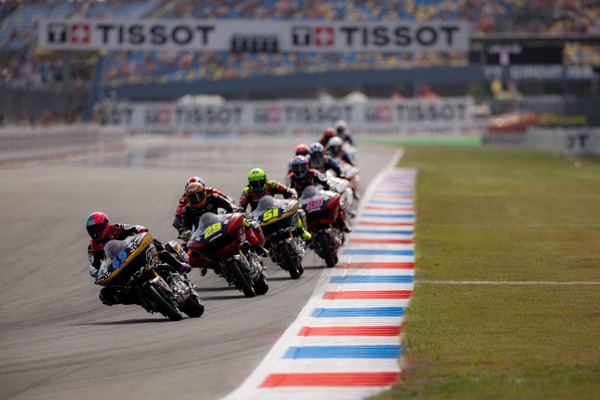
Harley-Davidson is moving its factory racing resources out of MotoAmerica's King of the Baggers championship and into a larger international programme built around the FIM Harley-Davidson Bagger World Cup. The 2027 reset is more than a change of series: it replaces a directly operated national team with a global, customer-team platform that Harley-Davidson also controls as a technical, product-development and brand asset.
The company announced two complementary programmes on 1 October. Premier Racing will centre on an expanded Bagger World Cup run with MotoGP, IRTA and the FIM. Grassroots Racing will support dealer and customer competition across disciplines and experience levels. Harley-Davidson will end its factory participation and official team support in MotoAmerica after the 2026 season.
That makes the new structure relevant to teams, suppliers and promoters on both sides of the Atlantic. The company is not leaving competition. It is concentrating its highest-level investment in a championship where it supplies the motorcycles, shapes the commercial proposition and gains access to MotoGP event audiences, while retaining a lower-cost route into national and local participation.
From factory entry to platform operator
Harley-Davidson's MotoAmerica programme was a conventional works effort inside a multi-manufacturer championship. The company says its factory team won three of the category's six national championships, while Kyle Wyman became its most successful rider with 27 individual victories. The programme therefore produced sporting value and engineering knowledge, but it also required Harley-Davidson to carry the operating burden of a factory team.
The Bagger World Cup uses a different business model. Its inaugural 2026 season ran at six MotoGP weekends across North America and Europe. Harley-Davidson supplied a common technical platform to independent teams, while the championship sat within the international event, media and hospitality infrastructure of MotoGP.
Harley-Davidson says the first season produced five different race winners, placed every team on the podium and kept the championship undecided until the final round. Those are the company's published measures, not audited commercial results. They nevertheless give the programme enough sporting proof to support expansion with more teams, riders and races in 2027.
The important shift is in who carries the operation. A works team spends money to compete against rivals under another championship's rules. A manufacturer-owned one-make platform can distribute vehicle operation across customer teams, sell or allocate technical packages, create series-wide inventory and use every entry to demonstrate the same product family.
That does not automatically make the world programme cheaper. International freight, spares, technical support, event servicing and championship promotion can absorb substantial budgets. But the spending supports an asset that Harley-Davidson can scale across markets instead of one factory entry whose exposure depends heavily on its results.
Racing data is being tied directly to product
Harley-Davidson says the World Cup will remain a development and demonstration platform for motorcycles and race-derived Screamin' Eagle performance products. Engineering capability built through Factory Racing will be redirected into the international championship, motorcycle development and the company's parts business.
That creates a clearer commercial loop. Competition generates data on engines, cooling, brakes, chassis loads, suspension, tyres and durability. The same programme demonstrates the results to customers at MotoGP events and through broadcast and digital content. Relevant learning can then support performance parts or future motorcycles sold through Harley-Davidson's dealer network.
For specialist suppliers, the opportunity is broader than supplying a race team. A growing one-make championship needs repeatable parts, service procedures and documentation that independent teams can use in multiple countries. The valuable work may include machining, thermal management, electronics, data systems, suspension, braking, logistics, technical training and controlled spares distribution.
The requirement is also stricter. Components must work across a fleet rather than one pair of factory motorcycles. Lead times, serial tracking, rebuild intervals and technical bulletins become championship-level responsibilities. A supplier that misses one delivery can affect several teams and the organiser's event product at the same time.
The MotoGP calendar changes the commercial audience
Moving the premier programme onto selected MotoGP weekends gives Harley-Davidson access to established promoters, broadcasters, hospitality operations and international fan traffic. It also places an American touring-motorcycle format in markets where the brand can use racing to support dealers, owners' groups and performance-product sales.
The 2026 championship combined one United States round with five European events. The 2027 calendar has not yet been published, so the number of additional races and any new regions remain open. Expansion into more markets would create new activation inventory, but it would also increase freight, customs, personnel and local-service demands for teams and suppliers.
Independent reporting has framed the change as a move toward the larger audience available through MotoGP. That is a reasonable business inference, but Harley-Davidson has not published comparative broadcast reach, sponsorship revenue, dealer leads or cost-per-round data for the two programmes. The scale argument will need measurement rather than assumption.
For promoters, the attraction is a distinctive support category with recognisable production-based motorcycles, a strong sound and visual identity, and a manufacturer able to mobilise dealers and owners. The risk is that the series must remain competitive and credible as it grows. Too much technical control can make customer teams feel like contractors; too little can produce cost escalation or inconsistent machinery.
Grassroots racing protects the participation funnel
Ending official MotoAmerica team support could have weakened Harley-Davidson's domestic racing connection. The new Grassroots Racing programme is intended to prevent that by supporting accessible competition in road racing, flat track, drag racing and dealer-led activity.
The two-level structure therefore separates objectives. Premier Racing is the high-visibility international showcase and development platform. Grassroots Racing is the participation, dealer and customer layer. That distinction can help budget owners decide whether spending is intended to create global media exposure, sell performance parts, support dealers or recruit new riders.
The public announcement does not yet specify contingency funds, eligible championships, dealer incentives, technical grants or prize structures. Until those details are released, teams should not assume that the grassroots programme replaces the level of support previously attached to a factory entry.
MotoAmerica's response thanked Harley-Davidson for its role in building King of the Baggers and said the championship will continue. The withdrawal therefore changes the competitive and commercial mix without ending the category. Indian Motorcycle remains an important manufacturer presence, while independent Harley-Davidson teams may still have a route to compete if technical and commercial support is available.
For MotoAmerica, the priority will be preserving grid quality, manufacturer rivalry and sponsor value after the works team departs. For Harley-Davidson, the challenge is maintaining a visible US pathway while persuading customers and dealers that the global World Cup and grassroots programmes form one coherent system.
What the 2027 model still needs to disclose
Teams considering the expanded World Cup need the calendar, entry process, technical regulations and commercial package. They will also need clarity on motorcycle ownership or lease terms, spares pricing, engine allocation, testing, data access, freight responsibilities, crash-damage exposure and the service level supplied at each event.
Suppliers need forecast volumes and a stable specification early enough to plan production. Promoters need to understand paddock space, session duration, freight windows, noise requirements, hospitality and local dealer activation. Sponsors need to know which rights sit with Harley-Davidson, MotoGP, the event promoter and the individual teams.
None of the public sources discloses the factory programme's previous budget, the 2027 World Cup investment, team subsidies, entry fees or the value of MotoGP-linked rights. It is therefore not possible to conclude that the restructure is a cost reduction. It is better understood as a reallocation of resources toward a platform with broader control and international growth potential.
The programme should be judged on separate technical and commercial measures. Technical measures include reliability across the fleet, parity, parts consumption, service turnaround and the transfer of useful learning into motorcycles and Screamin' Eagle products. Commercial measures include team and rider growth, dealer participation, hospitality use, audience reach, qualified customer leads and product sales.
Harley-Davidson's decision shows why manufacturers increasingly want racing programmes to do more than win. The 2027 model is designed to operate as a championship, a development fleet, a dealer-engagement tool and a global content platform. Its value will depend on whether independent teams and suppliers can scale with it—and whether the company publishes enough evidence to show that the new platform performs those jobs better than the factory programme it replaces.