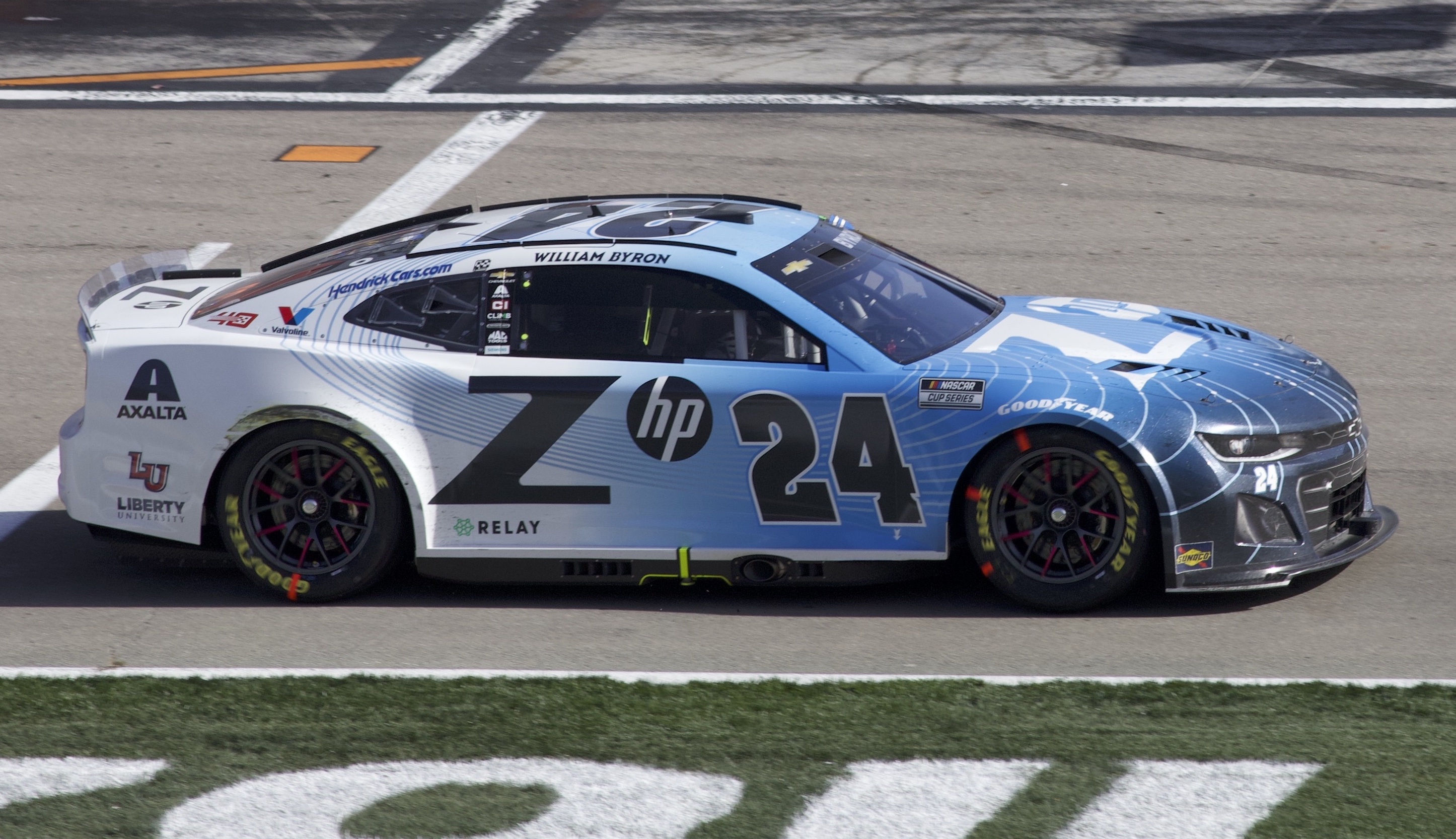
Hendrick Motorsports has extended its relationship with HP through the 2029 NASCAR Cup Series season, preserving a partnership that combines car sponsorship with technology used inside the race team.
The three-year renewal gives HP primary placement on William Byron's No. 24 Chevrolet at two races each season. The brand will also retain season-long visibility across the car, team apparel, fire suits and equipment. Financial terms, activation budgets and the two annual primary-race selections were not disclosed.
That inventory matters, but the more useful business signal is the structure behind it. Hendrick says HP Z workstations, mobile workstations, monitors and related solutions support competition and business operations. HP's own case study says the team uses the technology across design, engineering, simulation, aerodynamics and at-track workflows.
The renewal therefore is not just a logo extension. It joins a relatively limited number of high-visibility race entitlements to a year-round supplier relationship in which the customer can also become the product demonstrator.
Two primary races anchor a longer commercial season
HP first joined Hendrick Motorsports in 2022 through a marketing and innovation agreement. Its relationship with Byron and the No. 24 team began in 2023, before a package covering two primary races per season from 2024 through 2026.
The new term keeps that two-race model through 2029 rather than expanding HP into a full-season primary sponsor. In a team with several established partners, that approach preserves scarce car inventory while giving HP repeated flagship moments and a continuing associate presence.
For rights sellers, the distinction is important. A primary paint scheme can concentrate launch activity, hospitality and broadcast visibility around selected weekends. Season-long marks on the car, uniforms and equipment maintain continuity between those peaks. The operational relationship then gives the partner a third layer of content that is not dependent on a particular race result.
The public announcement does not identify the renewal's category exclusivity, hospitality allocation, driver-appearance schedule, digital content commitments or performance measures. Teams considering a similar package would need those details to value the rights properly. The disclosed structure nevertheless shows how a short primary schedule can sit inside a longer and broader agreement.
Technology deployment supplies the proof point
HP's role inside Hendrick provides a business-to-business story that can continue when its branding is not the dominant livery. The team says the hardware supports both competition and commercial operations. HP's published customer material describes engineers using high-performance workstations for computer-aided design, computational fluid dynamics, simulation and other data-intensive tasks.
Those are supplier claims, not an independently audited performance study. Neither company has published processing-time reductions, reliability data, total deployment volumes or a financial return from the technology. It would therefore be wrong to attribute Hendrick's sporting results to one hardware partner.
What the deployment does provide is a credible use environment. NASCAR teams work to fixed event deadlines, process large engineering datasets and need hardware that can move between design offices, simulation rooms and the race track. That lets HP demonstrate products against the same operational pressures faced by prospective engineering, manufacturing and enterprise customers.
For a technology company, the sponsorship can therefore support more than consumer awareness. It creates customer demonstrations, technical case studies, executive hospitality and sales conversations around a live workload. For Hendrick, the arrangement converts an internal procurement relationship into paid commercial inventory and partner content.
The driver platform carries measurable continuity
The agreement retains William Byron as HP's principal public-facing asset. Since the partnership expanded to the No. 24 team, Byron has won the Daytona 500 in 2024 and 2025 and the 2025 Cup regular-season championship. Hendrick and HP cite those results as evidence of a successful relationship.
Sporting success improves a partner's story but does not guarantee commercial return. The useful continuity is that the same driver, car number, team and technology narrative can run across the next three seasons. That reduces the need to rebuild creative assets and stakeholder recognition every year.
The two-race primary allocation also gives both parties room to select markets and events that fit annual product or customer priorities. The 2027 race choices have not been announced, so any assumptions about their geography or activation should wait for the schedule.
Sponsors evaluating comparable deals should separate three measurement sets. Media measures cover exposure and audience. Business measures cover hospitality use, qualified opportunities and sales influence. Operational measures cover deployment, workflow, support and user outcomes. Combining all three into a single value claim would hide whether the partnership is working as advertising, enterprise selling or technology supply.
Integration raises delivery expectations
An integrated partnership demands more coordination than a conventional decal package. Product teams need access to engineers and approved performance evidence. The race team must protect sensitive data while creating useful demonstrations. Marketing teams need technical claims that can survive scrutiny, and trackside support must fit NASCAR's travel and garage environment.
That creates work for suppliers around systems integration, cybersecurity, device management, displays, networking, technical support and content production. It also creates approval risk: a compelling engineering story cannot disclose competitive information, and a sponsorship promise cannot substitute for validated product performance.
The renewal's value is therefore in repeatability. Hendrick and HP have already worked through one multi-year cycle, including the two-race primary model. Extending the same core structure through 2029 suggests that both sides prefer a proven operating rhythm to a larger but less integrated rights package.
For teams, the lesson is to look beyond the number of races carrying a partner's full livery. A sponsor that supplies important tools, appears throughout the season and receives selected primary events can be embedded more deeply than a larger logo buyer. For technology suppliers, the opportunity is strongest when the product has a real job inside the organisation and the rights package is designed to make that work visible without overstating it.
No contract value was disclosed, so the renewal cannot be compared reliably with other NASCAR sponsorships on price. Its significance is structural: media inventory, operational supply and business proof have been renewed as one relationship through 2029.