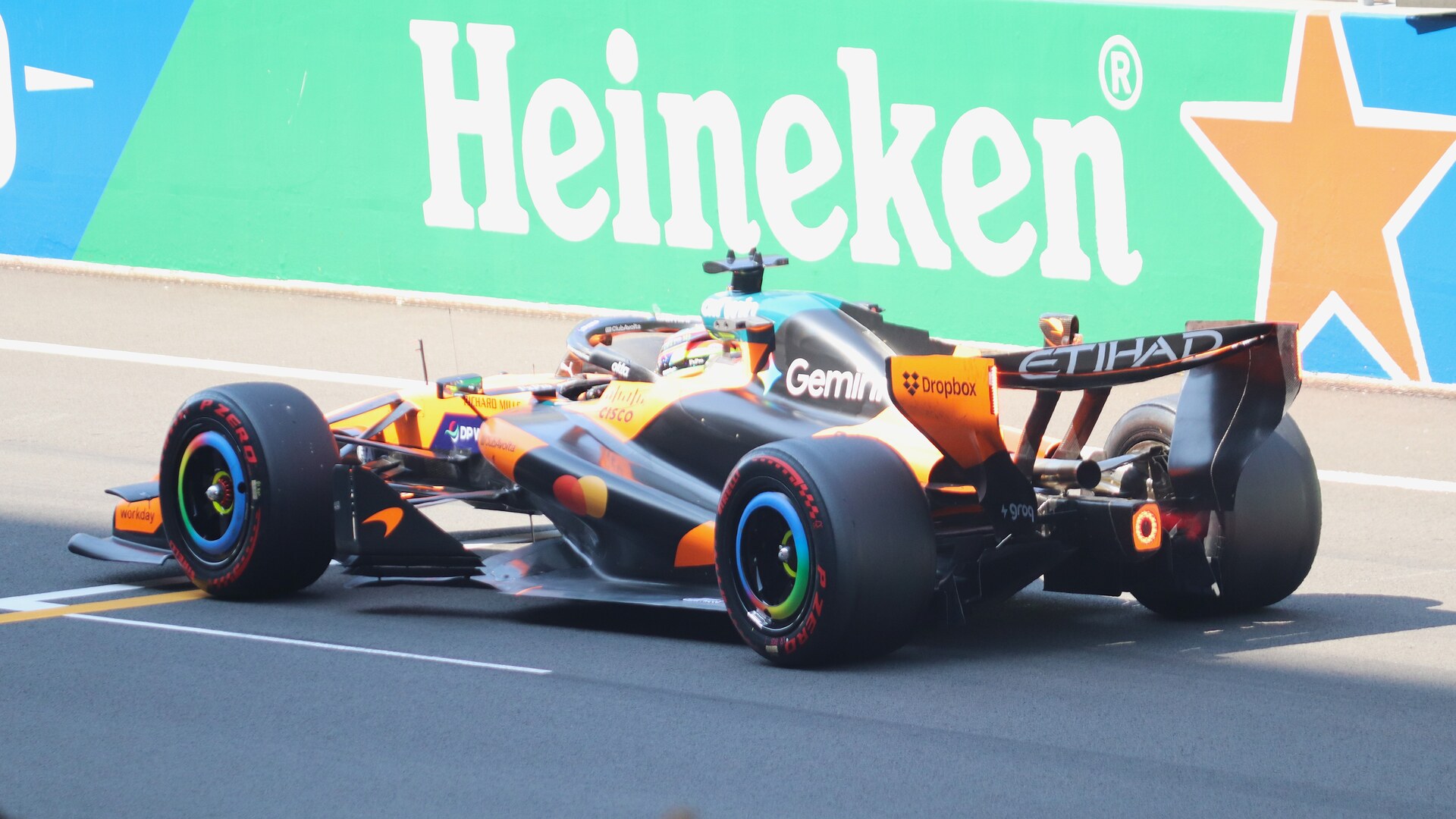
NTT’s new Formula 1 agreement with McLaren is a useful marker for where technology sponsorship is moving. The product being put on display is not only software, infrastructure or branding. It is the operating system by which a racing organisation decides where artificial intelligence can be used, who can approve it and how risk follows data across a crowded vendor estate.
The companies announced on 4 November that NTT will become an Official Partner of the McLaren Mastercard Formula 1 Team from the 2027 season under a multi-year agreement. NTT says it will support McLaren’s ambition to become the most “AI-fluent” team on the grid, with AI security governance at the core and support for a framework intended to regulate security risks arising from AI use.
That language matters. Formula 1 partnerships commonly use innovation as a broad commercial promise. NTT has attached the agreement to identifiable business functions: technical assistance for AI security governance, client and fan engagement, business co-creation using both parties’ customer bases, and brand growth in Latin America, Europe and Asia as well as North America.
For teams, suppliers and sponsors, this makes the agreement more than another technology logo. It turns governance into a sponsor deliverable and McLaren into a reference environment through which NTT can demonstrate how those controls work.
No rights fee, exact contract length, category exclusivity, deployment timetable, customer pipeline, data-access scope or performance target was disclosed. NTT has not said that it will control every McLaren AI system, and McLaren has not published a product inventory. The commercial opportunity is clear; the technical boundary still has to be built.
Governance becomes the product
AI governance can sound abstract until it is translated into operational decisions. NTT’s own group framework shows what those decisions can include.
The company classifies AI projects by risk level, uses a two-layer assessment by project managers and AI risk-management officers, applies mitigation according to risk, and continuously monitors implementation across group companies. Its published model combines rules, case evidence and specialist review, with an AI Governance Office supporting group-wide standards.
McLaren’s announcement does not say that this internal NTT framework will be copied into the team unchanged. It does, however, show the type of expertise NTT is selling. In a race organisation, equivalent controls would need to answer practical questions: which datasets can be used to train or prompt a system; whether driver, employee, supplier or fan information is involved; who owns generated output; whether a decision affects safety or sporting compliance; and what happens when a model or vendor changes.
The value is not a policy document on a shelf. It is a repeatable route from experiment to approved production use. That requires named owners, risk classification, evidence of testing, access controls, logging, incident escalation and a process for retiring tools that no longer meet the team’s standard.
Formula 1 gives that proposition unusual visibility. A team operates across design, simulation, manufacturing, race strategy, logistics, commercial content, hospitality and fan engagement. The rules, data sensitivity and tolerance for failure differ in each area. A governance system that can accommodate those differences becomes a credible business case study for NTT’s enterprise clients.
It also creates a measurable activation surface. Rather than relying only on brand impressions, NTT can bring customers into workshops, demonstrations and co-creation programmes around a live high-performance organisation. The official investor presentation is explicit that both customer and fan bases are part of the model.
McLaren’s partner stack needs an architecture
The agreement arrives inside a technology portfolio that already assigns specialist roles to several companies.
Intel became McLaren Racing’s Official Compute Partner in 2026, covering computing infrastructure and edge-processing work across Formula 1, IndyCar and F1 Academy. Rubrik holds a security and AI-operations partnership across McLaren’s Formula 1 and IndyCar teams. Airwallex will carry an Official AI Finance Partner designation from January 2027 while continuing financial and payment-technology work. McLaren also has wider transformation and digital relationships.
Those roles need not conflict. Compute, cyber resilience, finance applications and governance are different layers. But the more partners that use “AI” in their rights description, the greater the need for a documented division of responsibility.
NTT’s most valuable contribution may therefore sit above individual tools. Governance can define how a McLaren business owner evaluates a proposed use case, which suppliers need to be consulted, what data may cross company boundaries and what evidence is required before a system reaches employees, clients or fans.
That makes partner management part of the technical programme. A team cannot treat each agreement as a separate marketing island if the underlying systems share identity, networks, cloud services, data or incident-response obligations. Contracts and operating procedures need to align on audit rights, subcontractors, intellectual property, retention periods, model updates and exit plans.
Suppliers should read the NTT deal as a signal that procurement scrutiny will rise. A company offering an AI-enabled service to a team may be asked not just about performance and price, but about training data, model provenance, human oversight, security testing and the ability to export or delete information at the end of a contract.
For McLaren, the commercial task is to make the portfolio additive. If each partner has a distinct layer and shared governance connects them, the team can sell multiple meaningful technology categories without creating ambiguity. If scopes overlap, the same roster can slow decisions and create disputes over which partner is responsible when a problem crosses systems.
NTT is extending an existing motorsport sales engine
NTT is not entering motorsport as a first-time sponsor. It and NTT DATA have held title and technology roles with IndyCar since 2019, supplying AI and large-scale real-time analytics for venue operations, race operations and fan experiences. NTT Communications also worked with McLaren’s Formula 1 organisation under an earlier technology partnership, while NTT DATA has supported Arrow McLaren in IndyCar.
That history reduces one form of risk. NTT already understands how motorsport rights, technical delivery, event operations and client hospitality can be combined. The 2027 Formula 1 programme adds a global business-development platform to an established North American property.
The company’s investor material makes the geographic intent unusually clear: enhance awareness in Latin America, Europe and Asia in addition to North America. That is valuable context for rights sellers. The target is not simply global reach in the abstract; it is a regional extension of a brand and client programme that already has a strong motorsport base in the United States.
McLaren supplies several assets at once. Its Formula 1 team offers global broadcast visibility, a recognisable technology story and access to decision-makers through hospitality. Its existing relationship with NTT provides continuity, while the wider McLaren Racing portfolio creates context around NTT’s IndyCar position.
The “business co-creation” promise is the part to watch. It suggests a programme in which NTT and McLaren introduce clients, develop use cases and turn selected work into proof points that can be sold elsewhere. That can produce more durable value than exposure alone, but only if the partners define ownership of resulting intellectual property, reference rights and the route from demonstration to customer contract.
There is no public customer pipeline or revenue target. The agreement should therefore not be described as a guaranteed sales channel. Its design, however, gives NTT more ways to earn a return: brand consideration, executive engagement, technical credibility and new commercial work.
The metrics should go beyond logo exposure
Traditional sponsorship measures remain relevant, particularly because NTT has named regional brand growth as an objective. Media value, unaided awareness, share of voice and hospitality utilisation can show whether Formula 1 is extending the company’s profile outside North America.
They are not enough for a governance-led partnership. The programme also needs operating and sales measures.
McLaren could track how many AI use cases enter assessment, how long reviews take, how many are approved with conditions, whether high-risk projects receive the required mitigation and how quickly incidents are detected and closed. Training completion, policy adoption and supplier compliance would indicate whether “AI fluency” is becoming organisational capability rather than a campaign line.
NTT can measure the number and quality of client engagements, co-creation workshops, qualified opportunities and contracts influenced by the partnership. Regional performance should be separated so that growth in Europe, Asia and Latin America can be compared with the established North American platform.
The parties have not published those key performance indicators. Establishing them early would help distinguish technical work from activation and keep the programme accountable across multiple seasons.
There is also a disclosure balance to manage. A racing team cannot publicise sensitive systems, performance data or security weaknesses simply to create sponsor content. Case studies will need to explain the governance method and business outcome without exposing competitive or personal information. That constraint is itself a test of the framework.
What teams and suppliers should take from the deal
The first lesson is that governance can carry commercial rights. Sponsors no longer need to provide a visible hardware component to hold a meaningful technology category. A well-defined decision and assurance layer can be both operationally important and marketable.
Second, a large partner roster requires systems integration at the contractual level. Teams should map which company supplies each layer, which party can access each dataset, where responsibilities overlap and who leads during an incident. The map should be updated when partners, models or regulations change.
Third, AI-fluency claims create delivery obligations. Training staff to use tools is only one part. Teams need controls that let people experiment quickly while keeping high-risk applications behind stronger review gates. NTT describes its own approach as “accelerator and guardrails”; McLaren will be judged on whether speed and control can coexist in practice.
Fourth, suppliers should expect governance requirements to flow down the chain. Even a small vendor may hold valuable design, employee, customer or event data. Clear answers on provenance, security, retention, portability and human oversight will increasingly be part of winning and keeping motorsport work.
Finally, sponsors should build the client journey before the first race. NTT’s Formula 1 partnership begins in January 2027. The value of that start date will depend on whether executive programmes, demonstrations, regional campaigns and follow-up sales processes are ready alongside the branding.
NTT and McLaren have left the economics and detailed implementation private. What they have disclosed is still material: a governance function has become a named part of a Formula 1 commercial agreement, and the investor story links that function directly to co-creation and geographic expansion.
That is the development the industry should watch. The next generation of technology sponsorship will not be won by the team with the longest list of AI partners. It will be won by the organisation that can show how those partners, systems and data fit together—and turn that operating discipline into a client product.
Sources and further reading
- NTT partnership announcement, 4 November 2026 ↗
- NTT FY2026 results presentation and motorsport strategy, 4 November 2026 ↗
- NTT AI governance framework ↗
- K-Tai Watch independent report, 4 November 2026 ↗
- Intel compute partnership announcement, 12 May 2026 ↗
- Rubrik security and AI operations partnership announcement, 4 February 2026 ↗
- Airwallex AI finance partnership extension, 21 October 2026 ↗
- Wikimedia Commons image record ↗
- Creative Commons Attribution 4.0 licence ↗