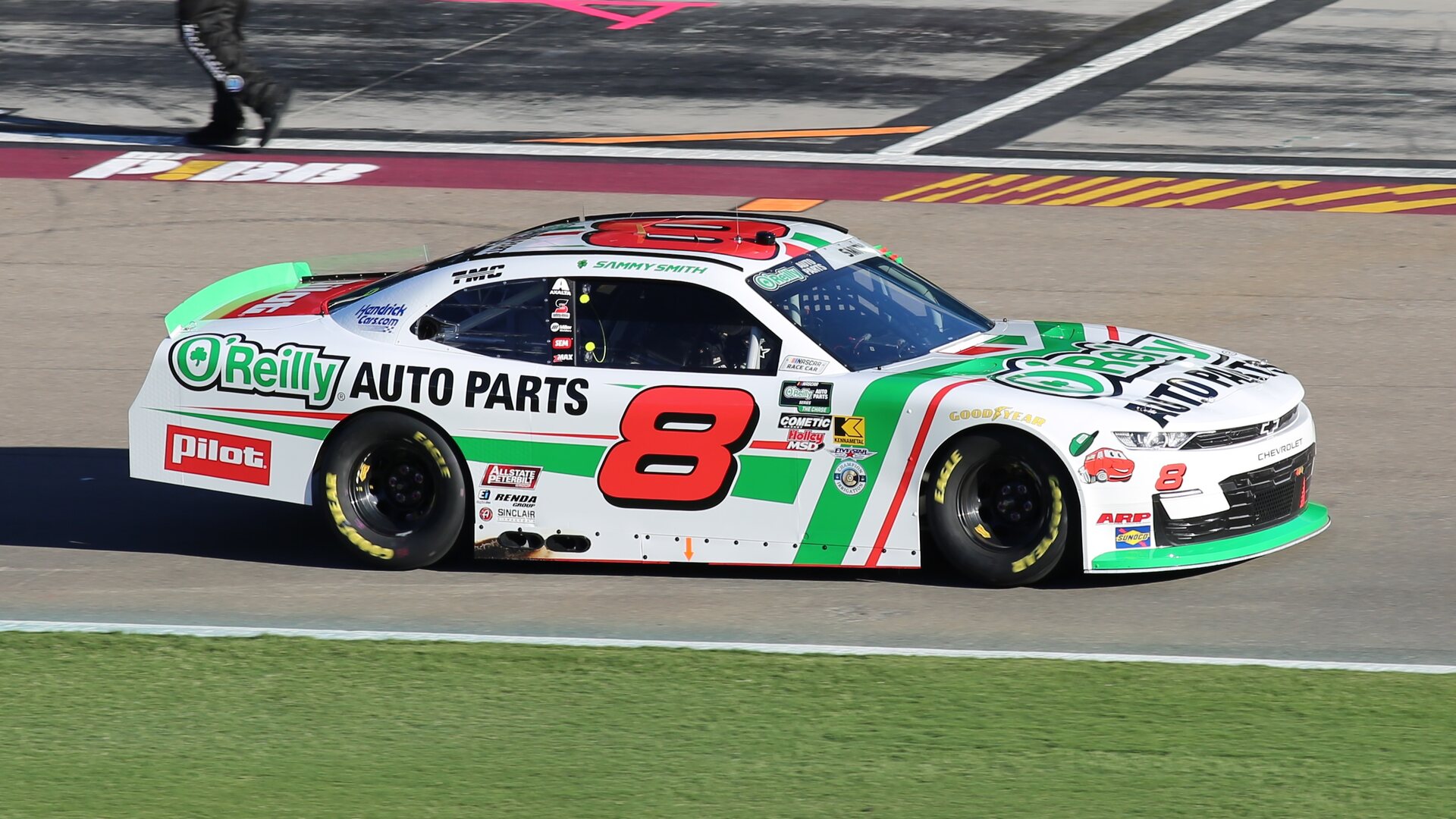
O’Reilly Auto Parts has attached a precise cash value to the sporting moments that its NASCAR series title is supposed to own.
NASCAR’s updated incentive-bonus hub, published on 31 October, confirms that O’Reilly will award $5,700 to the winner of each of the 33 races in its second-tier national series. That creates $188,100 of race-win bonuses. A further $26,000 goes to the driver with the most individual race bonuses, and $57,000 goes to the series champion.
Those three elements total $271,100. NASCAR combines them with the four $100,000 Dash 4 Cash prizes paid earlier in the season, taking the full 2026 O’Reilly-branded bonus distribution to $671,100.
The number is small beside the cost of a full-season NASCAR programme and is not a disclosed sponsorship fee, team purse or rights valuation. Its business importance comes from structure rather than scale. O’Reilly has turned a broad entitlement into a chain of specific, auditable transactions that connect the brand to race wins, a midseason contest, season-long consistency and the championship.
The $5,700 award is a brand device as well as a bonus
The per-race payment deliberately uses “57” to reference O’Reilly’s founding year of 1957. That makes the amount memorable in a way that a round $5,000 or $6,000 payment would not be. Every time the bonus is explained, the company’s history is explained with it.
Across 33 races, the device creates 33 opportunities for a winner photograph, social post, broadcast mention, store-level activation or dealer-style customer conversation. The season-end $26,000 payment then rewards repetition, while the $57,000 champion payment returns to the same founding-year cue at the title decider.
The programme is also intentionally broad at race level. NASCAR says every full-time and part-time driver is eligible for the $5,700 winner bonus. That matters because visiting Cup drivers, specialists and occasional entrants can still create a sponsored result. O’Reilly does not lose the activation simply because a winner is outside the regular championship field.
Dash 4 Cash uses a narrower sporting mechanism. Its four $100,000 prizes were open to drivers who had declared for O’Reilly Series points. The four highest-finishing eligible regulars progressed from one event to the next, so a driver could win the branded bonus without winning the race itself. That gives the sponsor a contest within the contest and keeps the entitlement visible even when the overall winner is not part of the programme.
Together, the two systems cover different commercial needs. The $5,700 race bonus maximises the number of eligible winners. Dash 4 Cash concentrates a larger sum on series regulars across a defined four-event sequence. The $26,000 and $57,000 season payments reconnect the activation to the championship narrative.
Entitlement becomes a performance product
Series naming rights normally deliver a large inventory: the sponsor appears in the championship name, schedules, standings, broadcast graphics, media references and venue material. O’Reilly’s multiyear agreement also includes promotional opportunities and integrations with The CW, the series’ exclusive US broadcaster.
That reach is valuable, but title rights can become passive if the brand is present everywhere and responsible for nothing specific. A payout programme gives the property an action. The sponsor is not only the name attached to the series; it is the organisation paying a defined reward when a sporting condition is met.
For commercial teams, this creates measurable units inside a much larger rights package. They can count 33 race awards, four Dash 4 Cash awards and two season-end awards. They can record the drivers and teams involved, the markets in which the awards were earned, content output, broadcast integrations and any retail activity built around each payment.
The published winner table makes the activation transparent. It records races won and bonus money earned, while the $5,700 multiplication can be checked against each driver’s total. That is useful for O’Reilly, NASCAR and participating teams because it turns a campaign promise into a public delivery record.
It also reduces the risk that a sponsor-funded incentive is announced once and then disappears from view. Each new winner updates the programme. The end-of-season leader and champion payments give it a final settlement point.
The retail logic is visible
O’Reilly’s latest investor material says the company operated 6,758 stores across the United States, Puerto Rico, Mexico and Canada at 30 September 2026. Its 2025 annual report describes automotive-event sponsorships and on-site appearances as part of an integrated marketing strategy alongside national media, stores, digital, social, email, text and its O’Rewards loyalty programme.
The NASCAR entitlement therefore sits inside a retail and professional-customer system rather than functioning as an isolated media purchase. A race winner can be used nationally, but also adapted for stores, local markets, customer communications and appearances. The CW integration adds a broadcast layer; the store network supplies physical distribution for activation.
This does not prove that the partnership produces sales or a positive return. O’Reilly has not disclosed the rights fee, activation budget, customer-acquisition results, incremental store traffic or sales attributable to the series. The $671,100 distribution should not be mistaken for the full cost of the sponsorship.
What it does show is a design that can be measured. A retailer can compare bonus events with regional sales, loyalty engagement, digital response, store visits or professional-account activity without claiming that the payment itself caused every change. The repeated, date-specific moments provide cleaner test points than a season of continuous logo exposure.
The programme also fits the company’s category. Winning a NASCAR race depends on preparation, parts, tools, service and people executing under time pressure. Those themes sit close to O’Reilly’s products and its professional and do-it-yourself customer base. The sponsor does not need to invent a distant lifestyle story to explain why it is rewarding performance.
Teams gain content, but the money is paid to drivers
The official wording is important for competitors. NASCAR describes the awards as driver bonuses. It does not state that the $671,100 is added to team race purses, shared with crews or paid through entrant prize-money structures.
Teams should therefore treat the programme first as a driver incentive and content asset, not as a budget line that automatically supports car preparation. Driver contracts, tax treatment, bonus assignment and any internal sharing arrangements may determine where the economic benefit ultimately lands. Those details are not disclosed in the public programme.
The commercial benefit can still extend beyond the recipient. A team whose driver wins can build sponsor content around the award, offer O’Reilly access to the driver, create partner-to-partner campaigns and use the programme to give other team sponsors an additional race-weekend story. Repeated winners also acquire a simple performance marker that can be used in future negotiations.
For smaller or part-time operations, open eligibility is meaningful even if $5,700 does not transform a programme budget. A single upset victory creates the same named award as a win by a championship contender. That gives the sponsor a reason to include the full field in its activation rather than concentrating only on a small group of contracted ambassadors.
The sponsor market is getting more layered
Sports Business Journal reported in February that NASCAR entered 2026 with 57 official sponsors, including seven new brands, and described the previous year as its strongest partner-business year since the 2019 NASCAR-ISC merger. O’Reilly joined as both the second-tier series title sponsor and a NASCAR Premier Partner.
That market makes differentiation harder. A brand buying league, series, team, race and broadcast assets can still compete with dozens of other official partners for attention. The performance pool gives O’Reilly an owned mechanic within the championship rather than relying only on the frequency of its marks.
The model also shows how rights can be layered without collapsing them into one vague package. The series title provides continuous identification. The CW agreement provides media integration. Dash 4 Cash creates a concentrated midseason promotion. The 33 winner bonuses maintain weekly cadence, and the season-end payments close the story.
Promoters and rights holders can use the same principle without copying the dollar amounts. A technical supplier could reward reliability or pit performance. A logistics partner could support privateer travel. A sustainability partner could pay for verified operational improvements. The condition must be credible, independently recorded and relevant to the sponsor’s business.
The payment also has to be large enough to matter to the recipient and clear enough for fans to understand. Complexity would weaken the content value. O’Reilly’s main race-win mechanic is one result and one number; the “57” mnemonic does the rest.
What the industry should measure next
The first question is delivery. NASCAR’s public table should reconcile with all 33 race results, the $26,000 leader award and the $57,000 championship award when the season is complete. Dash 4 Cash has already produced four recorded $100,000 winners.
The second is reuse. The real value of a $5,700 award will depend on what happens after payment: whether the winner appears in broadcast and social material, whether stores and professional customers see the content, and whether O’Reilly connects the result to offers, loyalty activity or appearances.
The third is partner participation. Teams, drivers, tracks and The CW can each extend the same moment to a different audience. Clear asset ownership, content access and approval processes will determine whether the incentive becomes a shared commercial platform or remains a line in a results table.
Finally, the industry should separate disclosed cash from undisclosed rights economics. The $671,100 figure is useful because it is verified and itemised. It says nothing about the total sponsorship investment, activation expenditure or return. Treating it as the value of the title deal would overstate what the evidence supports.
O’Reilly’s programme is nevertheless a practical example of modern entitlement design. Naming the championship supplies scale; rewarding defined performance supplies action. By combining a memorable founding-year payment, broad race eligibility, a high-value regular-driver contest and season-end awards, the company has made its title rights visible in cash at the moments the sport values most.
Sources and further reading
- NASCAR incentive-bonus hub, 31 October 2026 ↗
- NASCAR Dash 4 Cash record, updated 2 May 2026 ↗
- O’Reilly Auto Parts title-sponsorship announcement, 18 August 2025 ↗
- O’Reilly Auto Parts investor-relations company profile ↗
- O’Reilly Automotive 2025 Form 10-K ↗
- Sports Business Journal sponsorship-market report, 12 February 2026 ↗
- Wikimedia Commons image record ↗
- Creative Commons Attribution-ShareAlike 4.0 licence ↗